



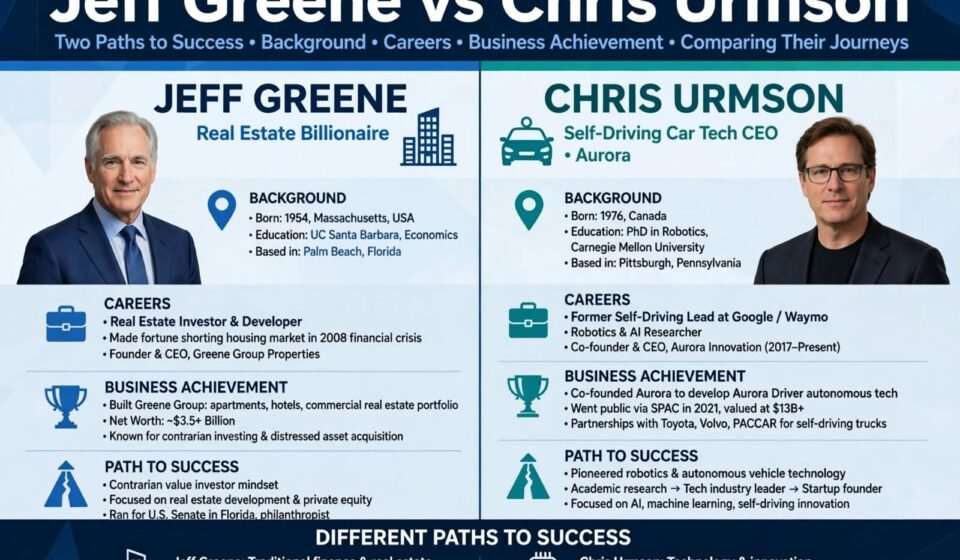
Jeff Greene and Chris Urmson: Background, Careers, Business Achievements, and Their Different Paths to Success

Jeff Greene and Chris Urmson are names associated with two very different areas of modern business. Jeff Greene is known for his work in real estate investment, financial markets, property development, and philanthropy. Chris Urmson has built his professional reputation in robotics, computer science, autonomous driving, and transportation technology. Although their careers developed in different industries, exploring Jeff Greene and Chris Urmson together offers an interesting look at how expertise, ambition, innovation, and long-term planning can shape professional success.
Interest in Jeff Greene and Chris Urmson also raises an important question about the relationship between their careers. Publicly available information identifies Greene primarily as a real estate entrepreneur and investor, while Urmson is recognized as an engineer and the chief executive of Aurora Innovation, a company developing autonomous driving technology. There is no clearly established public evidence that the two share a direct business partnership or a significant personal connection. Their names can therefore be examined together as two distinct professional stories rather than as confirmed collaborators.
Understanding Jeff Greene and Chris Urmson requires looking beyond their names and professional titles. Their experiences illustrate different approaches to solving difficult problems, evaluating risks, building organizations, and pursuing opportunities. Greene’s work has centered on financial decisions and valuable physical assets, whereas Urmson’s career has focused on creating technology capable of changing how vehicles operate.
This article explores their backgrounds, professional achievements, business philosophies, public profiles, and wider influence. It also explains why their careers are relevant to readers interested in entrepreneurship, wealth creation, emerging technology, and the changing relationship between business and innovation.
Who Are Jeff Greene and Chris Urmson?
Jeff Greene is an American real estate investor and entrepreneur whose career includes financial market investments, property development, and philanthropic activities. He gained substantial attention through investments connected with the American housing and credit markets. Over time, real estate became a central part of his business identity, particularly in major property markets in Florida and California.
Greene’s professional journey demonstrates how financial knowledge can be applied to opportunities in property ownership and development. His career has included acquiring real estate, evaluating changing market conditions, and participating in public life through political campaigns. He has also supported charitable projects, including educational initiatives, showing that his public profile extends beyond commercial investment.
Chris Urmson is a Canadian engineer and technology entrepreneur best known for his contributions to autonomous vehicle development. His background in computer engineering and robotics prepared him for work on robotic vehicles that could navigate complex environments. He later became a prominent technical leader in Google’s self-driving car project, which helped establish the foundations for the company now known as Waymo.
Urmson subsequently co-founded Aurora Innovation, a company focused on autonomous driving systems. His work addresses the engineering challenges involved in enabling vehicles to perceive their surroundings, interpret road conditions, and make driving decisions. Unlike Greene’s concentration on financial and property markets, Urmson’s career revolves around technical research, software development, and transportation systems.
The most useful way to understand Jeff Greene and Chris Urmson is to recognize both their differences and their shared interest in building something with lasting value. One has worked primarily through investment and real estate, while the other has pursued innovation through engineering. Their careers offer separate examples of how specialized knowledge can create opportunities in demanding industries.
Jeff Greene’s Early Life and Educational Background
Jeff Greene’s early experiences helped shape his interest in business, financial independence, and investment. His background is often discussed in connection with his determination to pursue education despite financial limitations. Rather than beginning his career with an established real estate empire, he developed his professional direction through education, employment, and a growing understanding of financial opportunities.
Greene attended Johns Hopkins University, where he completed his undergraduate education. He later earned a Master of Business Administration from Harvard Business School. These academic experiences gave him opportunities to study business strategy, finance, management, and the decisions involved in allocating capital. His education also placed him in an environment where he could examine how companies grow and how investors evaluate risk.
His experience of working while pursuing educational goals is an important part of his public biography. Accounts of his early life describe a willingness to take on different jobs to support his studies. Those experiences illustrate the practical side of his background and help explain why his professional story is often presented as one of persistence and ambition.
Education alone does not guarantee success in business, but it can provide a useful foundation. Greene’s later investment activities required him to assess market conditions, recognize potential opportunities, and make decisions under uncertainty. His academic background helped establish a framework for understanding these responsibilities, while his professional experience allowed him to apply financial concepts in real markets.
Jeff Greene’s Entry Into Financial Markets
Before becoming widely associated with real estate, Jeff Greene developed his career through financial markets. Investment decisions in these markets require an understanding of credit, economic conditions, interest rates, market expectations, and the relationship between financial instruments and underlying assets. Greene’s experience in this environment helped shape the investment approach that later contributed to his public reputation.
Financial markets can reward investors who identify opportunities that others overlook, but they can also expose them to substantial losses. Successful investing requires more than making a prediction about the economy. Investors must consider the price of an asset, the possibility that their assumptions may be wrong, and the consequences of changes in market conditions.
Greene attracted attention for investments connected with credit markets before and during the American housing crisis. His financial strategy has been described in public profiles as involving positions that benefited from the deterioration of subprime mortgage-related investments. The housing crisis created severe difficulties for households, lenders, and financial institutions, while some investors profited from correctly anticipating the risks within the market.
This aspect of Greene’s career illustrates how financial success can arise from identifying vulnerabilities in an economic system. It also demonstrates why such decisions require careful analysis and an understanding of the risks involved. An investment that succeeds during a market collapse may depend on circumstances that cannot be reproduced easily in another economic environment.
Greene’s experience in financial markets became a foundation for his subsequent real estate activities. It provided exposure to the forces that influence property values, credit availability, borrowing costs, and investor confidence. These factors remain important in understanding the broader relationship between finance and real estate.
Jeff Greene and Real Estate Investment
Real estate became one of the defining elements of Jeff Greene’s business career. Property investment can involve purchasing residential buildings, acquiring commercial assets, developing land, and managing properties over extended periods. Each activity requires decisions about location, financing, maintenance, market demand, and the possibility of future appreciation.
Greene’s real estate interests have included major American markets, especially South Florida and Los Angeles. These areas attract investors because of their population growth, economic activity, desirable locations, and demand for residential and commercial property. However, attractive markets also involve competition, high acquisition costs, and exposure to changing economic conditions.
An investor evaluating real estate must consider more than the purchase price. Rental income, operating expenses, insurance, property taxes, financing arrangements, local regulations, and future maintenance all influence the financial performance of an asset. Development projects introduce additional challenges because construction schedules, permits, labor costs, and market demand can change before a project is completed.
Greene’s career provides an example of how investors can build substantial portfolios by combining financial analysis with decisions about physical property. His public profile includes luxury properties and development interests, reflecting the importance of location and asset management in high-value real estate. Nevertheless, property investment is not automatically profitable, and the performance of individual assets can vary considerably.
The relationship between finance and property is particularly important when studying Jeff Greene and Chris Urmson together. Greene’s business model relies heavily on capital allocation and asset valuation. Urmson’s work, by contrast, requires investment in engineering teams, research, testing, and technical infrastructure. Both fields demand long-term planning, but the factors determining success are very different.
Jeff Greene’s Business Philosophy and Investment Approach
Investment decisions often require a balance between confidence and caution. Jeff Greene’s professional background suggests an approach shaped by examining market conditions, identifying opportunities, and understanding the potential value of assets over time. His experience in financial markets and real estate highlights the importance of looking beyond short-term headlines when evaluating a business opportunity.
One important principle in property investment is understanding the difference between market popularity and actual value. A property may attract attention because of its location or appearance, but its financial performance depends on broader considerations. Investors need to evaluate demand, income potential, expenses, borrowing costs, and the conditions that could affect future resale value.
Another principle is recognizing that markets change. Economic growth can support higher property prices, while recessions, rising interest rates, or reduced consumer confidence can weaken demand. An investor who understands these forces may be better positioned to prepare for different outcomes, although no strategy can eliminate uncertainty completely.
Greene’s professional experience also demonstrates the importance of patience. Real estate projects can take years to develop, and market cycles do not always follow an investor’s preferred schedule. Decisions about when to purchase, improve, hold, or sell a property can significantly influence the final result.
For readers researching Jeff Greene and Chris Urmson, these lessons should not be interpreted as proof that one business strategy is universally superior. Real estate investment and autonomous technology operate under different conditions. The common element is the need to make informed decisions while recognizing that success depends on a combination of expertise, execution, and external circumstances.
Jeff Greene’s Political Activities and Public Profile
Jeff Greene has also participated in American politics. His public activities include campaigns for the United States Senate in California and the Democratic nomination for governor of Florida. These campaigns brought additional attention to his views on economic policy, public services, healthcare, education, and other issues affecting American communities.
Political campaigns require a different set of skills from commercial investment. Candidates must communicate their positions, understand public concerns, build organizations, and persuade voters that their proposals deserve support. Financial resources can help a campaign reach a large audience, but they do not guarantee public approval or electoral success.
Greene’s political ambitions did not result in election to the offices he sought. Nevertheless, the campaigns became part of his public biography and demonstrated his interest in participating in policy discussions beyond the business world. They also illustrated the challenges faced by wealthy individuals who attempt to translate commercial success into political influence.
His political history is relevant because public perception of business leaders can be shaped by their positions on economic and social questions. Investors may be evaluated according to their financial achievements, while political candidates are also judged on their policy proposals, communication, and perceived understanding of ordinary voters.
Chris Urmson’s public role is different. His visibility largely comes from his leadership in autonomous driving and his participation in discussions about transportation technology. Comparing their public profiles reveals how individuals can become influential through different channels, whether by participating in political debate or by leading technical organizations.
Jeff Greene and Philanthropic Activities
Philanthropy is another part of Jeff Greene’s public profile. Wealthy individuals sometimes direct resources toward education, healthcare, research, and community development. These contributions can support organizations that might otherwise struggle to obtain funding, although their long-term impact depends on how programs are designed and managed.
Greene has been associated with educational philanthropy, including the Greene School in Palm Beach, Florida. Educational initiatives can provide opportunities for students, support specialized learning environments, and introduce approaches that may differ from those offered by traditional institutions. Their effectiveness depends on teaching quality, accessibility, student needs, and the sustainability of funding.
Philanthropy can also influence the way business leaders are perceived. Commercial success is usually measured through financial performance, while charitable work is assessed according to its social value. A donation can provide immediate resources, but lasting improvement often requires ongoing management, clear goals, and evidence that a program benefits the people it intends to serve.
Greene’s charitable interests demonstrate that his professional activities extend beyond investment and property ownership. They also show how financial resources can be directed toward projects that have a different purpose from generating commercial returns.
Although Chris Urmson is not primarily known as a philanthropist, his work on autonomous transportation raises broader questions about social benefit. Technology companies often describe their goals in terms of safety, efficiency, and public convenience. Those outcomes must ultimately be assessed through real-world performance, responsible deployment, and the effects on communities and workers.
Chris Urmson’s Early Life and Education
Chris Urmson’s career developed through a strong foundation in computer engineering and robotics. His educational background helped prepare him for the demanding task of building machines capable of navigating environments that were not fully controlled. Unlike many traditional software applications, autonomous vehicles must respond to changing physical conditions in real time.
Urmson completed undergraduate studies in computer engineering at the University of Manitoba before pursuing doctoral research at Carnegie Mellon University. His work at Carnegie Mellon focused on robotics and autonomous systems. This research environment provided opportunities to study how machines can gather information about their surroundings, determine their position, and plan movements toward a goal.
Robotics combines several disciplines, including computer science, mathematics, electronics, mechanical engineering, and artificial intelligence. A robotic system must process information from sensors, interpret that information, and select actions that allow it to operate effectively. In a moving vehicle, these tasks become more challenging because the environment can change rapidly.
Urmson’s early research involved robotic vehicles and navigation, areas that later became central to the development of self-driving technology. His experience illustrates the value of academic research that addresses practical problems. University laboratories can provide the space to test ideas, study technical limitations, and develop systems that may eventually be used outside the research environment.
The educational path taken by Chris Urmson differs significantly from Jeff Greene’s business-focused studies. Greene developed expertise related to management, finance, and investment, while Urmson specialized in engineering and autonomous systems. Both backgrounds helped prepare them for the professional challenges that followed.
Chris Urmson and the Development of Autonomous Vehicles
Autonomous vehicles are designed to perform some or all driving tasks with reduced or eliminated dependence on a human driver, depending on the system and its operating conditions. Developing this technology requires much more than connecting a computer to a steering mechanism. A vehicle must interpret its surroundings, recognize road users, estimate movement, plan a route, and respond safely to unexpected situations.
Chris Urmson became an important figure in this field through his work on robotic vehicles and autonomous driving research. During his time at Carnegie Mellon, he contributed to efforts associated with the DARPA Grand Challenge and Urban Challenge programs. These competitions encouraged research teams to develop vehicles capable of navigating demanding environments with varying levels of complexity.
The challenges helped advance public understanding of autonomous technology. Teams had to combine sensing equipment, mapping, vehicle control, software, and planning systems into machines that could perform practical navigation tasks. The results demonstrated both the potential of robotics and the considerable engineering work required to make autonomous systems reliable.
Autonomous driving technology has several core components. Cameras can provide visual information about road markings, signs, pedestrians, and nearby vehicles. Radar can help estimate the position and movement of objects, while lidar systems use laser pulses to measure distances and construct detailed representations of the environment. Software combines information from these sources to support driving decisions.
The technology must also handle uncertainty. A pedestrian may move unexpectedly, road markings may be difficult to see, and weather can reduce sensor performance. Engineers therefore need to evaluate how a system behaves across many scenarios rather than judging it only by successful demonstrations.
Urmson’s work helped establish his reputation as an engineer capable of leading complex autonomous vehicle projects. His experience in research, vehicle development, and technical management later prepared him for a leading role in the commercial self-driving industry.
Chris Urmson and Google’s Self-Driving Car Project
Google’s self-driving car project became one of the best-known efforts to bring autonomous driving from research laboratories to public roads. Chris Urmson joined the project and eventually became one of its leading technical figures. His responsibilities involved helping develop systems intended to allow vehicles to navigate real-world traffic conditions.
The project brought together engineers and researchers working on computer vision, mapping, robotics, machine learning, and vehicle control. These areas had to work together because an autonomous vehicle cannot make reliable decisions if its understanding of the environment is incomplete or inaccurate.
A vehicle traveling through a city must recognize intersections, interpret traffic signals, anticipate the movement of nearby vehicles, and respond to pedestrians and cyclists. It must also maintain a safe distance from other road users and obey applicable traffic rules. Each decision may depend on information gathered from several sensors and processed by complex software.
Google’s work attracted public attention because it demonstrated vehicles performing driving tasks that had previously required a human operator. However, demonstrations and testing are only part of the process. Commercial autonomous driving also requires extensive validation, safety procedures, operational planning, and compliance with transportation regulations.
Urmson’s leadership experience during this period became a significant part of his career. The project helped develop technical expertise and organizational knowledge that could be applied to future autonomous transportation businesses.
Google’s self-driving effort later became associated with Waymo, which continued developing autonomous driving systems as a separate business. Urmson left Google in the period when the project was transitioning toward its next stage, eventually pursuing a new entrepreneurial opportunity.
Chris Urmson and Aurora Innovation
Aurora Innovation is the company most closely associated with Chris Urmson’s current professional identity. He co-founded Aurora with Sterling Anderson and Drew Bagnell. The company was established to develop autonomous driving technology that could be used across transportation applications, including commercial trucking.
Aurora’s approach centers on building an integrated driving system rather than simply manufacturing a conventional vehicle. Autonomous driving depends on the relationship between sensors, computing hardware, perception software, planning systems, and vehicle controls. Each part must operate reliably as part of the larger system.
The company has pursued opportunities in commercial transportation because trucking involves substantial logistical demands. Freight vehicles move goods between distribution centers, warehouses, ports, and other destinations. Long-distance transport also creates operational challenges involving driver availability, schedules, fuel costs, maintenance, and vehicle utilization.
Autonomous trucking may eventually change aspects of freight transportation, but its development requires careful attention to safety and commercial practicality. Systems must operate within defined conditions, respond appropriately to unexpected hazards, and satisfy applicable legal requirements. A technically impressive vehicle is not sufficient if the operating model cannot be sustained economically.
Aurora has worked with partners in the automotive and transportation industries as it develops its technology. Such partnerships are important because autonomous driving companies need access to vehicles, logistics networks, testing environments, and operational expertise. Collaboration can help a technology business move from experimental systems toward practical deployment.
For Chris Urmson, Aurora represents the transition from research and technical leadership to building a commercial organization. The work involves not only engineering but also hiring, investment, partnerships, safety management, and long-term strategic decisions.
The Technology Behind Chris Urmson’s Work
Understanding Chris Urmson’s professional achievements requires understanding the technology that makes autonomous driving possible. A self-driving system must gather information about its surroundings and use that information to select suitable actions. The process must continue as the vehicle moves through changing traffic conditions.
Perception is one of the first major challenges. The system needs to identify relevant objects and estimate their positions, movement, and possible behavior. It must distinguish a stationary vehicle from a moving one, recognize pedestrians, interpret road boundaries, and identify hazards that may affect the vehicle’s route.
Prediction is another important task. Knowing where an object is now does not automatically reveal where it will be moments later. Software must estimate possible future movements based on available information. A cyclist may turn, a pedestrian may cross the road, and another vehicle may suddenly change lanes. Reliable planning depends on accounting for these possibilities.
Motion planning determines how the vehicle should move in response to its surroundings. The system must select a safe and practical path while respecting road rules and the limitations of the vehicle. It must consider speed, distance, available space, other road users, and the potential consequences of different actions.
Vehicle control then translates the selected plan into physical movement. Steering, braking, and acceleration must be coordinated so the vehicle follows the intended path. Even a well-designed planning system can perform poorly if the control system cannot carry out its decisions accurately.
These components illustrate why autonomous driving is a multidisciplinary challenge. Progress depends on software, hardware, testing, data, and engineering judgment working together. Urmson’s career has involved leading teams that address these connected problems.
Jeff Greene and Chris Urmson: Comparing Their Professional Careers
Comparing Jeff Greene and Chris Urmson highlights two distinct routes to professional influence. Greene developed his reputation through investment and real estate, while Urmson established his through robotics and autonomous vehicle technology. Their experiences are useful examples of how different forms of expertise can support leadership in demanding industries.
Greene’s work focuses on evaluating assets, allocating capital, understanding economic conditions, and managing property-related opportunities. Real estate investment requires decisions about location, financing, market demand, development costs, and long-term value. The results may depend heavily on economic cycles and changes in local markets.
Urmson’s work focuses on building and deploying technology. Autonomous driving requires engineers to develop reliable systems, test them against difficult situations, and demonstrate that they can operate safely within defined conditions. Progress depends on technical performance, regulatory acceptance, partnerships, and the ability to turn research into a viable business.
Their educational backgrounds also reflect their different career directions. Greene studied business and finance, while Urmson pursued computer engineering and robotics. These paths illustrate the importance of matching specialized knowledge with the problems an individual intends to solve.
There are also similarities. Both careers involve managing uncertainty, making decisions with incomplete information, and building organizations around a long-term objective. Greene must consider changes in property markets and economic conditions. Urmson must account for unpredictable road environments, technical limitations, and the challenges of introducing new technology into established transportation systems.
Neither career provides a universal blueprint for success. Their professional experiences demonstrate that results depend on the specific industry, the quality of decision-making, the resources available, and the ability to adapt when circumstances change.
Business Strategy and Risk Management
Risk management is relevant to both Jeff Greene and Chris Urmson, even though the risks they face are different. Investors must evaluate the possibility that an asset will lose value, operating costs will increase, or financing will become more expensive. Technology entrepreneurs must consider whether a system will work reliably, whether customers will adopt it, and whether development costs can be supported by future revenue.
For Greene, financial analysis and market research are essential to investment decisions. A property may appear attractive because of its location, but the investment could still perform poorly if demand weakens or expenses rise. Evaluating different scenarios helps investors understand the range of possible outcomes before committing capital.
For Urmson, risk management includes technical testing, system validation, safety engineering, and operational oversight. Autonomous vehicles operate in environments where mistakes can have serious consequences. Testing must therefore examine not only ordinary driving situations but also unusual conditions and difficult edge cases.
Both fields also require realistic expectations. Property prices do not always rise, and a strong investment thesis can fail when market conditions change. Likewise, autonomous driving technology cannot be judged only by its performance in favorable conditions. It must be assessed against the situations it is expected to handle in actual use.
A further similarity is the importance of long-term planning. Real estate projects may require years of development and management. Autonomous transportation systems also require sustained investment in research, testing, partnerships, and deployment. Organizations that focus only on immediate results may struggle to support projects whose benefits emerge gradually.
The careers of Jeff Greene and Chris Urmson therefore illustrate different forms of disciplined decision-making. One emphasizes financial and asset-related judgment, while the other emphasizes engineering reliability and technological progress.
The Role of Leadership in Their Careers
Leadership is a central element of any large business or technical project. A leader must establish priorities, communicate expectations, attract capable people, allocate resources, and make decisions when the available information is incomplete. These responsibilities become more complicated as an organization grows and its projects become more ambitious.
Jeff Greene’s career has involved investment decisions that can affect property portfolios, development plans, and business operations. Real estate leaders must coordinate with financial professionals, property managers, contractors, architects, legal advisers, and local authorities. Their decisions influence both the financial performance of an asset and the practical work required to maintain it.
Chris Urmson’s leadership responsibilities are different because autonomous driving requires collaboration across specialized technical disciplines. Software engineers, robotics researchers, hardware developers, safety specialists, and operational teams must work toward compatible goals. A promising component has limited value if it cannot be integrated reliably with the rest of the system.
Technical leadership also involves deciding which problems deserve attention first. Autonomous driving companies face many possible improvements, but resources are limited. Leaders must determine how to balance development speed, reliability, safety, commercial priorities, and long-term research.
Greene’s work similarly requires prioritization. An investor cannot pursue every possible opportunity. Decisions about which assets to acquire, how much capital to commit, and when to sell or hold property shape the overall investment strategy.
These differences demonstrate that leadership is not a single skill that operates identically across every industry. Effective leadership depends on understanding the relevant risks, respecting specialized expertise, and aligning an organization around achievable goals.
The Economic Impact of Real Estate and Autonomous Technology
Real estate and autonomous transportation affect the economy in different but interconnected ways. Property investment influences housing availability, commercial development, local employment, and the use of land. Autonomous technology may influence freight movement, vehicle operations, logistics planning, and the development of new technical services.
Real estate activity can create employment through construction, maintenance, management, architecture, and related professional services. New developments may attract businesses and residents, while poorly planned projects can create pressure on infrastructure or contribute to affordability challenges. The economic effect of a property investment therefore depends on more than its financial return to the owner.
Autonomous transportation could change how goods move through supply chains. Commercial vehicles operate within networks that depend on schedules, fuel, maintenance, warehouse capacity, and driver availability. Improvements in vehicle utilization or operating efficiency could affect transportation costs, although the extent of any benefit depends on real-world performance and the cost of implementing the technology.
These changes also raise questions about employment. Automation can create demand for software engineers, safety specialists, maintenance technicians, and technical support workers while changing the responsibilities of existing transportation jobs. The effects may differ by region, occupation, and stage of adoption.
The comparison between Jeff Greene and Chris Urmson highlights the variety of ways business decisions can influence economic life. Property investors work with physical assets that shape neighborhoods and cities. Autonomous technology leaders develop systems that could affect how vehicles move through those environments.
Both industries must operate within legal and social frameworks. Real estate decisions involve zoning, building standards, environmental rules, and housing policies. Autonomous transportation involves vehicle regulations, safety requirements, liability questions, and public-road operating permissions.
Public Perception and Professional Reputation
A professional reputation develops through a combination of achievements, public communication, organizational performance, and the way an individual responds to challenges. Jeff Greene and Chris Urmson are evaluated through different expectations because their industries have different measures of success.
For Greene, public attention often centers on wealth, property holdings, investment decisions, philanthropy, and political activity. Real estate entrepreneurs may be praised for creating businesses and supporting community projects, while their activities can also attract questions about housing affordability, economic inequality, and the influence of wealth in public life.
For Urmson, reputation is closely linked to technical expertise, organizational leadership, and the progress of autonomous driving technology. The public often evaluates self-driving systems according to their potential benefits and their ability to operate safely. Expectations must be balanced against the complexity of the technology and the difficulty of testing it across diverse conditions.
Public communication matters in both cases. Business leaders need to explain their decisions clearly, while technology leaders must communicate what their systems can and cannot do. Exaggerated claims can create unrealistic expectations and damage trust when results do not match promises.
Credibility also depends on distinguishing demonstrated results from future ambitions. A real estate development that has been completed is different from a proposed project. Similarly, a vehicle successfully completing a demonstration is not the same as a fully established autonomous transportation service operating under all possible conditions.
Examining Jeff Greene and Chris Urmson through this perspective encourages readers to look beyond headlines. A balanced assessment considers verified achievements, ongoing challenges, and the evidence available to support claims about their work.
What Entrepreneurs Can Learn From Jeff Greene and Chris Urmson
Entrepreneurs can draw useful lessons from the different careers of Jeff Greene and Chris Urmson without assuming that either person’s experience can be copied exactly. Their industries require different forms of expertise, but both illustrate the importance of preparation, informed decision-making, and sustained effort.
One lesson is the value of developing deep knowledge. Greene’s background in finance and property investment reflects the importance of understanding the markets in which capital is deployed. Urmson’s work demonstrates the value of technical specialization when developing products that must solve difficult engineering problems.
Another lesson is the need to evaluate risk realistically. Entrepreneurs often become enthusiastic about an opportunity before examining the costs, limitations, and possible failures. A careful approach involves identifying what could go wrong, considering alternative outcomes, and deciding whether the potential reward justifies the commitment.
A further lesson is the importance of patience. Real estate investment may require long periods of ownership and management before an opportunity produces its expected results. Technology development can involve extensive research and testing before a product is ready for widespread use. Both paths require the ability to work toward goals that may not deliver immediate rewards.
Entrepreneurs can also learn from the importance of building effective teams. Large investments depend on professionals who understand finance, law, development, and operations. Autonomous technology companies depend on people with expertise in engineering, computing, safety, and business management. Individual talent matters, but complex projects usually require coordinated effort.
Finally, long-term success requires adaptation. Economic conditions change, customer expectations evolve, and technology improves. Business leaders must be prepared to revise their assumptions when evidence suggests that a different approach may be more effective.
Challenges Facing Real Estate Investors and Autonomous Driving Companies
Real estate investors face a range of challenges that can affect both income and property values. Interest rates influence borrowing costs, while economic uncertainty can affect demand for housing and commercial space. Insurance, maintenance, taxes, construction expenses, and local regulations can also change the financial outlook for a property.
Market timing is another challenge. Investors may purchase assets when demand is strong, only to discover that conditions have changed by the time a project is completed. Even experienced investors can misjudge future demand, and a property that performs well in one market cycle may become less attractive in another.
Autonomous driving companies face a different collection of obstacles. They must develop systems capable of operating safely in complex environments, gather evidence about reliability, and address regulatory requirements. Weather, road construction, unusual traffic behavior, and sensor limitations can all create difficult situations for an autonomous vehicle.
Commercial deployment also requires a sustainable business model. Developing sophisticated technology can be expensive, and companies must determine how the costs of hardware, software, maintenance, monitoring, and operations compare with the benefits provided to customers. Technical progress does not automatically produce a profitable service.
Public trust is important in both industries. Property owners must maintain assets responsibly and meet their obligations to tenants, customers, and communities. Autonomous vehicle companies must demonstrate that their systems are designed, tested, and operated with appropriate attention to safety.
These challenges show why the professional achievements associated with Jeff Greene and Chris Urmson should be understood in context. Their careers involve different responsibilities, and both investment and technological innovation require continued attention to changing conditions.
Is There a Direct Connection Between Jeff Greene and Chris Urmson?
Readers searching for Jeff Greene and Chris Urmson may expect to discover a shared company, investment, personal relationship, or major professional collaboration. However, the available public information does not establish a clear direct connection between the two individuals.
Jeff Greene’s documented professional profile centers on real estate investment, finance, philanthropy, and political activity. Chris Urmson’s profile centers on robotics, autonomous driving, and Aurora Innovation. Their known career histories therefore point toward different professional networks and different areas of expertise.
It is important not to assume that two people have worked together simply because their names appear in the same search query or article title. A genuine business relationship would normally require supporting evidence, such as an official company announcement, a documented investment, a shared leadership position, or credible reporting describing the connection.
The absence of a clearly documented connection does not prove that the individuals have never met or interacted privately. It simply means that a specific relationship should not be presented as established fact without reliable evidence.
For readers, this distinction is especially important when researching people whose careers attract public attention. Search results can combine names for editorial, analytical, or search-engine purposes even when no substantial relationship exists. Reliable research separates confirmed information from assumptions and speculation.
Accordingly, Jeff Greene and Chris Urmson are best discussed here as individuals with separate professional achievements. Their careers can be compared meaningfully, but claims that they are business partners or close collaborators would require further verification.
Why Jeff Greene and Chris Urmson Attract Search Interest
People search for public figures for many reasons. Some want to understand how an entrepreneur accumulated wealth, while others want to learn about a technology leader’s education, professional achievements, or role in a major company. The phrase Jeff Greene and Chris Urmson brings together two individuals whose work attracts interest for different reasons.
Greene’s financial history makes him relevant to readers interested in investment, property markets, and entrepreneurship. His participation in political campaigns and philanthropic projects adds further dimensions to his public profile. Readers researching him may want to understand how his investment activities developed and how he became associated with high-value real estate.
Urmson attracts interest because autonomous driving is a technically challenging field with potentially significant implications for transportation. His experience with university robotics research, Google’s self-driving car project, and Aurora Innovation connects him to several major stages in the development of autonomous vehicles.
Search interest can also arise when readers encounter unfamiliar names together. They may wonder whether the individuals have a shared project or whether a particular article is comparing their careers. In such cases, clear explanations help readers understand what is known and what remains unverified.
The broader appeal of these two careers lies in their different approaches to building value. Greene’s work is associated with the acquisition and management of physical assets. Urmson’s work is associated with creating and deploying advanced technical systems. Both provide material for readers interested in business, innovation, and professional development.
The Future of Real Estate Investment
Real estate will continue to be influenced by economic conditions, population changes, construction costs, interest rates, and local development policies. Investors must understand these factors when deciding which properties to acquire and how to manage them over time.
Technology is also changing how the property industry operates. Digital tools can support market analysis, building management, energy monitoring, maintenance planning, and communication with tenants. These systems may improve efficiency, but their value depends on implementation, cost, and the quality of the information they provide.
Environmental considerations are increasingly important in property development. Buildings consume energy, require maintenance, and interact with the surrounding environment. Investors and developers may need to consider energy efficiency, resilience to extreme weather, water management, and changing expectations about sustainable construction.
Urban development creates additional responsibilities. New housing and commercial projects can provide useful space and support economic activity, but they also influence traffic, infrastructure, neighborhood character, and affordability. Responsible planning requires considering the wider effects of development rather than focusing exclusively on the value of an individual asset.
Jeff Greene’s real estate career provides a starting point for understanding these issues because it connects financial investment with physical property. His experience also illustrates that real estate decisions take place within broader economic and social systems.
Future opportunities in property will likely reward investors who combine financial discipline with a realistic understanding of local needs and changing market conditions. However, outcomes will continue to vary, and no single strategy can guarantee success across every location or economic cycle.
The Future of Autonomous Transportation
Autonomous transportation remains an important area of engineering and commercial development. Companies continue to investigate how automated driving systems can be used in passenger transportation, freight movement, and other applications. Progress depends on technical performance, regulatory decisions, operational reliability, and the ability to build sustainable services.
Commercial trucking has received particular attention because freight vehicles operate within structured logistics networks. Routes between distribution centers and major transport facilities may offer opportunities to develop clearly defined operating procedures. Even so, real-world roads contain unpredictable events, and autonomous systems must be designed to respond safely within their intended operating conditions.
Future progress may involve improvements in perception, computing hardware, planning algorithms, testing methods, and system reliability. Better tools for evaluating safety could help companies identify weaknesses before vehicles are deployed. Partnerships with vehicle manufacturers and transportation businesses may also support practical integration.
The economic impact of autonomous transportation will depend on how the technology performs outside controlled demonstrations. Companies must evaluate costs, maintenance requirements, vehicle utilization, customer needs, and the legal responsibilities associated with operating automated systems. Adoption may proceed at different rates across regions and applications.
Chris Urmson’s work at Aurora places him within this ongoing effort to develop autonomous driving technology for practical use. His career illustrates the transition from academic research to commercial engineering, where success requires not only a promising idea but also reliable implementation.
The future of autonomous transportation will ultimately be shaped by evidence, safety performance, public acceptance, and economic viability. Technological ambition is important, but the lasting value of these systems will depend on whether they solve real problems responsibly.
Conclusion: Understanding Jeff Greene and Chris Urmson
Jeff Greene and Chris Urmson represent different approaches to professional achievement. Greene built his public reputation through finance, real estate investment, property development, philanthropy, and political participation. Urmson developed his career through computer engineering, robotics research, autonomous vehicle development, and leadership at Aurora Innovation.
Their experiences show that professional success can emerge from very different forms of expertise. Real estate investment depends on evaluating assets, understanding economic conditions, managing capital, and making decisions over long periods. Autonomous driving requires technical innovation, careful testing, multidisciplinary teamwork, and attention to safety.
The comparison also highlights several shared themes. Both careers involve uncertainty, long-term planning, leadership, and the need to adapt when circumstances change. Neither field offers guaranteed results, and both require decisions grounded in evidence rather than assumptions.
It is equally important to maintain a clear distinction between comparison and documented association. Although the careers of Jeff Greene and Chris Urmson can be explored together, publicly available information does not establish a specific direct business partnership or personal connection between them. Their stories are most accurately understood as separate professional journeys that illustrate different paths to building value.
For readers interested in entrepreneurship, investment, technology, and leadership, these careers provide useful perspectives on how specialized knowledge can be applied to complex challenges. Greene’s experience offers insight into financial and property markets, while Urmson’s work demonstrates the ambition and difficulty of developing autonomous transportation systems.
Ultimately, understanding Jeff Greene and Chris Urmson means looking beyond their names to the industries they represent, the challenges they have faced, and the professional decisions that have shaped their careers. Their different paths provide a broader perspective on business, innovation, and the many ways individuals can influence the modern economy.
Frequently Asked Questions About Jeff Greene and Chris Urmson
Who is Jeff Greene?
Jeff Greene is an American real estate investor, entrepreneur, and philanthropist. He is known for his involvement in financial markets, property investment, and development, as well as his participation in American political campaigns.
Who is Chris Urmson?
Chris Urmson is a Canadian engineer and technology entrepreneur known for his work in robotics and autonomous driving. He helped lead Google’s self-driving car project and co-founded Aurora Innovation, where he serves as a senior executive.
Are Jeff Greene and Chris Urmson business partners?
There is no clearly established public evidence confirming that Jeff Greene and Chris Urmson are business partners. Their documented professional activities are concentrated in different industries, with Greene associated with real estate and finance and Urmson associated with autonomous driving technology.
What is Jeff Greene best known for?
Jeff Greene is best known for his real estate investments and his earlier activities in financial markets. His public profile also includes philanthropy and unsuccessful campaigns for political office.
What is Chris Urmson known for in technology?
Chris Urmson is known for his contributions to autonomous vehicle research and development. His work has included robotics research, leadership in Google’s self-driving car project, and the creation of Aurora Innovation.
What does Aurora Innovation do?
Aurora Innovation develops autonomous driving technology intended for transportation applications, including commercial trucking. Its work involves vehicle perception, planning, control systems, and the technical infrastructure needed to support automated driving.
How are Jeff Greene and Chris Urmson different?
Jeff Greene focuses primarily on finance, real estate investment, and property development. Chris Urmson focuses on engineering, robotics, and autonomous transportation. Their careers require different forms of expertise, although both involve leadership, risk management, and long-term planning.
What lessons can entrepreneurs learn from their careers?
Entrepreneurs can learn the importance of developing specialized knowledge, evaluating risk, building capable teams, and maintaining realistic expectations. Their careers also show why long-term success requires adaptation and careful execution rather than relying on ambition alone.
Why are people searching for Jeff Greene and Chris Urmson together?
The combined search may reflect interest in comparing their careers or understanding whether they share a professional connection. The available public information supports a comparison of their separate achievements but does not establish a specific direct relationship.
What is the main takeaway from their professional stories?
The main takeaway is that different industries offer different paths to achievement. Greene’s career illustrates the role of finance and real estate investment, while Urmson’s career demonstrates the challenges of turning advanced engineering research into practical transportation technology.
Stay in touch to get more updates & news on Magazine Dispatch!