



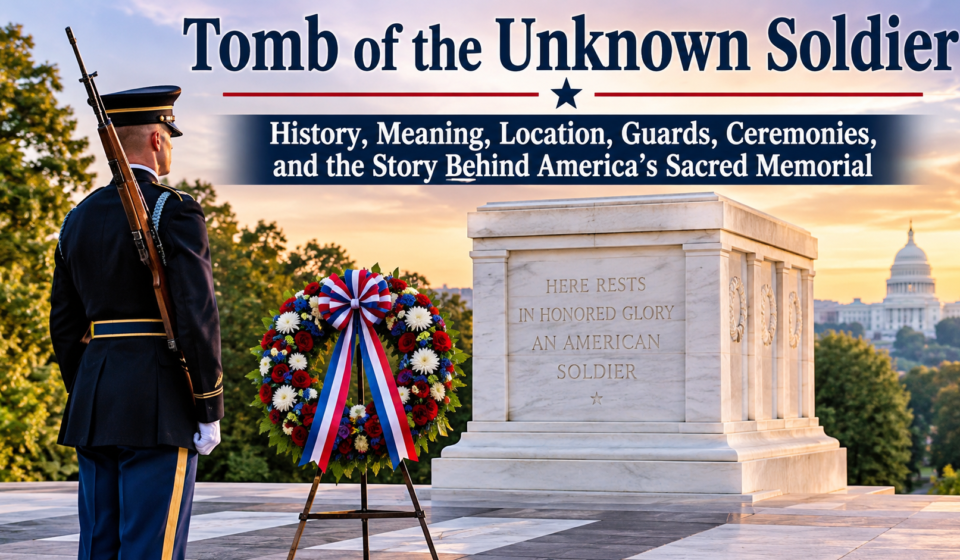
Tomb of the Unknown Soldier: History, Meaning, Location, Guards, Ceremonies, and the Story Behind America’s Sacred Memorial

The Tomb of the Unknown Soldier is one of the most meaningful military memorials in the United States. Located at Arlington National Cemetery in Virginia, this remarkable monument honors American service members who lost their lives while serving their country but whose identities could never be established. It represents countless military personnel who made the ultimate sacrifice and whose families never received the certainty of knowing where their loved ones were laid to rest. The Tomb of the Unknown Soldier is much more than a traditional grave or historical monument. It is a national symbol of courage, remembrance, respect, and gratitude toward those who gave everything in the service of freedom. Visitors from across the United States and around the world come to this sacred location to reflect on military history and honor the sacrifices made by generations of Americans. Its carefully maintained appearance, powerful inscriptions, and continuously present military guards make it one of the most recognizable memorials in the country. Understanding the Tomb of the Unknown Soldier means exploring the history of modern warfare, the experiences of grieving families, and the enduring importance of remembering people whose names may never be known.
What Is the Tomb of the Unknown Soldier?
The Tomb of the Unknown Soldier is a national military memorial at Arlington National Cemetery. It honors unidentified American service members who died during wartime and represents the many military personnel whose remains could not be identified after their deaths. The monument provides a permanent place for the country to remember individuals who might otherwise have no recognizable grave or personal memorial. Although the original burial honored an unidentified American soldier from the First World War, additional crypts were later created to recognize unidentified service members from other major conflicts.
The meaning of this memorial extends beyond the individual people buried there. Every unknown service member represents a family, a community, and a personal story affected by war. Some soldiers died far from home, while others disappeared during battles in which identifying their remains became impossible. Their families often experienced years of uncertainty because they could not visit a known grave or receive a definite answer about what had happened. The Tomb of the Unknown Soldier gives these families and the entire nation a place to express remembrance and respect.
The monument also represents military service without focusing on rank, wealth, social background, or personal recognition. The individual buried beneath the main structure is honored not because of a famous achievement or a distinguished military career but because of the sacrifice made while serving the country. This idea makes the memorial especially powerful. It reminds visitors that every service member matters, whether their name appears in history books or remains unknown.
Where Is the Tomb of the Unknown Soldier Located?
The Tomb of the Unknown Soldier is located at Arlington National Cemetery in Arlington, Virginia, near Washington, D.C. The cemetery sits across the Potomac River from the nation’s capital and is one of America’s most important national burial grounds. The monument stands on a prominent plaza near the Memorial Amphitheater, allowing visitors to experience its impressive architecture and observe the military ceremonies performed there.
Its location is significant because Arlington National Cemetery is closely connected to American military history. The cemetery contains the graves of service members from numerous conflicts, as well as memorials dedicated to individuals and groups who contributed to the nation’s history. The Tomb of the Unknown Soldier occupies a particularly important place within this landscape because it represents people whose individual identities could not be preserved.
The setting also creates a powerful connection between remembrance and national responsibility. Visitors can see the carefully arranged cemetery grounds, rows of military headstones, and the memorial’s impressive stone structure. The atmosphere encourages quiet reflection rather than ordinary sightseeing. People often arrive with family members, veterans, school groups, and visitors from other countries to pay their respects.
The location is accessible to visitors who follow Arlington National Cemetery’s entry requirements and visitor guidelines. Because it is an active military cemetery and a sacred memorial site, visitors are expected to behave respectfully. The Tomb is not simply a tourist attraction. It is a place of burial, remembrance, and national honor.
The History Behind the Tomb of the Unknown Soldier
The history of the Tomb of the Unknown Soldier is closely connected to the enormous human losses caused by modern warfare. Throughout history, armies have struggled to identify soldiers who died during battles. Before modern identification systems became widely available, military personnel could disappear during combat, become separated from their units, or be buried without reliable records. Weapons, explosions, environmental conditions, and the speed of military operations often made identification extremely difficult.
In earlier American conflicts, unidentified soldiers were sometimes buried in mass graves or placed in individual graves marked as unknown. The problem became especially serious during the American Civil War, when enormous numbers of soldiers died across a large geographical area. Military burial systems gradually improved, but many remains could not be identified. The establishment of national cemeteries helped provide more organized and respectful burial arrangements, although it could not solve every identification problem.
The First World War created an even greater need for national remembrance. Millions of military personnel died across Europe, and many families could not identify or recover their relatives’ remains. The scale of destruction made it difficult to determine exactly who had died in particular locations. The experience encouraged several countries to establish memorials dedicated to unidentified soldiers.
The idea of honoring one unknown individual as a representative of all unidentified war dead became a meaningful way to address this problem. Rather than leaving these individuals without recognition, nations created symbolic graves where the public could remember everyone who had sacrificed their lives without receiving a known burial place.
The American memorial developed within this international movement. It became a permanent national expression of mourning and gratitude, bringing the memory of unidentified American service members into the center of public life.
How World War I Inspired the Memorial
World War I played a central role in the creation of the Tomb of the Unknown Soldier. The conflict caused extraordinary destruction and resulted in millions of military deaths. Soldiers fought in trenches, across devastated landscapes, and under conditions that made the recovery and identification of remains extremely challenging. Explosions and heavy artillery frequently destroyed identification materials or separated remains from personal belongings.
Many families wanted their loved ones returned home for burial. However, governments faced enormous logistical challenges when attempting to recover and identify every person who had died overseas. Some remains could not be identified, while others were never recovered. This created a painful situation for families who had no confirmed grave to visit.
After the war, Britain and France introduced important national memorial traditions honoring unidentified military personnel. Britain buried its Unknown Warrior at Westminster Abbey, while France established its Unknown Soldier memorial beneath the Arc de Triomphe in Paris. These memorials demonstrated that a single unidentified individual could represent thousands of people who had died without receiving individual recognition.
The American government eventually adopted a similar approach. The proposed memorial would bring home the remains of an unidentified American service member and provide a permanent resting place at Arlington National Cemetery. The person would represent all American service members whose identities had been lost during the war.
The idea carried a deeply emotional message. A soldier whose name could not be established would receive the respect of the entire nation. His identity would remain unknown, but his sacrifice would never be forgotten.
The Creation of the American Tomb
The establishment of the American memorial required government approval, military planning, and a carefully organized selection process. Congressman Hamilton Fish Jr., a veteran of the First World War, played an important role in promoting the proposal. He supported the idea of bringing home an unidentified American warrior whose sacrifice could represent the broader experience of the nation’s military dead.
The proposal reflected the desire to honor service members without distinguishing between their social backgrounds, religious beliefs, or geographical origins. The memorial would recognize the shared sacrifice of American military personnel and offer families a national place for mourning.
Congress approved the resolution in March 1921. The plan called for an unidentified American soldier to be buried at Arlington National Cemetery. The location near Memorial Amphitheater was selected as an appropriate place for a national memorial ceremony.
Military officials then began organizing the selection of the remains. The process needed to ensure that the chosen individual genuinely represented an unidentified American service member who had died during the First World War. The remains were recovered from American military cemeteries in France and transported for the formal selection ceremony.
The final selection was conducted with considerable care and respect. Once the unknown service member had been chosen, arrangements were made to bring the casket to the United States. The journey became an important national event and demonstrated the significance attached to the memorial.
The burial ceremony transformed the proposed monument into a lasting symbol of national remembrance. From that moment onward, the unknown soldier became a representative figure for all Americans who had died in military service without receiving an identified resting place.
How the Unknown Soldier Was Selected
The selection of the First World War Unknown Soldier was a carefully organized military procedure. Four unidentified American service members were exhumed from separate American military cemeteries in France. Their remains were placed in similar caskets so that the person making the final selection would have no obvious way to distinguish one individual from another.
The selection took place at Châlons-sur-Marne, a French city now known as Châlons-en-Champagne. Military personnel prepared the location for the ceremony, ensuring that the caskets were handled with dignity. The selection was designed to prevent personal information or the original burial location from influencing the decision.
Sergeant Edward F. Younger was chosen to select the unknown service member. He was a decorated American soldier who had served during the war. During the ceremony, he approached the arranged caskets and placed a spray of white roses on one of them. The chosen casket contained the remains that would eventually be brought to Arlington National Cemetery.
The remaining unidentified remains were returned for burial in France. The selected individual began a carefully arranged journey home, first traveling through French cities before being transported across the Atlantic Ocean aboard the USS Olympia.
The ceremony is an important part of the memorial’s history because it demonstrates how the unknown identity was preserved deliberately. The selected individual was not chosen for fame or personal distinction. He was selected to represent all those whose identities had disappeared in the tragedy of war.
The Journey to the United States
After the selection ceremony in France, the Unknown Soldier began a journey that received considerable public attention. The casket was transported through French territory before reaching the port city of Le Havre. From there, the remains were carried aboard the USS Olympia, a United States Navy cruiser that brought the Unknown Soldier across the Atlantic.
The USS Olympia had its own place in American naval history, making it a meaningful vessel for this important national mission. Its role in transporting the unidentified service member connected military history with the broader national ceremony planned in Washington.
When the ship arrived in the United States, the casket was received with military honors. The remains were transported to Washington, D.C., where they were placed in the United States Capitol Rotunda. This arrangement allowed members of the public to pay their respects before the final burial.
Thousands of Americans visited the Capitol to honor the Unknown Soldier. People from different backgrounds gathered to express their gratitude and share in a national moment of mourning. For families who had lost loved ones overseas, the unidentified soldier represented a personal connection to the broader tragedy of the war.
The journey was more than a transportation operation. It became a symbolic return home for an individual who represented thousands of Americans who had died far from their families. The public response demonstrated how strongly the country felt about remembering its unidentified military dead.
The Original Burial Ceremony at Arlington
The burial ceremony for the American Unknown Soldier took place on November eleventh, 1921, at Arlington National Cemetery. The date was significant because it marked the anniversary of the armistice that ended the fighting of the First World War. It was already associated with remembrance and national reflection.
The casket was carried from Washington to Arlington in a formal military procession. A horse-drawn caisson transported the remains while military personnel, government representatives, and members of the public participated in the ceremony. The procession represented the nation’s gratitude toward those who had served and sacrificed their lives.
President Warren G. Harding attended the ceremony and delivered remarks honoring the Unknown Soldier. The casket received the Medal of Honor, representing the nation’s highest military recognition. Foreign representatives also presented military decorations, demonstrating that the memorial had significance beyond American borders.
The ceremony included a moment of silence that allowed people throughout the country to participate in remembrance. Even individuals who could not attend in person could share the national expression of grief and gratitude.
The Unknown Soldier was placed in a simple marble grave. Although the original structure was modest compared with the monument visitors see today, its meaning was already enormous. The grave provided a permanent place to remember those who had died without identification.
The ceremony established a tradition that continues to shape the memorial’s identity. The Tomb of the Unknown Soldier became a place where military service, national mourning, and public gratitude could come together.
Why the Tomb of the Unknown Soldier Is So Important
The importance of the Tomb of the Unknown Soldier comes from its ability to represent countless individual lives through one memorial. Every unidentified service member had a personal history, family relationships, hopes, and experiences. Although the public may never know these stories, the memorial ensures that their sacrifices remain part of the national memory.
For families who never received confirmation of a loved one’s final resting place, the monument offers a place for remembrance. It does not replace the personal experience of visiting a family grave, but it provides a shared location where grief can be expressed. Visitors may think about a relative, friend, or military colleague whose remains were never recovered.
The memorial also teaches future generations about the human cost of war. Military history is often discussed through battles, strategies, political decisions, and famous commanders. The Tomb brings attention to the ordinary service members whose experiences are equally important. It reminds people that every military conflict involves individual lives and families.
Another important aspect is the memorial’s message of equality. The unknown service member is honored without a visible distinction based on rank or social position. The grave represents the idea that sacrifice deserves recognition regardless of whether the individual became famous.
The monument also connects military remembrance with national identity. It encourages visitors to consider the responsibilities that come with freedom, the experiences of veterans, and the importance of respecting those who serve.
The Architecture of the Tomb
The architecture of the Tomb of the Unknown Soldier was designed to create a powerful and dignified memorial. Its elevated location, white marble construction, and carefully carved details give the monument a commanding appearance without making it unnecessarily decorative. The design communicates seriousness, permanence, and respect.
The original grave was a simple marble slab. As public interest in the memorial increased, plans developed for a more substantial structure. Congress authorized the construction of the permanent monument, and the present sarcophagus was completed in the early nineteen thirties.
The main structure is made from white marble and features classical architectural influences. Its design reflects the tradition of using monumental stone structures to honor military sacrifice and national history. The carved decorations provide symbolic meaning while maintaining a balanced appearance.
The sarcophagus stands above the grave of the First World War Unknown Soldier. Additional crypts were later placed nearby to represent unidentified service members from subsequent conflicts. Together, these burial spaces create a memorial that reflects the changing history of American military service.
The architecture is deliberately restrained. It does not rely on elaborate decoration or dramatic visual effects. Instead, the monument communicates its importance through its location, material, inscriptions, and connection to the people it honors.
Visitors often notice the careful maintenance of the marble and the precision of the surrounding ceremonial area. These details contribute to the atmosphere of respect that defines the memorial.
The Meaning of the Sculptures and Carvings
The Tomb of the Unknown Soldier contains carved figures and decorative details that communicate important national values. The main sarcophagus features symbolic figures representing Peace, Victory, and Valor. These figures express the ideals associated with military service and the hope that sacrifice will contribute to a more peaceful future.
Peace represents the ultimate goal of avoiding conflict and protecting human life. Although military personnel may be required to fight during wartime, their service is often understood as part of a larger effort to defend their country and preserve security. The symbol encourages visitors to think about the relationship between military responsibility and the desire for peace.
Victory represents the successful defense of national interests and the achievements of military personnel during conflict. However, its presence on the memorial does not suggest that war is without suffering. Instead, it acknowledges the courage and determination required to face extraordinary challenges.
Valor represents bravery, personal responsibility, and the willingness to serve despite danger. It reflects the qualities displayed by service members who faced difficult circumstances and remained committed to their duties.
The decorative wreaths on the sarcophagus also contribute to its symbolism. Wreaths have long been associated with remembrance, honor, and respect. Their presence reinforces the idea that the memorial is a permanent tribute rather than an ordinary burial place.
Every part of the structure contributes to its meaning. The sculptures, inscriptions, and architectural design work together to communicate the importance of remembering people whose names may never be recovered.
The Famous Inscription on the Tomb
One of the most recognizable features of the Tomb of the Unknown Soldier is its inscription. The words carved into the monument express the central idea behind the memorial: the person resting there is an American soldier whose identity is known only to God.
The inscription reads, “Here rests in honored glory an American soldier known but to God.”
These words are short, but they carry considerable emotional meaning. They acknowledge that the individual cannot be identified through ordinary historical records while emphasizing that the person’s service deserves permanent respect.
The inscription also avoids unnecessary distinctions. It does not mention a particular military rank, hometown, family background, or personal achievement. Instead, it recognizes the Unknown Soldier as a representative of all American service members who died without identification.
For visitors, the message often creates a powerful moment of reflection. People may wonder about the person’s childhood, family, friendships, and experiences before entering military service. Although these details cannot be recovered, the inscription ensures that the individual is not forgotten.
The phrase also communicates humility. The nation honors the Unknown Soldier without pretending to know more than the available evidence allows. His identity remains unknown, but his sacrifice is recognized.
This simple message has become one of the defining elements of the memorial and helps explain why the Tomb continues to attract visitors from around the world.
The Additional Unknowns From World War II and Korea
The memorial expanded after the Second World War and the Korean War. These conflicts created new challenges for military identification, and many American service members remained unidentified. The government eventually decided that additional unknown service members should be honored at Arlington National Cemetery.
President Dwight D. Eisenhower approved the selection and burial of Unknowns from both conflicts. The decision reflected the continued importance of the memorial and the desire to recognize unidentified military personnel from different generations.
The selection process for the Second World War Unknown was particularly complicated because the conflict had taken place across several continents. American service members had died in Europe, North Africa, the Pacific, and other regions. The chosen individual needed to represent unidentified American dead from the wider conflict rather than one particular battlefield.
The remains were carefully selected through military procedures. A separate Unknown was also chosen to represent the Korean War. Both caskets were brought to Washington, where they received public honors before being buried at Arlington.
These additional burials transformed the memorial into a broader representation of American military history. The Tomb of the Unknown Soldier no longer represented only the First World War. It became a lasting tribute to unidentified service members from several major conflicts.
The arrangement also demonstrates how the meaning of the memorial has developed over time. Each additional crypt represents another generation of military personnel whose identities could not be established after their deaths.
The Vietnam War Unknown and the Importance of DNA Identification
The Vietnam War created another difficult question for the memorial. Many Americans wanted unidentified service members from the conflict to receive recognition at Arlington. However, advances in forensic science raised an important possibility: remains that could not previously be identified might eventually be identified through improved technology.
A bronze plaque honoring Vietnam War service members was dedicated at Arlington in the late nineteen seventies. The memorial recognized those who had served and sacrificed during the conflict while the government continued considering how an unknown service member might be represented.
In nineteen eighty-four, the remains of a Vietnam War Unknown were selected and brought to Arlington for burial. The ceremony received national attention and reflected the continuing commitment to honoring people whose identities had been lost.
However, scientific progress eventually changed the situation. Researchers examined the available evidence and developed a strong basis for identifying the remains as those of United States Air Force First Lieutenant Michael Joseph Blassie. DNA testing later confirmed his identity.
Blassie’s remains were exhumed in nineteen ninety-eight at the request of his family. After identification, his family chose to have him reburied at Jefferson Barracks National Cemetery in Missouri.
This development demonstrated the importance of modern forensic science in military identification. The discovery allowed a family to receive a definite answer and gave an individual his name back after years of uncertainty.
The crypt previously used for the Vietnam Unknown was subsequently rededicated to honor all missing American service members from the Vietnam War era. Its empty condition carries an important message: the country must continue searching for missing personnel and working to identify recovered remains whenever possible.
The Sentinels Who Guard the Tomb
The military personnel who protect the Tomb of the Unknown Soldier are known as Sentinels or Tomb Guards. Their duty is one of the most respected ceremonial responsibilities in the United States Army. They maintain a continuous presence at the memorial and perform carefully organized routines that demonstrate discipline, professionalism, and respect.
The guards belong to the Third United States Infantry Regiment, widely known as The Old Guard. This regiment has a long history of ceremonial responsibilities and participates in important military events throughout the Washington area.
The responsibility for guarding the Tomb became a permanent assignment in the twentieth century. Over time, the duty developed into a highly respected military tradition. The guards remain present throughout the day and night, regardless of weather conditions.
Their responsibilities involve much more than standing near the monument. They must maintain strict standards of appearance, follow precise movements, and demonstrate complete awareness of their surroundings. The work requires physical endurance, concentration, and a strong understanding of the memorial’s importance.
Visitors often find the guards’ discipline especially impressive. Their movements are deliberate, their uniforms are carefully maintained, and their behavior remains professional throughout the ceremony.
The Sentinels represent the living military personnel who continue honoring those who came before them. Their presence connects the memorial’s historical meaning with the present-day commitment to remembrance.
How Soldiers Become Tomb Guards
Becoming a Tomb Guard is a demanding achievement within the United States Army. Soldiers who seek this responsibility must demonstrate strong military performance, discipline, physical fitness, and professional conduct. The selection process is designed to ensure that only qualified individuals receive the assignment.
Candidates must understand the history of the memorial and the responsibilities associated with protecting it. They are expected to learn about the unidentified service members represented by the Tomb and the traditions that have developed around the ceremonial duty.
Training involves learning precise marching patterns, movements, uniform standards, and ceremonial procedures. The soldiers must perform their duties consistently because even small errors can affect the appearance of the ceremony.
The selection process also tests attention to detail. A Tomb Guard must maintain a professional appearance and demonstrate the ability to perform under pressure. Weather conditions, long periods of standing, and public attention can make the assignment physically and mentally challenging.
The honor associated with the position comes from the responsibility of representing the Army at one of the country’s most important military memorials. A Sentinel is not simply performing a routine task. The soldier is participating in a tradition that honors unidentified Americans and reminds visitors of the cost of military service.
Those who successfully complete the training become part of a respected community of soldiers who have protected the Tomb across generations.
The Meaning Behind the Twenty-One Steps
One of the most recognized features of the Tomb Guard ceremony is the Sentinel’s walking pattern. The guard marches twenty-one steps along the black mat behind the Tomb before turning and performing the next part of the routine.
The number of steps is connected symbolically to the twenty-one-gun salute, which is among the highest military honors. This connection gives the guard’s movements a deeper ceremonial meaning.
After completing the first part of the walk, the Sentinel turns and faces east for a period of time before turning to face north. The guard then returns along the mat, maintaining the same careful pace and precise movements.
The routine is repeated throughout the guard’s assigned shift. Its consistency demonstrates that the memorial receives the same respect regardless of the weather, time of day, or number of visitors present.
The steps also communicate discipline and control. Every movement has a defined purpose, and the guard must perform it with accuracy. The ceremony is not designed for entertainment. It is a formal expression of military honor.
Visitors often watch the routine quietly because they understand that the Sentinel’s movements represent a serious responsibility. The ceremony makes the memorial’s meaning visible through the actions of living service members.
The Changing of the Guard Ceremony
The changing of the guard is one of the most memorable traditions associated with the Tomb of the Unknown Soldier. It takes place when one Sentinel completes a shift and another assumes responsibility for guarding the memorial.
The ceremony follows a formal sequence. The relief commander approaches the plaza and announces the change. The incoming Sentinel then participates in the procedure, which includes carefully controlled movements and military salutes.
The outgoing guard and the incoming guard follow established instructions to ensure that responsibility is transferred properly. The ceremony demonstrates that the duty continues without interruption.
The schedule varies depending on the season. During the colder part of the year, the guard changes on an hourly schedule. During the warmer part of the year, the ceremony generally takes place more frequently.
Visitors are asked to stand quietly and observe the ceremony respectfully. The process provides an opportunity to appreciate the professionalism of the soldiers and understand the importance attached to their duty.
The changing of the guard also carries symbolic meaning. Although individual soldiers complete their assignments and move on to other responsibilities, the nation’s commitment to honoring unidentified military personnel remains continuous.
The ceremony connects generations of Sentinels and reminds visitors that remembrance requires ongoing dedication rather than a single historical event.
Guarding the Tomb During Bad Weather
The Sentinels protect the Tomb throughout the year, including periods of extreme weather. Rain, snow, cold temperatures, and summer heat do not remove the responsibility of maintaining the guard.
Weather conditions can make the assignment particularly challenging. Soldiers must remain focused while wearing their ceremonial uniforms and carrying out their established routines. Snow and ice require additional attention because the plaza can become slippery.
During heavy rain, the guards continue performing their duties while maintaining the standards expected of their position. In hot weather, the soldiers must manage the physical demands of the assignment without allowing the ceremony to lose its formal appearance.
This commitment is one reason visitors admire the Sentinels. Their duty does not depend on comfortable conditions or convenient schedules. It reflects a consistent promise to honor the Unknown Soldier.
The guards’ work also demonstrates the seriousness of military responsibility. Service often requires people to complete important tasks even when conditions become difficult. Their presence at the Tomb provides a visible example of discipline and commitment.
The memorial remains protected through changing seasons, reminding the public that national remembrance does not stop when circumstances become uncomfortable.
The Old Guard and Its Responsibility
The Third United States Infantry Regiment, known as The Old Guard, is the Army’s official ceremonial regiment. Its soldiers perform important duties in the nation’s capital, including military funerals, official ceremonies, and other events requiring a formal military presence.
The regiment has a long history connected to the development of the United States Army. Its ceremonial responsibilities allow the public to see military traditions in action and understand the importance of discipline and respect within the armed forces.
Guarding the Tomb is among its most significant assignments. The responsibility requires soldiers to maintain a high level of professionalism because they represent both the Army and the national memorial.
The Old Guard also supports important events at Arlington National Cemetery. Its soldiers participate in ceremonies honoring fallen service members and assist with the traditions associated with military burials.
The connection between the regiment and the Tomb demonstrates that remembrance is an active military responsibility. The soldiers do not simply preserve an old tradition. They continue it through daily service.
Their presence helps ensure that the Unknown Soldier receives the same respect today that was expressed during the original burial ceremony.
Memorial Amphitheater and Its Connection to the Tomb
The Memorial Amphitheater is an important part of the setting surrounding the Tomb of the Unknown Soldier. It provides a formal location for national ceremonies, military observances, and events honoring American service members.
The amphitheater was designed to accommodate large gatherings while maintaining a dignified atmosphere. Its architecture reflects the classical traditions often used in national memorials and government buildings.
The Tomb stands on the plaza associated with this important structure. Together, the two sites create a setting where military history and public remembrance come together.
The amphitheater has hosted ceremonies connected to national holidays, military anniversaries, and memorial observances. These events allow government representatives, veterans, military personnel, and members of the public to participate in honoring those who served.
The relationship between the amphitheater and the Tomb strengthens the memorial’s national importance. Visitors can observe the guard ceremony, explore the surrounding architecture, and learn about the people represented by the monument.
The setting also encourages visitors to consider the broader purpose of Arlington National Cemetery. It is not simply a place containing graves. It is a landscape of national memory where individual sacrifice is recognized and preserved.
The Difference Between the Tomb and the Unknown Warrior Memorial
The Tomb of the Unknown Soldier in the United States is closely connected to similar memorials established in other countries. One of the most important examples is Britain’s Tomb of the Unknown Warrior at Westminster Abbey in London.
Britain’s Unknown Warrior was buried on Armistice Day in nineteen twenty. The memorial represents British service personnel who died during the First World War without receiving an identified grave.
The American Tomb followed a similar idea and was dedicated the following year. Both memorials recognize unidentified military personnel through the burial of a representative individual.
There are important differences in their locations and traditions. The British Unknown Warrior rests inside Westminster Abbey, while the American Unknown Soldier is buried at Arlington National Cemetery. The American memorial also contains additional crypts connected to later military conflicts.
France established another important example beneath the Arc de Triomphe in Paris. Its Unknown Soldier memorial is associated with the national remembrance of French military personnel who died during the First World War.
These memorials demonstrate that the desire to honor unidentified war dead became an international tradition. Countries developed different ceremonies and architectural designs, but the underlying message remained similar.
Each monument provides a permanent place where people can remember military personnel whose individual identities were lost during war.
The Global Tradition of Unknown Soldier Memorials
The tradition of unknown soldier memorials developed as nations searched for meaningful ways to honor people whose remains could not be identified. The First World War accelerated this development because of the enormous number of casualties and the difficulties associated with recovering and identifying bodies.
The idea spread across Europe and eventually influenced memorial traditions in other parts of the world. Countries created monuments that represented their unidentified military dead and provided a public location for national remembrance.
These memorials often became important sites for annual ceremonies. Government representatives, military leaders, veterans, and ordinary citizens gather to honor those who died during conflicts.
The designs differ considerably. Some monuments are located inside historic churches, while others occupy prominent public squares, cemeteries, or national memorial grounds. Their architectural styles reflect local history and cultural traditions.
Despite these differences, the central message remains consistent. A person does not need to be individually identified to deserve dignity and remembrance. The absence of a name should never mean the absence of honor.
The Tomb of the Unknown Soldier is an important American example of this international tradition. Its history shows how a national memorial can connect individual grief with a shared understanding of sacrifice.
The Role of Families in the Memorial’s Meaning
Families are central to the meaning of the Tomb of the Unknown Soldier. Every unidentified service member represents people who may have spent years wondering what happened to someone they loved.
Military families often experience difficult circumstances when a service member disappears during conflict. They may receive incomplete information, uncertain reports, or no confirmed explanation of the person’s final moments.
A known grave provides a physical place where relatives can visit, leave flowers, and express their feelings. When remains are never identified, families may not have that opportunity. The national memorial helps address this absence by offering a shared place of remembrance.
The Tomb does not claim to represent every family’s experience in exactly the same way. Instead, it provides a national symbol that acknowledges the suffering caused by unidentified military deaths.
Visitors sometimes bring personal thoughts, memories, and feelings to the monument. A person may be remembering a family member who served in the military, a friend who died during combat, or someone whose remains were never recovered.
The memorial also encourages people to recognize the emotional experiences of military families. Behind every military casualty is a network of relationships affected by loss.
Its enduring significance comes partly from this human connection. The Tomb of the Unknown Soldier is not only about military history. It is also about families, grief, and the importance of remembering those who cannot speak for themselves.
The Connection Between the Tomb and Veterans Day
Veterans Day is closely connected to the history of the Tomb of the Unknown Soldier because the original burial took place on November eleventh, nineteen twenty-one. The date was already associated with the end of the First World War and the remembrance of military personnel who had died.
The original Armistice Day observance developed into a broader national tradition honoring military service. Veterans Day eventually became a time to recognize all American veterans, including people who served during peacetime as well as wartime.
The Tomb remains an important location for national observances. Ceremonies held at Arlington often include military honors, wreath presentations, and moments of silence.
The connection between the holiday and the memorial reinforces the importance of remembering both living veterans and those who never returned home. Veterans Day is not limited to celebrating military achievements. It also recognizes the responsibilities, difficulties, and sacrifices associated with service.
The Tomb provides a powerful setting for these observances because it represents people whose individual stories may never be known. It reminds visitors that every generation has a responsibility to recognize military service.
The relationship between Veterans Day and the memorial continues to strengthen the national tradition of gratitude and remembrance.
The Connection Between Memorial Day and the Tomb
Memorial Day is another important occasion associated with the Tomb of the Unknown Soldier. Unlike Veterans Day, which recognizes all American veterans, Memorial Day specifically honors service members who died while serving in the military.
The memorial provides an appropriate setting for ceremonies dedicated to fallen service members. Its meaning is especially relevant because the individuals represented by the Tomb died without receiving identified graves.
During Memorial Day observances, military personnel and government representatives may participate in formal ceremonies at Arlington National Cemetery. Visitors also come to honor relatives, friends, and other Americans who made the ultimate sacrifice.
The atmosphere is often deeply reflective. People may observe moments of silence, attend military ceremonies, or visit graves throughout the cemetery.
The Tomb reminds visitors that military deaths are not merely historical statistics. Each individual had a personal identity, relationships, and a life that ended under extraordinary circumstances.
The connection between Memorial Day and the monument encourages a broader understanding of national remembrance. Honoring the fallen means recognizing both the known individuals and those whose identities remain unknown.
How the Tomb of the Unknown Soldier Represents All Americans
The Tomb of the Unknown Soldier is a national memorial because its meaning extends beyond one military branch, one state, or one generation. The unidentified person buried beneath the monument represents service members from across the country who gave their lives while serving the United States.
This symbolic representation makes the memorial particularly inclusive. Visitors do not need to share the same military background or family history to understand its message. The monument recognizes a common human experience: people who leave their homes to serve and may never return.
Its meaning also extends beyond traditional ideas of military fame. The individual honored at the Tomb may never have received a public award during life or achieved recognition through a famous battle. Yet the nation recognizes the sacrifice through a permanent memorial.
The Tomb encourages people to look beyond individual accomplishments and consider the collective contribution of military personnel. It recognizes that a country’s history is shaped not only by prominent leaders but also by ordinary people who accept extraordinary responsibilities.
The memorial also connects different generations. A visitor may come to honor a relative who served decades ago, while another may be thinking about a modern military deployment. Both can find meaning in the same monument.
Its national importance comes from this ability to unite different experiences through a shared expression of respect.
The Role of Modern Technology in Identifying Unknown Soldiers
Modern technology has changed the way military authorities investigate unidentified remains. Advances in forensic science, DNA analysis, historical research, and record management have created opportunities to identify individuals who were previously considered impossible to identify.
DNA testing is particularly important because it can help establish biological relationships between recovered remains and living relatives. When suitable reference samples are available, scientists can compare genetic evidence and determine whether a set of remains belongs to a particular individual.
Other techniques may also contribute to identification. Dental records, medical information, personal belongings, military documents, and historical photographs can provide useful evidence. Investigators often combine several sources rather than relying on one piece of information.
The identification of Michael Joseph Blassie demonstrated the importance of these developments. His remains had previously been honored as the Vietnam War Unknown before DNA evidence established his identity.
Modern identification programs continue to investigate missing service members from historical conflicts. These efforts are important for families who may still be waiting for answers.
The Tomb of the Unknown Soldier therefore has a relationship with both remembrance and the continuing search for identification. Its meaning does not depend on keeping individuals unidentified forever. Instead, it honors those whose identities remain unknown while supporting efforts to recover names whenever possible.
Why the Vietnam Crypt Remains Empty
The empty Vietnam crypt at Arlington National Cemetery is an important part of the memorial’s modern history. It became vacant after DNA testing identified the remains previously buried there as those of First Lieutenant Michael Joseph Blassie.
The decision to identify and return Blassie’s remains to his family reflected the importance of giving military personnel their names back whenever reliable evidence makes that possible.
Rather than selecting another unidentified individual for permanent burial in the crypt, officials rededicated the space to honor missing American service members from the Vietnam War era.
The empty crypt does not mean that those missing individuals have been forgotten. It serves as a continuing reminder that many families have experienced uncertainty and that efforts to account for missing service members remain important.
The space also represents progress in forensic science. What could not be established through earlier identification methods became possible through modern DNA analysis.
For visitors, the empty crypt may carry a different emotional meaning from the occupied graves. It represents both hope and unfinished responsibility. There is hope that more missing personnel may eventually be identified, while the continuing search reflects the obligation to remember those who have not yet been found.
The decision demonstrates that the purpose of the memorial is not simply to preserve unidentified remains. It is to honor people and support the dignity of every service member.
What Visitors Can Expect When Visiting the Tomb
Visitors who travel to Arlington National Cemetery to see the Tomb of the Unknown Soldier can expect a formal and respectful environment. The memorial is located within the cemetery grounds, where visitors can explore other military graves, monuments, and historic sites.
The Tomb itself is one of the most prominent attractions within the cemetery. Many people arrive specifically to observe the changing of the guard and learn about the history of the unidentified service members honored there.
The guard ceremony is usually the highlight of a visit. Visitors gather around the designated viewing area and observe the Sentinel’s precise movements. The ceremony is conducted according to established military traditions, and people are expected to remain quiet and respectful.
The surrounding area also provides opportunities to understand the architecture and historical significance of the memorial. Visitors can examine the inscriptions, observe the carved figures, and learn about the additional crypts.
A visit may also include time at Memorial Amphitheater and other locations throughout Arlington National Cemetery. The cemetery is extensive, so planning ahead can make the experience more comfortable.
Visitors should check official cemetery guidance before arriving because entry arrangements, visitor access, security procedures, and ceremony schedules may change. Respecting the site’s rules helps protect the dignity of the memorial and ensures that everyone can experience it appropriately.
Proper Etiquette at the Tomb of the Unknown Soldier
The Tomb of the Unknown Soldier is a sacred burial site, and visitors are expected to treat it with respect. Its importance goes beyond architecture and tourism because it contains the remains of unidentified military personnel who died while serving their country.
Quiet behavior is especially important during the changing of the guard. Visitors should avoid unnecessary conversations, shouting, or actions that interrupt the ceremony. The guards are performing a formal military responsibility, and the public is expected to recognize the seriousness of that duty.
People should also follow posted instructions and directions from cemetery staff. Restricted areas exist to protect graves, military ceremonies, and other sensitive locations. Visitors should never cross barriers or attempt to approach the monument in unauthorized ways.
Photography should be handled respectfully. Visitors may wish to preserve memories of their visit, but they should avoid disruptive behavior or actions that interfere with other people observing the memorial.
Appropriate clothing and respectful conduct help maintain the atmosphere of dignity. The most important rule is to remember that the location is a grave and national memorial rather than an ordinary entertainment destination.
By following these expectations, visitors contribute to the preservation of a place that holds deep meaning for military families and the country.
The Emotional Experience of Standing Before the Tomb
Standing before the Tomb of the Unknown Soldier can be a powerful experience because the memorial creates a direct connection between national history and individual loss. Visitors may arrive with different reasons for coming, but many leave with a stronger understanding of the human cost of military service.
Some people think about relatives who served in the armed forces. Others may remember friends, veterans, or individuals who died during a particular conflict. Even visitors without a personal military connection can understand the significance of honoring people who sacrificed their lives.
The unidentified nature of the person buried beneath the main sarcophagus adds to the emotional experience. Visitors cannot look at a name and learn about an individual’s hometown, military unit, or family. Instead, they are encouraged to consider the thousands of possible lives represented by the memorial.
The guard ceremony also contributes to this atmosphere. The Sentinel’s precise movements create a visible expression of respect that requires no lengthy explanation.
The memorial may lead visitors to think about questions that do not have simple answers. What did the unknown service member experience before dying? Did the individual have children or parents waiting at home? Was there someone who never stopped hoping for his return?
These questions reveal the deeply human meaning behind the monument. The Tomb gives a permanent place of honor to someone whose personal story may never be recovered.
Educational Importance for Students and Future Generations
The Tomb of the Unknown Soldier is an important educational resource because it introduces students to military history through a human perspective. Rather than focusing only on battles and political events, it encourages young people to understand the experiences of ordinary service members.
Teachers can use the memorial to explain how warfare affects individuals and families. Students can learn about identification methods, military burial traditions, and the development of national cemeteries.
The history of the monument also provides an opportunity to discuss the First World War and its international consequences. The establishment of similar memorials in Britain, France, and the United States demonstrates how different countries responded to the shared experience of mass military loss.
The changing of the guard can also introduce students to military discipline and ceremonial traditions. It shows how institutions preserve important responsibilities through training, standards, and repeated practices.
Another educational lesson concerns scientific progress. The identification of Michael Joseph Blassie illustrates how modern DNA analysis can solve historical mysteries and provide families with important answers.
Most importantly, the memorial teaches respect. It encourages younger generations to recognize that historical events involve real people whose lives and relationships mattered.
By learning about the Tomb, students can develop a deeper appreciation for military service, national remembrance, and the importance of preserving historical evidence.
The Tomb as a Symbol of Courage and Sacrifice
Courage and sacrifice are two of the most important themes associated with the Tomb of the Unknown Soldier. The people represented by the monument served during conflicts that placed them in dangerous and uncertain circumstances.
Military service often requires individuals to leave their homes, families, and ordinary routines. They may face unfamiliar environments, difficult decisions, and risks that cannot always be predicted.
The Unknown Soldier represents the service members who accepted these responsibilities and did not return home. Their identities may remain unavailable, but their contribution is recognized through the national memorial.
The monument also encourages visitors to think about sacrifice beyond the battlefield. Families experience emotional challenges when loved ones serve far from home. Communities lose people who might otherwise have contributed to their neighborhoods, workplaces, and families for many years.
The Tomb acknowledges these wider consequences. It provides a place where the public can recognize that military sacrifice affects more than the individual service member.
Its symbolism remains relevant because every generation faces the responsibility of remembering people who served before them. The monument represents courage not as a distant historical idea but as a quality demonstrated by real individuals under difficult circumstances.
How the Memorial Has Changed Over Time
The Tomb of the Unknown Soldier has developed significantly since its original dedication. What began as a relatively simple marble grave became a larger national monument with additional crypts and carefully established ceremonial traditions.
The original structure was intentionally modest. Its importance came from the individual buried there and the symbolic meaning attached to his unknown identity. However, the growing number of visitors and the desire to create a more permanent architectural tribute encouraged the construction of the present sarcophagus.
The addition of the Second World War and Korean War Unknowns expanded the memorial’s historical scope. These burials recognized unidentified service members from later generations and demonstrated that the original purpose remained relevant.
The Vietnam War crypt introduced another important chapter. Its eventual identification through DNA testing showed how technology could change the understanding of a national memorial.
The guard tradition also developed over time. What began as a military presence intended to protect the grave eventually became a continuous ceremonial duty performed by specially trained soldiers.
These changes have not altered the memorial’s central meaning. Instead, they have allowed it to respond to changing military history while preserving the original commitment to honoring unidentified service members.
The Tomb continues to serve as a connection between America’s past and present.
The Difference Between Known and Unknown Military Graves
Military cemeteries contain both identified and unidentified graves. An identified grave provides information about the individual, such as a name, military service details, and sometimes additional personal information.
An unknown grave is used when authorities cannot establish the identity of the person whose remains have been recovered. This may happen because identification documents are missing, remains have been damaged, or historical records are incomplete.
Both types of graves deserve the same dignity and respect. The difference concerns the availability of personal information rather than the importance of the person being remembered.
The Tomb of the Unknown Soldier gives national recognition to unidentified military personnel. It also reminds visitors that an unknown grave is not an empty historical category. It represents a person whose life and service mattered.
Modern military identification programs attempt to reduce the number of unidentified remains through improved records, forensic techniques, and cooperation with families.
The goal is to identify individuals whenever possible while maintaining respectful burial practices for those whose identities cannot be established.
The memorial’s continued importance comes from this balance between honoring unknown service members and supporting efforts to recover their identities.
The Role of Government in Preserving the Memorial
The preservation of the Tomb of the Unknown Soldier involves government institutions and military personnel who maintain the memorial and protect its historical significance. Arlington National Cemetery is responsible for managing the site and providing visitors with information about its history and traditions.
The Army also plays an important role through The Old Guard, whose soldiers perform the ceremonial guard assignment. Their training and daily responsibilities ensure that the tradition continues according to established standards.
Government support is necessary for maintaining the monument’s physical condition, organizing national ceremonies, protecting the cemetery, and preserving historical records.
The memorial also reflects broader responsibilities involving missing military personnel. Government agencies and scientific organizations continue working to identify recovered remains and provide answers to families whenever possible.
These efforts demonstrate that national remembrance requires more than building a monument. It involves maintaining the site, protecting its traditions, preserving evidence, and continuing the search for individuals who remain unaccounted for.
The Tomb stands as a visible reminder of these responsibilities. Its presence encourages the country to honor the past while continuing to support military families and veterans.
Why the Tomb Remains Relevant Today
The Tomb of the Unknown Soldier remains relevant because the challenges it represents have not disappeared. Military conflicts continue to create situations in which service members may become missing or unidentified.
Although modern identification systems are considerably more advanced than those used during the First World War, difficult circumstances can still prevent immediate identification. Recovery operations, environmental damage, and incomplete historical records may complicate investigations.
The memorial also remains relevant because public remembrance is an ongoing responsibility. New generations need opportunities to understand the experiences of people who served before them.
Its symbolism is not limited to one conflict or historical period. The Tomb represents a continuing commitment to recognize military service and honor people whose personal stories may never be fully recovered.
The memorial also provides an important place for national ceremonies. Its presence at Arlington National Cemetery allows the country to express gratitude in a visible and meaningful way.
For families, veterans, and ordinary visitors, the monument continues to communicate a simple message: people who sacrificed their lives should never be forgotten simply because their names are unknown.
Common Misunderstandings About the Tomb of the Unknown Soldier
Several misunderstandings exist about the Tomb of the Unknown Soldier, especially among people who are learning about it for the first time. One common misunderstanding is that the monument contains only one unidentified service member. In reality, the Arlington memorial includes crypts associated with different American military conflicts.
Another misunderstanding concerns the Vietnam War crypt. Some visitors assume that it still contains unidentified remains. However, the remains previously buried there were identified as those of Michael Joseph Blassie and returned to his family for reburial. The crypt is now dedicated to honoring missing service members from the Vietnam War era.
Some people also believe that the guard ceremony is performed only during public visiting hours. The Sentinels maintain a continuous presence at the Tomb, including overnight and during difficult weather conditions.
Another misconception is that the guard’s movements are simply a performance for tourists. In reality, the ceremony is a formal military tradition that represents respect and responsibility.
Visitors may also confuse the American Tomb with Britain’s Unknown Warrior memorial. Both were inspired by the same broad tradition, but they are separate monuments with different burial locations and national histories.
Understanding these distinctions helps people appreciate the memorial more accurately and recognize the historical events that shaped its development.
The Lasting Legacy of the Tomb of the Unknown Soldier
The legacy of the Tomb of the Unknown Soldier extends far beyond the marble structure at Arlington National Cemetery. It represents a national promise to remember people whose identities may have been lost during war but whose sacrifices remain meaningful.
The memorial has survived changing generations, military conflicts, scientific developments, and evolving public attitudes toward remembrance. Its original purpose remains recognizable even as new historical chapters have been added.
The Sentinels continue to guard the monument, maintaining a tradition that connects present-day military personnel with those who served before them. Their duty ensures that the Unknown Soldier receives continuous respect.
The memorial also reminds the public that military history is made up of individual lives. Every unknown service member had a personal story, even if that story can no longer be reconstructed.
For families, the Tomb offers a place to express feelings that may be difficult to put into words. For veterans, it represents a connection with fellow service members. For students and visitors, it provides an opportunity to understand the human consequences of war.
Its legacy is therefore both historical and emotional. It preserves the memory of unidentified Americans while encouraging future generations to respect service, courage, and sacrifice.
Final Thoughts on the Tomb of the Unknown Soldier
The Tomb of the Unknown Soldier is one of the most meaningful memorials in American history. Located at Arlington National Cemetery, it honors unidentified service members who gave their lives while serving the United States. Its origins in the First World War reflect the enormous human losses caused by modern conflict and the desire to provide every fallen service member with dignity and recognition.
The monument has developed over time through the addition of crypts representing later conflicts, the establishment of the continuous guard tradition, and the creation of ceremonies that bring people together in remembrance. The identification of the Vietnam War Unknown also demonstrated the importance of scientific progress and the continuing effort to give missing service members their names back.
Stay in touch to get more updates & news on Magazine Dispatch!