






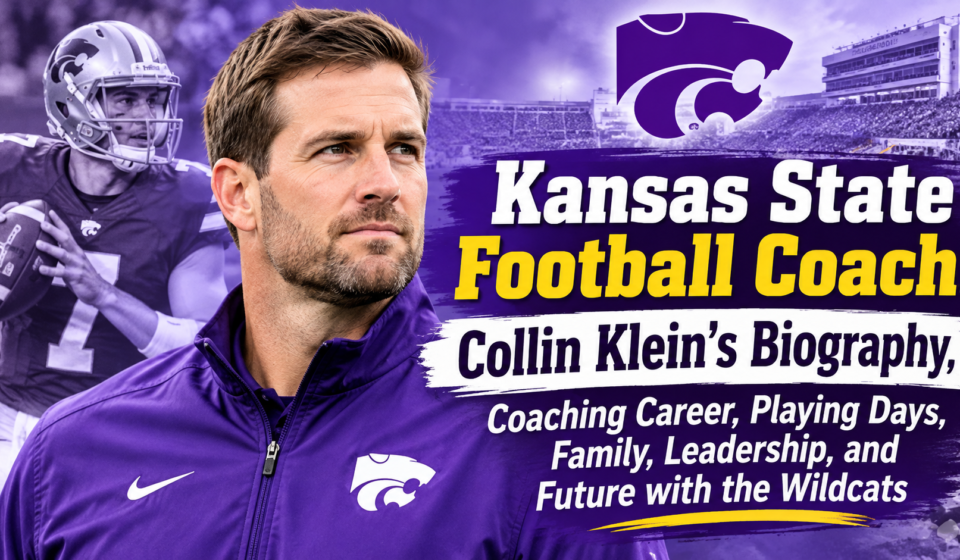
Kansas State Football Coach: Collin Klein’s Biography, Coaching Career, Playing Days, Family, Leadership, and Future with the Wildcats

The Kansas State football coach plays an important role in shaping the identity, performance, and future of the Kansas State Wildcats. College football supporters are always interested in learning about the person leading their favorite team, including their background, playing experience, coaching philosophy, achievements, and plans for building a successful program. At Kansas State University, football has a proud tradition, and the head coach carries the responsibility of maintaining that tradition while preparing the team for new challenges.
The current head football coach of the Kansas State Wildcats is Collin Klein. He was appointed as the program’s head coach on December 4, 2025, and began his first season in the position in 2026. His appointment attracted considerable attention because he is not simply a new coach joining the program. He is also a former Kansas State quarterback, a respected member of the university’s football history, and someone who understands the culture of the Wildcats from personal experience. Kansas State University Athletics+1
Klein’s journey from college football player to offensive coordinator and eventually head coach makes his story especially interesting. His experience at Kansas State, Northern Iowa, and Texas A&M helped prepare him for the responsibility of leading a major college football program. For Wildcats supporters, his appointment represents a connection between the university’s successful past and its ambitions for the future.
This article explores the Kansas State football coach’s biography, early life, education, playing career, coaching experience, family background, leadership approach, coaching staff, football achievements, and future expectations.
Who Is the Current Kansas State Football Coach?
Collin Klein is the current head football coach of the Kansas State Wildcats. He became the program’s thirty-sixth head coach after being appointed in December 2025. His first season as head coach began in 2026, bringing a new chapter to the Wildcats’ football program.
Klein is a familiar name among Kansas State supporters because he previously played quarterback for the university. His performances as a player helped establish his reputation as one of the program’s memorable athletes. After completing his playing career, he remained connected to football through coaching positions, eventually returning to Kansas State as an assistant and offensive coordinator.
One of the most interesting aspects of Klein’s appointment is his understanding of the university. He knows the expectations of the supporters, the importance of the football traditions, and the pressure associated with competing in the Big 12 Conference.
As head coach, he is responsible for overseeing the entire football program. His duties include developing players, organizing practices, managing assistant coaches, recruiting talented athletes, and preparing the team for conference competition.
Collin Klein’s Early Life and Background
Collin Klein was born and raised in Loveland, Colorado. Growing up in Colorado, he developed an interest in sports and eventually became particularly involved in American football. His early experiences helped him build the discipline, competitive attitude, and determination that later became important parts of his playing and coaching careers.
Loveland provided the foundation for his development as a young athlete. Like many successful college football players, Klein spent years improving his skills, understanding the game, and preparing himself for higher levels of competition.
His early football journey eventually led him to Kansas State University. The opportunity to play college football at a major university allowed him to develop both academically and athletically while building a strong connection with the Wildcats.
His background also helps explain why his return as head coach attracted so much attention. He understands what it means to represent Kansas State because he experienced the program as a student-athlete before becoming one of its leaders.
Collin Klein’s Age and Personal Details
Collin Klein was thirty-six years old when he began his first season as Kansas State’s head coach in 2026. His relatively young age makes him one of the younger head coaches in the Football Bowl Subdivision, but his experience in college football extends well beyond his years as a head coach.
His background includes playing at Kansas State, working with quarterbacks, coordinating offenses, and coaching at another major university. These experiences have given him an understanding of different aspects of the sport.
Here is a quick overview of his background.
| Personal Detail | Information |
|---|---|
| Full Name | Collin Klein |
| Profession | Football Coach |
| Current Position | Kansas State Head Coach |
| Birthplace | Loveland, Colorado |
| College | Kansas State University |
| Playing Position | Quarterback |
| Coaching Experience | More than a decade |
| First Season as Head Coach | 2026 |
| Previous School | Texas A&M |
| Wife | Shalin Klein |
| University | Kansas State |
These details help explain why Klein is considered an important figure in the Wildcats’ football program. His connection with the university goes back to his student-athlete days, and his professional career has continued to develop through different coaching responsibilities. Kansas State University Athletics+1
Collin Klein’s Education at Kansas State University
Education played an important role in Collin Klein’s development. He attended Kansas State University, where he studied while competing as a quarterback for the Wildcats.
Klein graduated in 2011 with a bachelor’s degree in Business Financial Services and Controllership. His academic experience provided him with knowledge beyond football and helped prepare him for responsibilities outside the playing field.
He later continued his education and earned a master’s degree in Academic Advising from Kansas State in 2019. This additional qualification reflects his continued connection with education and student development.
His academic background is particularly relevant to his coaching career. College football coaches work in an environment where athletic development and academic responsibilities must operate together. They need to understand the demands placed on student-athletes and help them balance their commitments.
Klein’s experience as a former Kansas State student and graduate gives him a personal understanding of the university’s academic environment. It also helps him appreciate the importance of developing athletes as students and individuals, rather than focusing exclusively on football performance.
Collin Klein’s College Football Playing Career
Before becoming the Kansas State football coach, Collin Klein established himself as an important quarterback in the university’s football history. He played for the Wildcats from 2008 through 2012 and became particularly recognized for his leadership and ability to contribute to the offense.
Quarterbacks have a special responsibility in college football. They must understand defensive formations, communicate with teammates, make quick decisions, and execute offensive plays under pressure. Klein developed these abilities throughout his playing career.
His playing style combined passing ability with mobility. He could contribute through the air and create opportunities with his legs, making him a challenging opponent for defensive teams.
His performances helped Kansas State achieve important results during his college years. The team competed for conference success and earned opportunities to participate in major postseason games.
The experience of playing at Kansas State also gave him an understanding of the pressure associated with representing the university. Years later, this experience became an important part of his identity as a coach.
Collin Klein and the Kansas State Wildcats’ Successful Era
Klein’s playing career became especially memorable during the Wildcats’ successful campaign in 2012. Kansas State produced an outstanding season and captured the Big Twelve Conference championship.
That campaign helped establish Klein as one of the most recognizable players in the program’s modern history. His performances demonstrated leadership, toughness, and an ability to make important plays in difficult situations.
Kansas State’s success also created opportunities for national recognition. The Wildcats finished the regular season with an impressive record and earned a place in the Fiesta Bowl.
The team’s achievements during that period remain an important part of the program’s history. Klein was closely associated with that success because of his role as quarterback and his contribution to the team’s offensive identity.
For supporters, his return as head coach carries special meaning. They remember him as a player who represented the university during an important period, and now they have an opportunity to watch him lead the program from the sidelines.
Collin Klein’s Heisman Trophy Recognition
One of the most significant achievements of Klein’s playing career was becoming a finalist for the Heisman Trophy in 2012. The award recognizes outstanding individual performances in college football and is one of the sport’s most prestigious honors.
His nomination reflected the impact he made during Kansas State’s successful season. As quarterback, he contributed through passing, rushing, and leadership, making him one of the most important players in the country that year.
Heisman recognition can influence how a player is remembered long after their college career ends. For Klein, becoming a finalist strengthened his reputation and helped establish his place in Kansas State football history.
Although individual awards are important, his playing career was also defined by team achievements. Winning the Big Twelve championship and helping the Wildcats reach the Fiesta Bowl were major accomplishments that remain connected to his legacy.
Collin Klein’s Coaching Career Before Becoming Head Coach
After completing his playing career, Klein decided to remain involved in football through coaching. His transition from quarterback to coach was a natural development because he already understood offensive systems, player responsibilities, and the importance of preparation.
His early coaching experience included administrative and recruiting responsibilities at Kansas State. These positions allowed him to understand how a college football program operates beyond the playing field.
He later worked at Northern Iowa as a quarterbacks coach. This opportunity helped him gain additional experience working directly with players and developing their understanding of offensive football.
His career eventually brought him back to Kansas State, where he continued working with quarterbacks and later became involved in offensive coordination.
Every coaching position contributed to his development. Instead of moving directly into a leadership role, Klein gained experience in different areas of college football, helping him understand the responsibilities involved in building and managing a team.
Collin Klein at Northern Iowa
Northern Iowa was an important stop in Klein’s early coaching journey. He joined the program in 2016 as a quarterbacks coach, giving him an opportunity to develop his coaching abilities outside Kansas State.
Working with quarterbacks requires patience, technical knowledge, and strong communication. Coaches must help players understand defensive coverage, footwork, passing mechanics, decision-making, and offensive responsibilities.
Klein’s experience as a former college quarterback gave him a useful foundation for this work. He had personally experienced the challenges of playing the position and could use that knowledge when teaching younger athletes.
His time at Northern Iowa also provided exposure to a different football environment. Working outside his former university helped him expand his professional experience and prepare for future coaching opportunities.
Collin Klein Returns to Kansas State as an Assistant Coach
Klein returned to Kansas State in 2017 as the quarterbacks coach. His return was an important moment because he had the opportunity to contribute to the same football program where he had built his playing reputation.
As quarterbacks coach, his primary responsibility involved developing players at one of the most important positions on the field. He worked on passing mechanics, understanding defensive systems, decision-making, and leadership.
His previous playing experience gave him a useful connection with the athletes he coached. He understood the pressure quarterbacks face and the preparation required to perform consistently.
During his time at Kansas State, Klein continued to take on greater responsibilities. He became a co-offensive coordinator in 2018 while maintaining his involvement with the quarterback position.
His continued growth eventually led to his appointment as the Wildcats’ offensive coordinator, creating another important chapter in his coaching career. Kansas State University Athletics+1
Collin Klein as Kansas State Offensive Coordinator
Klein served as Kansas State’s offensive coordinator and quarterbacks coach during the 2022 and 2023 seasons. This role represented a major step forward because he became responsible for helping organize the team’s overall offensive approach.
An offensive coordinator works closely with the head coach and other assistants to develop a game plan. The position requires an understanding of formations, passing concepts, rushing strategies, opponent tendencies, and situational football.
Klein’s experience as a quarterback helped him understand how offensive systems operate from the player’s perspective. He could evaluate how different plays worked in practice and consider how players might respond to defensive pressure.
His work during this period contributed to an important era for Kansas State. The Wildcats won the Big Twelve championship in 2022, giving the program another major achievement.
The team’s offensive production during that campaign was also impressive. The Wildcats established strong rushing and overall offensive numbers, demonstrating the effectiveness of their system.
For Klein, the experience was valuable preparation for eventually becoming a head coach. It allowed him to develop leadership skills and gain experience managing a larger portion of the football program.
The Big Twelve Championship and Klein’s Coaching Reputation
Kansas State’s Big Twelve championship in 2022 was one of the major highlights of Klein’s coaching career before becoming head coach.
Championship success requires contributions from the entire program. Offensive coaches, defensive coaches, special teams personnel, players, and support staff must work together throughout a demanding season.
As offensive coordinator, Klein played an important role in developing the Wildcats’ offensive approach. The team demonstrated its ability to produce points, control possession, and compete against strong conference opponents.
The championship also helped reinforce the importance of Kansas State’s football culture. The university has built a reputation for competitive teams, disciplined performances, and passionate supporters.
For Klein, being part of that success as a coach created another connection with the program’s history. He had already experienced important achievements as a player, and now he was helping the Wildcats succeed from a different position.
Collin Klein Joins Texas A&M
After his successful period at Kansas State, Klein moved to Texas A&M in 2024. He joined the Aggies as offensive coordinator and quarterbacks coach, giving him an opportunity to work in another major college football environment.
Texas A&M is a prominent program with substantial resources, passionate supporters, and high expectations. Coaching there provided Klein with additional experience in recruiting, player development, and offensive planning.
His responsibilities included overseeing the offensive system and working directly with quarterbacks. He needed to understand the team’s personnel, develop an effective strategy, and prepare players for competitive SEC football.
Moving to another university also allowed him to experience a different conference environment. The Southeastern Conference is known for its competitive football programs and demanding schedules.
His work at Texas A&M expanded his professional background and helped prepare him for a future leadership opportunity.
Collin Klein’s Texas A&M Coaching Experience
Klein’s time at Texas A&M included the responsibility of developing an offense capable of competing against some of the strongest teams in college football.
The offensive coordinator position requires more than designing plays. Coaches must evaluate player abilities, identify weaknesses in opposing defenses, and adjust strategies according to the situation.
Quarterback development was another important responsibility. Klein needed to help players improve their understanding of the game and make effective decisions during competitive situations.
Texas A&M’s environment also provided exposure to the expectations associated with a major SEC program. The experience strengthened his understanding of managing talent and preparing a team for high-pressure contests.
His coaching experience at Texas A&M ultimately became an important part of his professional preparation before returning to Manhattan as Kansas State’s head coach.
Why Collin Klein Returned to Kansas State
Klein’s return to Kansas State was significant because of his personal and professional connection with the university. He had played there, graduated there, coached there, and helped the Wildcats win a conference championship.
When the head coaching opportunity became available, his familiarity with the program made him an attractive candidate. His experience also meant he understood many of the expectations associated with the position.
For supporters, his appointment represented a return of a former Wildcat who had already contributed to the program’s success.
His background provides a connection between different generations of Kansas State football. Former teammates, alumni, students, and current players can all recognize his relationship with the university.
The decision also demonstrated the program’s interest in leadership that understands its traditions while bringing fresh ideas and modern coaching experience.
Collin Klein’s Appointment as Kansas State Head Coach
Kansas State appointed Collin Klein as its thirty-sixth head football coach on December 4, 2025. The announcement created excitement among Wildcats supporters because the university selected a former player with a strong history of involvement in the program.
His appointment marked the beginning of a new chapter for Kansas State football. Klein entered the position with experience as a quarterback, quarterbacks coach, offensive coordinator, and assistant at multiple universities.
Taking over a major college football program is a significant responsibility. A head coach must coordinate several departments, manage a large group of athletes, oversee recruiting, and make important decisions throughout the season.
Klein’s first season as head coach began in 2026. His immediate challenge was to establish his leadership approach and help the Wildcats compete in a demanding Big Twelve environment.
The university’s official coaching biography identifies him as the first former Kansas State letterwinner to lead the program since Ellis Rainsberger served from 1975 through 1977. Kansas State University Athletics+1
What Happened to Former Kansas State Coach Chris Klieman?
Before Collin Klein became head coach, Kansas State was led by Chris Klieman. Klieman had an important role in developing the Wildcats into a competitive Big Twelve program and helped the university achieve significant football success.
Chris Klieman became Kansas State’s head coach in 2019. During his tenure, he worked to establish a disciplined football program and continued the competitive tradition associated with the Wildcats.
His leadership included important achievements, including the Big Twelve championship in 2022. The program also participated in several postseason bowl games during his time in charge.
When the coaching position changed after the 2025 season, Klein became the new leader of the program. His appointment was especially meaningful because he had previously worked under the Kansas State football system and understood its culture.
Collin Klein’s Coaching Philosophy
A successful football coach needs a clear philosophy that influences how players practice, prepare, and compete. Klein’s background as a quarterback and offensive coordinator provides an important foundation for his coaching approach.
His experience suggests a strong understanding of offensive football, particularly quarterback development and creating balanced offensive opportunities. A coach with quarterback experience can often explain the technical and mental demands of the position in a practical way.
Teamwork and communication are also important parts of a successful football program. Players must understand their responsibilities and trust their teammates, especially when facing difficult opponents.
Klein’s challenge is to bring these principles together across the entire team. A head coach cannot focus exclusively on offense because defensive performance, special teams, player development, and preparation are equally important.
Collin Klein’s Offensive Strategy
Offensive strategy is one of the areas where Klein has significant professional experience. His previous responsibilities as an offensive coordinator and quarterbacks coach have helped him develop an understanding of how to organize a productive offense.
A successful offense needs balance. Teams must be capable of moving the football through passing plays and running plays, making it difficult for opponents to predict what will happen next.
Quarterback decisions are central to this process. Players need to recognize defensive formations, understand their options, and make quick decisions when the defense changes its approach.
Klein’s playing background also gives him a different perspective when developing offensive strategies. He knows that a play must be understandable to the athletes executing it, not simply look impressive on a coaching board.
The Importance of Quarterback Development
The quarterback position is one of the most important responsibilities in college football. Quarterbacks influence offensive rhythm, communication, decision-making, and the ability to respond when a game becomes difficult.
As a former quarterback, Klein understands the pressure associated with leading an offense. He experienced the responsibilities of the position during his own playing career and later coached other quarterbacks at Kansas State and Texas A&M.
Quarterback development involves several areas. Players must improve passing accuracy, footwork, defensive recognition, timing, and communication with their teammates.
Coaches also need to help quarterbacks develop confidence without encouraging unnecessary risks. Knowing when to attempt a difficult pass and when to protect possession can make a significant difference.
For Kansas State, developing reliable quarterback play is an important part of building a competitive offense under Klein’s leadership.
How Collin Klein Builds Relationships With Players
Relationships between coaches and players can influence the overall environment of a football program. Athletes perform better when they understand expectations, receive useful feedback, and feel that their coaches are invested in their development.
A head coach must communicate clearly with players while maintaining appropriate standards. Discipline, accountability, and mutual respect are important for building a strong team culture.
Klein’s experience as a former Kansas State athlete gives him an understanding of the university’s football environment. He knows what players experience during practices, road trips, conference games, and academic responsibilities.
His background in coaching different positions and working at multiple universities also provides a wider perspective on player development.
Building strong relationships takes time, especially when a coaching staff is working with a roster that includes returning players and new transfers. Consistency in communication can help create a positive environment.
Kansas State Football Coaching Staff Under Collin Klein
A head coach does not work alone. College football programs depend on a group of assistants, coordinators, recruiting specialists, and support personnel who contribute to different areas of the team.
Klein’s 2026 coaching staff includes several experienced football professionals. Their responsibilities cover offensive development, defensive preparation, special teams, strength training, and player recruitment.
The offensive coordinator helps organize the attacking system, while the defensive coordinator oversees strategies designed to stop opposing teams. Position coaches work directly with specific groups of athletes.
The support staff also plays an important role. Recruiting personnel identify potential players, while the general manager helps manage roster planning and related program operations.
Here are some of the key names listed on the official Kansas State football coaching staff.
| Coach | Position |
|---|---|
| Collin Klein | Head Coach |
| Thad Ward | Associate Head Coach and Wide Receivers |
| Sean Gleeson | Offensive Coordinator |
| Jordan Peterson | Defensive Coordinator and Defensive Backs |
| Stanton Weber | Special Teams Coordinator |
| Christian Ellsworth | Quarterbacks |
| Cory Patterson | Running Backs |
| Brian Lepak | Tight Ends |
| Mike Schmidt | Offensive Line |
| Nick Toth | Linebackers |
| Buddy Wyatt | Defensive Line |
The coaching structure allows the Wildcats to divide responsibilities while maintaining a common football philosophy. Each coach contributes to preparing players for competition. Kansas State University Athletics+1
Sean Gleeson and the Kansas State Offense
Sean Gleeson serves as Kansas State’s offensive coordinator under Klein. His responsibility is to help organize the offense and develop strategies that allow the Wildcats to move the football effectively.
The offensive coordinator works closely with the head coach, quarterbacks, and other offensive assistants. Planning includes evaluating opposing defenses, designing plays, and identifying opportunities to take advantage of defensive weaknesses.
A productive offense requires cooperation between several position groups. The offensive line must protect the quarterback, running backs need to find open spaces, and receivers must execute their routes effectively.
For Kansas State, the offensive coaching group has an important role in developing consistency throughout the season.
Jordan Peterson and Defensive Leadership
Jordan Peterson serves as Kansas State’s defensive coordinator and defensive backs coach. His role is essential because defensive performance can determine whether the Wildcats remain competitive against strong conference opponents.
The defensive coordinator evaluates opposing offenses and develops strategies to stop their progress. This includes studying quarterback tendencies, running formations, passing combinations, and individual player strengths.
Defensive backs must be prepared to cover receivers, defend deep passes, and support the team against running plays. Their communication is particularly important because mistakes in the secondary can create opportunities for opponents.
A strong defensive system requires teamwork across the entire unit. Defensive linemen, linebackers, and defensive backs must understand how their responsibilities connect.
Special Teams and the Role of Stanton Weber
Special teams are sometimes overlooked when supporters discuss football strategy, but they can influence the outcome of close games.
Stanton Weber serves as Kansas State’s special teams coordinator. His responsibilities include preparing the kicking game, punt coverage, kickoff returns, and other specialized situations.
Special teams can create important scoring opportunities. A successful return can provide an offense with favorable field position, while a reliable kicker can help secure points during difficult possessions.
Punting and coverage are also important because they influence where the opposing team begins its offensive drive.
For a program competing in a demanding conference, strong special teams can provide an advantage in games where offensive and defensive performances are closely matched.
Kansas State Football Culture and Tradition
Kansas State football has a long history of building strong connections with its university community. Supporters follow the Wildcats through conference games, postseason appearances, recruiting announcements, and other program developments.
The university’s football identity is closely associated with Manhattan, Kansas, where the team plays its home games at Bill Snyder Family Stadium.
The atmosphere at home games reflects the enthusiasm of students, alumni, families, and long-time supporters. Fans wear purple, participate in traditions, and create an energetic environment for the team.
For Klein, maintaining this culture is an important responsibility. His personal history with the university gives him an understanding of why supporters care deeply about the program.
Bill Snyder Family Stadium and the Wildcats’ Home Advantage
Bill Snyder Family Stadium is the home of the Kansas State Wildcats. Located in Manhattan, Kansas, the stadium has become an important part of the university’s athletic identity.
The stadium provides a home environment where supporters gather to watch the Wildcats compete. Its purple atmosphere, university traditions, and passionate fan base make it a recognizable location in college football.
Home-field advantage can influence football performance in several ways. Players are familiar with the environment, supporters provide encouragement, and visiting teams must adjust to the atmosphere.
For Klein, home games are important opportunities to connect the team with its supporters. Strong performances at the stadium can help establish confidence and create excitement throughout the university community.
Kansas State Football and the Big Twelve Conference
Kansas State competes in the Big Twelve Conference, which includes several established college football programs. Conference competition is a major part of the Wildcats’ season and creates challenges for the coaching staff.
The Big Twelve features teams with different playing styles and offensive systems. Coaches must prepare for opponents that can emphasize passing, rushing, defensive pressure, or a balanced approach.
Klein’s experience at Kansas State gives him familiarity with the conference. He understands the competitive environment and the importance of preparing consistently throughout the season.
Conference success also requires depth. Teams must be capable of handling injuries, difficult road games, and demanding stretches of the schedule.
For Kansas State supporters, the Big Twelve remains an important measure of the program’s competitiveness.
Collin Klein’s First Season as Kansas State Head Coach
The 2026 season represents a major milestone in Klein’s professional career because it is his first campaign as a head coach.
Moving from offensive coordinator to head coach involves a significant change in responsibility. Instead of focusing mainly on offensive development, he must oversee every part of the program.
The first season also provides an opportunity to establish expectations. Players must become familiar with the new leadership structure, while coaches work together to implement their approach.
Kansas State’s 2026 season has included both encouraging performances and difficult results. The Wildcats entered November facing challenges in Big Twelve competition, making the final part of the campaign an important period for evaluating the team’s progress.
The transition also involves building a foundation for future seasons. Recruiting, player development, and staff organization will remain important priorities as Klein continues his work in Manhattan.
Kansas State’s Performance During the 2026 Season
The 2026 season has been a learning experience for Kansas State under its new head coach. The Wildcats have faced several competitive opponents and experienced the challenges associated with introducing a new coaching direction.
The team’s performances have included important offensive contributions, but consistency has been difficult to maintain. Injuries and roster changes have also influenced the team’s ability to perform at its best.
Following the November twenty-first defeat against Arizona, Kansas State stood at four wins and seven losses overall, with one conference victory and seven conference defeats. Arizona won the game thirty-five to twenty-eight in overtime after recovering from an eleven-point fourth-quarter deficit. Bring On The Cats+1
For Klein, these results provide an opportunity to evaluate the roster and identify areas that need improvement. The coaching staff must understand what worked, what failed, and how the team can become more consistent.
The Impact of Roster Changes on Kansas State Football
Roster management has become an increasingly important part of modern college football. Coaches must evaluate returning athletes, incoming high school recruits, and transfer players when building a competitive team.
Kansas State’s roster underwent considerable changes before the 2026 campaign. The official football media information reported fifty-eight newcomers, including high school recruits and transfers.
Such changes can create opportunities while also introducing challenges. New players need time to understand the team’s system, develop relationships with teammates, and become comfortable with the coaching staff.
A large number of newcomers can also influence team chemistry. Coaches must identify players who can contribute immediately while developing others for future seasons.
Klein’s ability to manage these changes will be an important part of his long-term success at Kansas State.
The Transfer Portal and Collin Klein’s Recruiting Strategy
The transfer portal has changed how college football programs build their rosters. Coaches can now recruit experienced athletes from other universities, giving teams additional opportunities to strengthen positions that need improvement.
For Klein, the transfer portal represents an important part of roster management. He must evaluate players according to their ability, experience, academic situation, and suitability for the Wildcats’ football system.
Recruiting through the portal also requires careful planning. Adding talented players is useful, but the coaching staff must consider how newcomers will fit into the existing roster.
High school recruiting remains equally important. Developing young athletes over several seasons can create stability and help the program establish a consistent identity.
A balanced recruiting approach can help Kansas State build a deeper roster and compete more effectively in the Big Twelve.
Collin Klein’s Relationship With Kansas State Supporters
Supporters play a major role in college football. They attend games, follow recruiting developments, discuss coaching decisions, and provide financial and emotional support for their universities.
Klein’s relationship with Kansas State supporters is particularly interesting because he previously represented the Wildcats as a player. His history gives him a connection with fans who remember his performances during the successful seasons of his playing career.
However, being a former player does not automatically guarantee success as a head coach. Supporters will ultimately judge his leadership through team development, competitive performances, recruiting, and long-term achievements.
Maintaining open communication with the university community can also help build trust. Coaches who understand the importance of university traditions often have an opportunity to create strong connections with supporters.
How Collin Klein Handles Pressure as a Head Coach
College football coaching involves significant pressure. Every game attracts attention, and important decisions are often discussed by supporters, journalists, and former players.
A head coach must remain focused when results are disappointing. Losing games can create frustration, but coaches need to identify practical solutions rather than allowing pressure to influence every decision.
Klein’s previous coaching experience gives him an understanding of the competitive environment. He has worked with different programs and experienced the expectations associated with major college football.
The transition into a head coaching role, however, brings additional responsibilities. He must manage the entire team, communicate with university leadership, and make decisions that influence the future of the program.
His ability to respond to difficult situations will be an important part of establishing his reputation.
What Makes Collin Klein Different From Other College Coaches?
One distinguishing feature of Klein’s background is his connection with Kansas State. He is a former quarterback who returned to the university after developing his coaching career elsewhere.
This connection provides a personal understanding of the program’s history and traditions. He knows the expectations associated with wearing the Wildcats uniform and representing the university.
Another important factor is his offensive experience. His work with quarterbacks and offensive systems has given him a detailed understanding of how teams organize their attacking strategies.
He also brings experience from Texas A&M, where he worked in a different conference environment and developed his professional background.
These experiences give him several useful perspectives, although his success will ultimately depend on how effectively he brings them together as a head coach.
Collin Klein’s Future Goals at Kansas State
Building a successful football program takes time. A head coach must establish a clear direction, develop a strong roster, and create an environment where players can improve throughout their college careers.
One of Klein’s important goals will be improving Kansas State’s consistency in conference competition. The Wildcats need to compete effectively against established Big Twelve programs and become more reliable in challenging situations.
Recruiting will also influence the future of the program. Bringing talented athletes to Manhattan and helping them develop can strengthen the team over several seasons.
Another important objective is building a balanced team. Successful programs need productive offenses, disciplined defenses, reliable special teams, and sufficient depth to handle difficult stretches of the schedule.
For Kansas State supporters, the long-term expectation is to see a team that regularly competes for conference honors and postseason opportunities.
Can Collin Klein Lead Kansas State to Another Big Twelve Championship?
Winning a conference championship is a major goal for any competitive college football program. Kansas State has already experienced championship success, and supporters naturally hope to see the Wildcats return to that level.
Klein has experience contributing to a championship-winning team as both a player and an offensive coordinator. His connection with the program’s successful periods provides useful experience.
However, winning another championship will require consistent improvement across the entire roster. Recruiting, coaching, player development, and performance against conference opponents will all influence the team’s chances.
The coaching staff must also develop a strong approach to close games. Many important conference contests are decided by a small number of plays, making discipline and decision-making essential.
Although championship ambitions are understandable, the immediate priority is establishing a competitive foundation and improving the team’s performance.
What Kansas State Needs to Improve Under Collin Klein
Every coaching transition creates opportunities for evaluation. Kansas State’s staff needs to identify the areas where the team can become more effective.
Offensive consistency is one important consideration. The Wildcats need to create productive possessions, avoid turnovers, and make better use of scoring opportunities.
Defensive improvement is equally important. Stopping opponents on important downs, defending the passing game, and limiting explosive plays can help the team remain competitive.
Special teams also deserve attention. Effective kicking, reliable coverage, and smart decisions during returns can influence close games.
Finally, player availability and roster depth remain essential. A successful team needs athletes who can contribute when starters are unavailable.
These improvements can help Klein develop a more consistent football program over the coming seasons.
The Importance of Recruiting for the Wildcats’ Future
Recruiting is one of the most demanding responsibilities for a college football head coach. Programs compete for talented athletes who can contribute to the team’s success while developing academically and personally.
Kansas State must compete with other Big Twelve universities and major college football programs when recruiting players.
The coaching staff needs to explain why Manhattan is an attractive destination for student-athletes. Facilities, coaching relationships, playing opportunities, academic programs, and the university environment can all influence recruiting decisions.
Klein’s experience as a former player can be useful when communicating with potential recruits. He can explain his own experience at Kansas State and discuss the opportunities available within the program.
Long-term recruiting success requires patience. Not every recruit will become an immediate starter, but developing talented athletes over several seasons can create a strong foundation.
Collin Klein’s Leadership Beyond the Football Field
A college football head coach has responsibilities that extend beyond game preparation. Coaches influence the development of student-athletes and help them understand the importance of discipline, teamwork, and accountability.
Players must balance academic work, training, travel, and competition. Managing these responsibilities can be challenging, particularly during the most demanding parts of the season.
Klein’s educational background gives him an additional connection with the academic side of university life. His master’s degree in Academic Advising is particularly relevant to understanding student development.
A strong college football program should encourage players to prepare for life beyond their athletic careers. Education, professional development, and personal responsibility remain important regardless of how successful someone becomes in football.
This broader responsibility is an important part of what makes college coaching different from many other professional sports roles.
Why Kansas State Fans Are Interested in Collin Klein’s Biography
Fans often want to understand the background of a coach before evaluating his performance. They are interested in where he grew up, how he became involved in football, what he achieved as a player, and how he developed into a leader.
Klein’s biography is particularly interesting because his connection with Kansas State goes back many years. He experienced the university as a student, quarterback, assistant coach, and offensive coordinator before becoming its head football coach.
His journey provides several different perspectives on the program. He knows what players experience on the field and understands the preparation required behind the scenes.
For supporters, learning about his biography also helps explain why the university selected him to lead the Wildcats into a new era.
Where Can Fans Follow Kansas State Football Coach Updates?
Supporters who want reliable information about Klein and the Wildcats should follow official university athletics announcements.
Kansas State Athletics publishes coaching news, staff updates, interviews, player information, and football-related announcements.
The university’s football website also provides access to team statistics, schedules, rosters, and coaching biographies.
Sports news organizations can provide additional coverage, including game analysis, press conference reports, and discussions about recruiting.
Following official sources is particularly important when checking coaching appointments, staff changes, and player information because outdated reports can continue circulating online.
Frequently Asked Questions About the Kansas State Football Coach
Who Is the Current Kansas State Football Coach?
Collin Klein is the current head football coach of the Kansas State Wildcats. He was appointed in December 2025 and began his first season as head coach in 2026.
How Old Is Collin Klein?
Collin Klein was thirty-six years old when he began his first season as Kansas State’s head coach in 2026.
Where Was Collin Klein Born?
Collin Klein was born in Loveland, Colorado. He attended Kansas State University and later developed his coaching career at several college football programs.
Did Collin Klein Play Football at Kansas State?
Yes. Klein played quarterback for Kansas State from 2008 through 2012. He became one of the program’s recognizable players and was a Heisman Trophy finalist in 2012.
Was Collin Klein a Heisman Trophy Finalist?
Yes. He received Heisman Trophy finalist recognition during the 2012 college football season after an outstanding campaign as the Wildcats’ quarterback.
Who Was the Kansas State Football Coach Before Collin Klein?
Chris Klieman was the previous Kansas State head coach. He led the Wildcats beginning in 2019 and helped the program achieve important conference success.
When Did Collin Klein Become Kansas State’s Head Coach?
Kansas State announced Klein’s appointment on December 4, 2025. He officially began his first season as head coach in 2026.
Did Collin Klein Work at Texas A&M?
Yes. Klein served as offensive coordinator and quarterbacks coach at Texas A&M during the 2024 and 2025 seasons before returning to Kansas State.
Is Collin Klein Married?
Yes. Collin Klein is married to Shalin Klein, who also attended Kansas State and played women’s basketball for the university.
Does Collin Klein Have Children?
Yes. Collin and Shalin Klein have four children: three sons named Beric, Rhett, and Trek, and a daughter named Briar.
What Is Collin Klein’s Educational Background?
Klein graduated from Kansas State in 2011 with a bachelor’s degree in Business Financial Services and Controllership. He later earned a master’s degree in Academic Advising in 2019.
What Position Did Collin Klein Play?
He played quarterback during his college football career. His experience at the position later helped him develop as a quarterbacks coach and offensive coordinator.
Is Collin Klein the First Kansas State Former Player to Become Head Coach?
He is the first former Kansas State letterwinner to become the program’s head coach since Ellis Rainsberger served in that position from 1975 through 1977.
What Conference Does Kansas State Play In?
Kansas State competes in the Big Twelve Conference, which features several competitive college football programs.
Who Is the Offensive Coordinator at Kansas State?
Sean Gleeson serves as the offensive coordinator on Collin Klein’s 2026 coaching staff.
Final Thoughts on the Kansas State Football Coach
The story of the Kansas State football coach is closely connected to the history and future of the Wildcats. Collin Klein’s journey from a talented college quarterback to an experienced offensive coordinator and eventually head coach is an important part of his professional biography.
His achievements as a player, including his Heisman Trophy finalist recognition and involvement in Kansas State’s successful 2012 campaign, helped establish his reputation. His later coaching experience at Kansas State, Northern Iowa, and Texas A&M provided valuable preparation for leading a major college football program.
Stay in touch to get more updates & news on Magazine Dispatch!
