



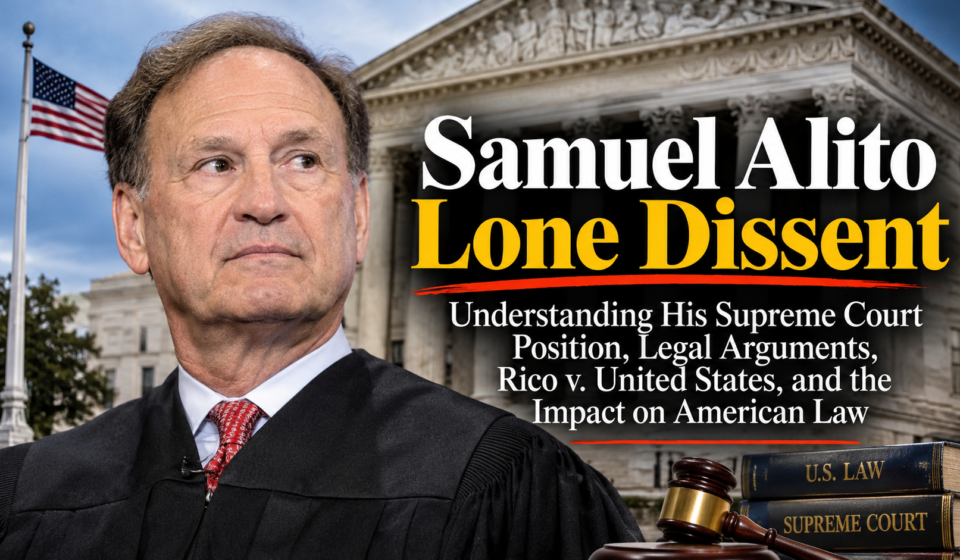
Samuel Alito Lone Dissent: Understanding His Supreme Court Position, Legal Arguments, Rico v. United States, and the Impact on American Law

The phrase Samuel Alito lone dissent has attracted attention among people following the United States Supreme Court, particularly after Justice Samuel Alito found himself standing alone against the Court’s decision in Rico v. United States. His disagreement brought renewed attention to his judicial philosophy, his interpretation of federal sentencing law, and the importance of dissenting opinions in America’s highest court.
A lone dissent occurs when a Supreme Court justice disagrees with the majority and no other justice joins that position. Although the dissent does not determine the outcome of a case, it can provide an important alternative interpretation of the law. It can also highlight legal questions that deserve further discussion.
The Samuel Alito lone dissent is particularly interesting because Alito is generally associated with the Supreme Court’s conservative justices. However, his position in Rico v. United States demonstrated that justices can disagree even when they share broadly similar judicial philosophies. His argument focused on federal supervised release, the consequences of a defendant avoiding supervision, and the sentencing judge’s authority.
Understanding the Samuel Alito lone dissent requires looking beyond the headline. It involves examining the case, the legal arguments presented by the justices, the meaning of supervised release, and the broader role of individual opinions in the American judicial system.
Who Is Samuel Alito?
Samuel Alito is an Associate Justice of the Supreme Court of the United States. He has served on the nation’s highest court since January 2006, following his nomination by President George W. Bush and confirmation by the United States Senate. Over the years, he has become an influential figure in American constitutional law, particularly in cases involving individual rights, federal authority, religious liberty, and criminal justice.
Alito is widely recognized for his conservative judicial philosophy and his attention to the wording of statutes and constitutional provisions. His opinions often emphasize the importance of historical traditions, legal precedent, and the proper boundaries of government power. However, his judicial approach cannot be reduced to a simple political label. Individual cases can raise legal questions that lead him to disagree with colleagues who otherwise share his general philosophy.
The Samuel Alito lone dissent in Rico v. United States illustrates this point. Rather than joining the majority, Alito developed a separate argument about how a federal sentencing judge could account for criminal conduct committed while a defendant was avoiding supervision. His position demonstrated his willingness to challenge the reasoning of the majority even when the disagreement involved a relatively technical question of criminal law.
His role in this decision also demonstrates why Supreme Court opinions deserve attention beyond their final voting results. A justice’s individual reasoning can reveal important differences in how judges understand statutory language, judicial discretion, and the responsibilities of federal courts.
What Does Samuel Alito Lone Dissent Mean?
The expression Samuel Alito lone dissent describes a situation in which Justice Samuel Alito is the only Supreme Court justice to formally disagree with the Court’s majority in a particular decision. A dissenting opinion explains why a justice believes the majority reached the wrong legal conclusion or applied the law incorrectly.
The Supreme Court generally decides cases through majority opinions. When several justices agree on the outcome and the reasoning, one justice is usually assigned to write the Court’s opinion. Other justices can join that opinion, write separate concurring opinions, or disagree through dissenting opinions. A lone dissent occurs when only one justice takes the dissenting position.
In Rico v. United States, Justice Neil Gorsuch wrote the majority opinion, which was joined by Chief Justice John Roberts and Justices Clarence Thomas, Sonia Sotomayor, Elena Kagan, Brett Kavanaugh, Amy Coney Barrett, and Ketanji Brown Jackson. Alito was the only justice who dissented. The decision was therefore an eight-to-one ruling. LII / Legal Information Institute+1
This division made the Samuel Alito lone dissent especially interesting. The Court’s conservative and liberal members joined the same majority opinion, demonstrating that the legal issue did not follow the ideological divisions commonly associated with Supreme Court decisions.
A lone dissent does not mean that the dissenting justice has no influence or that the argument is automatically unreasonable. It simply means that the justice’s interpretation did not persuade enough colleagues to become part of the Court’s controlling decision. The dissent remains part of the official judicial record and can be examined by lawyers, judges, researchers, and members of the public.
Rico v. United States: The Case Behind the Lone Dissent
The central case associated with the Samuel Alito lone dissent is Rico v. United States. The dispute concerned Isabel Rico, a federal criminal defendant who had been released from prison under a period of supervised release. Her case eventually reached the Supreme Court because of a disagreement about whether disappearing from supervision automatically pauses the legal clock governing that period.
Supervised release is an important part of the American federal criminal justice system. It allows people who have completed their prison sentences to live in the community while following specific conditions imposed by a court. These conditions can include avoiding criminal activity, reporting to a probation officer, maintaining an approved residence, and complying with other restrictions.
Rico’s situation became complicated when she stopped reporting to her probation officer and moved without providing the required notification. Authorities issued a warrant, but she remained outside their supervision for several years. During that period, she committed additional state-law offenses, including a drug offense.
The dispute was not simply about whether Rico had violated the conditions of her supervised release. The important legal question was whether the period of supervised release had automatically stopped running while she was absent. If the clock had stopped, the later drug offense could potentially be treated as a violation of the federal supervision period. If it continued running, the original term had already expired before that offense occurred.
The Supreme Court examined this question through the language of the federal Sentencing Reform Act. Its decision ultimately rejected the automatic extension rule adopted by the lower appeals court. Alito disagreed with the majority’s approach to the case and wrote separately. LII / Legal Information Institute+1
The Background of Isabel Rico’s Supervised Release
Understanding the Samuel Alito lone dissent requires examining the circumstances that brought Rico before the Supreme Court. Her legal situation began after she served a federal prison sentence connected to a drug conviction. Following her imprisonment, she entered a supervised release period that required her to follow specific rules while living outside prison.
Supervised release is different from simply completing a prison sentence and returning to ordinary life without court supervision. Individuals remain subject to legal requirements, and violating those requirements can result in additional consequences. The purpose is to support reintegration while protecting public safety and ensuring compliance with the conditions established by the sentencing judge.
Rico began a forty-two-month supervised release term in December 2017. Among her obligations were avoiding illegal drugs, refraining from criminal conduct, and informing her probation officer if she changed her address. These requirements were important because they allowed the federal supervision system to maintain contact with her and monitor compliance.
In May 2018, Rico moved without notifying her probation officer. A warrant was issued for her arrest, but authorities did not locate her immediately. She remained a fugitive until January 2023. During this period, she committed several state-law offenses, including a drug crime in January 2022.
The timing of that drug offense became central to the Supreme Court dispute. Under the original schedule, Rico’s supervised release term was due to expire in June 2021. The later drug offense therefore occurred after the date on which her original supervision period should have ended.
The government argued that Rico’s decision to disappear should prevent her from benefiting from the passage of time. The legal question was whether federal law allowed the supervision period to be automatically extended because she had avoided the authorities. supremecourt.gov+1
Why the Supervised Release Dispute Became Important
The disagreement in Rico v. United States involved a legal principle that can affect many federal criminal cases. If a defendant can automatically extend a supervision period by disappearing, courts may have a broader ability to punish conduct committed after the original expiration date. If the law does not permit that automatic extension, the government must rely on the enforcement mechanisms actually provided by Congress.
The issue matters because supervised release is governed by specific federal statutes. Judges cannot simply create additional punishment whenever they believe a defendant’s behavior deserves a stronger response. They must work within the authority granted by Congress.
The government wanted the Court to recognize a rule that would prevent defendants from gaining an advantage by avoiding supervision. Its argument was connected to the broader idea of fugitive tolling, a principle that can stop a legal period from running when someone deliberately avoids legal authorities.
However, the Supreme Court had to consider whether that principle could be applied to supervised release under the statutory framework Congress created. The majority concluded that the law did not authorize the automatic extension rule advanced by the government.
Alito approached the dispute differently. He believed the Court did not need to resolve the tolling question to determine whether the district judge had acted within the authority provided by federal sentencing law. This difference in approach formed the foundation of the Samuel Alito lone dissent.
What Is Supervised Release Under Federal Law?
Supervised release is a court-ordered period of community supervision that generally follows imprisonment for a federal offense. It is designed to help individuals transition back into society while remaining accountable for their conduct.
During this period, a person may be required to meet regularly with a probation officer, maintain employment, avoid certain individuals, participate in treatment programs, and refrain from committing new crimes. The precise conditions depend on the individual’s circumstances and the sentencing judge’s order.
Federal law provides mechanisms for dealing with violations. Under the relevant provisions of Title Eighteen of the United States Code, a court may revoke supervised release when the legal requirements are satisfied. The court can impose imprisonment and, where authorized, another period of supervised release after imprisonment.
These provisions give federal judges meaningful authority. However, that authority has limits. A court must identify a valid legal basis for treating conduct as a violation and imposing additional punishment.
The Samuel Alito lone dissent highlighted a disagreement about how these rules should operate when a defendant disappears during supervision. It raised a broader question about whether the courts should interpret existing statutes flexibly to address difficult situations or follow the statutory language without adding an automatic rule that Congress did not expressly provide.
The Meaning of Fugitive Tolling
Fugitive tolling is a legal concept associated with situations in which a person deliberately avoids legal authorities. Under certain legal rules, the passage of time may be paused while someone is actively evading the process of justice.
The basic argument behind the concept is that people should not be able to benefit from deliberately making themselves unavailable. For example, a person who disappears to avoid arrest may face legal consequences that would not apply if the person had remained accessible to the authorities.
However, different legal situations have different rules. A principle that applies in one area of criminal law does not automatically apply in every other area. Courts must examine the relevant statutes, historical practices, and legal precedents before deciding whether a particular doctrine is appropriate.
In Rico v. United States, the government relied on the idea that Rico should not benefit from avoiding supervision. The Ninth Circuit had accepted an approach under which her supervised release period was treated as paused during her absence.
The Supreme Court majority rejected the automatic extension rule. It reasoned that supervised release is governed by statutory provisions that do not authorize the government to extend the term automatically simply because a defendant absconds.
This distinction is essential to understanding the Samuel Alito lone dissent. The disagreement was not about whether evading supervision is acceptable. It concerned the legal mechanism available to punish violations and whether the district judge’s sentencing decision could stand without relying on the tolling theory.
The Supreme Court’s Majority Decision
Justice Neil Gorsuch delivered the Supreme Court’s majority opinion in Rico v. United States. Seven other justices joined him, producing an eight-to-one decision in favor of Rico’s position on the automatic extension question.
The majority focused on the Sentencing Reform Act and the specific authority Congress provided to federal courts. It concluded that the statute did not create a general rule automatically extending supervised release whenever someone failed to report to a probation officer.
The Court explained that the government was asking for more than a simple administrative adjustment. An automatic extension could expose a person to additional punishment for conduct that occurred after the originally scheduled expiration of supervision. Such a rule would have significant consequences for criminal defendants and the federal sentencing system.
The majority also considered the distinction between an escaped prisoner and a person who absconds while on supervised release. An escaped prisoner may not receive credit toward a prison sentence for time spent outside custody. However, a person on supervised release remains subject to the conditions of release during the period established by the court.
According to the majority, these legal situations are not identical. The fact that someone has avoided supervision does not automatically give a federal court permission to extend the original term beyond its scheduled expiration date.
The majority emphasized that existing federal law already provides several ways to address violations. It refused to create an additional automatic extension rule that was not authorized by the statute. LII / Legal Information Institute+1
Justice Neil Gorsuch’s Reasoning
Justice Neil Gorsuch’s majority opinion was based primarily on statutory interpretation. He examined what Congress had written in the Sentencing Reform Act and whether the government could establish an automatic extension rule through judicial interpretation.
The majority’s central position was that courts must respect the boundaries of statutory authority. Even when a defendant behaves irresponsibly or deliberately avoids supervision, a judge cannot automatically add time to a sentence unless federal law permits that result.
Gorsuch also considered the practical consequences of the government’s argument. If the government could automatically pause supervised release whenever a person absconded, the length of supervision might become uncertain. Individuals could face additional punishment based on an extension that was not expressly included in the original sentencing order.
The majority recognized that avoiding supervision creates genuine enforcement problems. Nevertheless, it concluded that the responsibility for changing the statutory framework belongs to Congress rather than the judiciary.
This reasoning helps explain why the Samuel Alito lone dissent became a significant point of discussion. Alito did not accept the majority’s conclusion that the district court’s sentencing decision required the same legal analysis. He believed another route was available under existing federal sentencing rules.
Samuel Alito’s Main Argument in His Dissent
Justice Alito opened his dissent by suggesting that the case was much simpler than the majority’s opinion made it appear. He argued that the Court did not need to determine whether Rico’s supervised release period had been tolled during her absence.
His disagreement centered on the sentencing judge’s authority. According to Alito, the district judge could consider the January 2022 drug offense when determining an appropriate sentence for the violations that occurred during the original supervised release period.
This distinction is important. Alito was not necessarily arguing that the original supervised release term automatically continued running beyond its scheduled expiration date. Instead, he believed the later criminal conduct could be considered as part of the sentencing process even if it did not independently qualify as a violation of supervised release.
The federal sentencing system gives judges discretion when selecting an appropriate sentence within the boundaries of applicable law. The Sentencing Guidelines provide recommendations, but they are generally advisory rather than mandatory. Judges can sometimes impose sentences outside the recommended range when they provide an appropriate legal explanation.
Alito believed that the district judge had used this sentencing authority properly. In his view, the case did not require the Court to decide the broader tolling question because the judge had another lawful basis for imposing the sentence.
His central criticism was that the majority focused on an issue that did not need to determine the final outcome. He considered the district court’s decision valid under the available sentencing framework.
The Samuel Alito lone dissent therefore presented a different way of understanding the relationship between a defendant’s later criminal conduct and the court’s authority to impose punishment for earlier supervision violations. supremecourt.gov+1
The Difference Between Alito and the Majority
The main difference between Alito and the majority involved the legal route each believed the Court should follow. Both sides were examining the federal sentencing system, but they disagreed about how the district judge’s decision should be evaluated.
The majority concentrated on whether the January 2022 offense could legally qualify as an independent violation of supervised release. Because Rico’s original supervision term had expired before that offense occurred, the Court concluded that the Ninth Circuit could not rely on an automatic tolling rule to treat the offense as a violation.
Alito focused on another question. He believed the district judge could consider the later offense when deciding the appropriate punishment for violations that had already occurred during the original supervision period.
In other words, the majority examined whether the later offense could extend the legal period of supervision, while Alito emphasized whether that offense could inform the judge’s sentencing decision.
These approaches may sound similar, but they have important legal differences. Treating conduct as an independent violation can create consequences that depend on the conditions and duration of supervised release. Considering conduct during sentencing involves a different legal inquiry and requires the judge to remain within the authority provided by federal sentencing law.
The majority was unwilling to assume that the district court had properly used this alternative approach because the lower court had treated the later offense as an independent violation. It considered that distinction important enough to leave any harmless-error question for further consideration on remand.
The Samuel Alito lone dissent therefore highlighted a disagreement about judicial reasoning, not merely a disagreement about whether Rico’s conduct was serious.
Why Alito Called the Tolling Debate Pointless
One of the most interesting aspects of Alito’s opinion was his criticism of the discussion surrounding tolling. He believed the Court was spending too much attention on whether Rico’s supervised release period had stopped running while she was avoiding supervision.
Alito’s position was that the sentencing judge had sufficient authority to account for the later drug offense through the ordinary sentencing process. If that was correct, determining whether the original supervision period had been paused would not be necessary to resolve the case.
His criticism reflected a preference for deciding cases through what he considered the most direct legal route. Rather than addressing a broad question about statutory interpretation, he wanted the Court to focus on whether the district judge had made an actual legal mistake.
The majority, however, believed the distinction was important because the lower courts had relied on the automatic tolling theory. The Supreme Court could not simply assume that the district judge would have reached the same result through another sentencing method.
This disagreement illustrates an important feature of appellate review. Judges do not always agree about which legal question should receive priority. One justice may believe that an alternative ground resolves a dispute, while another may insist that the Court must address the reasoning actually used by the lower court.
The Samuel Alito lone dissent demonstrates how procedural questions can become just as important as the underlying facts of a criminal case.
The Role of the Sentencing Reform Act
The Sentencing Reform Act is the federal legal framework that governs many aspects of criminal sentencing in the United States. It established important rules concerning imprisonment, supervised release, sentencing procedures, and the role of the federal sentencing guidelines.
The legislation gives federal judges authority to impose sentences that reflect the seriousness of an offense while considering public safety, deterrence, rehabilitation, and other legal objectives.
Supervised release is an important part of this system because it allows courts to impose conditions after imprisonment. A person may complete a prison sentence but still have legal obligations that continue for a specified period.
The Act also explains when supervised release may be revoked and when a new term can be imposed after imprisonment. These provisions help ensure that judges have tools to respond when defendants violate the conditions of their release.
However, the statute does not give courts unlimited authority. The government must identify a valid legal basis for the punishment it seeks. Judges must also distinguish between conduct that violates a supervision condition and conduct that may be considered during the sentencing process.
The Samuel Alito lone dissent brought these distinctions into focus. It demonstrated how different interpretations of the same statutory framework can produce different approaches to a defendant’s sentence.
Understanding the Advisory Sentencing Guidelines
The Federal Sentencing Guidelines provide recommendations that help judges determine appropriate sentences in federal criminal cases. They consider factors such as the seriousness of the offense, the defendant’s criminal history, and other relevant circumstances.
Although the guidelines are important, they are generally advisory. This means that judges are not always required to impose a sentence that falls exactly within the recommended range.
A judge can consider other legally relevant circumstances when determining an appropriate sentence. However, the judge must still follow federal law and provide a reasoned explanation for the decision.
This distinction played an important role in Alito’s argument. He believed the district judge could take Rico’s later drug offense into account when selecting a sentence for her earlier supervised release violations.
The majority did not accept that reasoning as a sufficient basis for resolving the case at the Supreme Court level. It pointed out that the lower courts had treated the later offense as an independent violation rather than resolving the matter through an alternative sentencing approach.
This difference demonstrates why sentencing cases can be complicated. A fact may be relevant to a judge’s overall assessment without necessarily qualifying as an independent legal violation.
The Samuel Alito lone dissent is a useful example of how the advisory nature of the sentencing guidelines can become relevant when courts examine the limits of judicial discretion.
Why the Supreme Court Rejected the Automatic Extension Rule
The Supreme Court rejected the government’s automatic extension argument because it found no sufficient statutory authorization for that approach.
The majority believed that extending a supervised release term automatically could result in additional punishment beyond the period originally established by the sentencing judge. Such a rule would significantly change how supervised release operates.
The government argued that defendants should not be rewarded for deliberately disappearing. This concern was understandable because avoiding supervision can make it difficult for probation officers to monitor individuals and enforce court-ordered conditions.
However, the majority explained that the federal sentencing system already provides legal tools to respond to violations. These include revocation proceedings and other authorized sentencing consequences.
The Court also emphasized that Congress is responsible for changing federal sentencing laws when existing provisions do not adequately address a particular problem.
This was an important separation-of-powers consideration. The judiciary interprets and applies laws, while Congress creates and amends federal statutes. A court cannot simply add a new punishment mechanism because it believes that mechanism would be useful.
The decision therefore established an important limitation on the government’s ability to extend supervised release automatically when a defendant absconds. LII / Legal Information Institute+1
The Ninth Circuit’s Earlier Decision
Before the case reached the Supreme Court, the United States Court of Appeals for the Ninth Circuit had considered the dispute. The appeals court accepted the government’s position that Rico’s disappearance effectively paused the supervised release clock.
Under that approach, her period of supervision continued beyond the original expiration date because she had failed to comply with her reporting obligations and had avoided the authorities.
This interpretation allowed the government to treat the January 2022 drug offense as a violation of supervised release. The district court had relied on that offense when imposing additional punishment.
Rico challenged the decision, arguing that the original supervision term had already expired when the later offense occurred. She maintained that the government could not treat conduct committed after expiration as an independent violation of the federal supervision order.
The Ninth Circuit disagreed with her position, creating the legal conflict that eventually brought the case before the Supreme Court.
The Supreme Court reversed the Ninth Circuit’s judgment and sent the case back for further proceedings. The majority rejected the automatic tolling approach, while Alito disagreed with the Court’s handling of the district judge’s alternative sentencing authority. supremecourt.gov+1
Why the Eight-to-One Supreme Court Vote Was Surprising
Supreme Court decisions are often discussed in terms of ideological divisions. Conservative justices may agree with one another on certain constitutional issues, while liberal justices may take a different approach.
However, the Rico v. United States decision did not follow the usual pattern of a divided ideological vote. Seven justices joined Gorsuch’s opinion alongside Chief Justice Roberts, while Alito stood alone in dissent.
The coalition included justices with different judicial philosophies and backgrounds. This made the decision particularly interesting for observers who expected the Court’s conservative members to take a united position.
The case involved statutory interpretation rather than a major cultural or political controversy. The justices were considering how Congress had structured federal sentencing law and what authority the statute actually provided.
Their agreement demonstrated that judicial disagreements can cross ideological boundaries. A justice’s preferred interpretation may depend on the specific legal question, the wording of a statute, and the procedural history of the case.
The Samuel Alito lone dissent also showed that ideological labels cannot fully explain every Supreme Court vote. Legal reasoning often requires a more detailed examination of the arguments made by each justice.
Samuel Alito’s Judicial Philosophy
Samuel Alito is generally considered one of the Supreme Court’s conservative justices. His opinions frequently emphasize the importance of constitutional text, historical understanding, statutory language, and the role of courts in interpreting legal rules.
He often takes a careful approach to questions involving federal authority and individual rights. His judicial philosophy is particularly visible in cases concerning religious freedom, freedom of speech, constitutional structure, and criminal law.
Alito has also demonstrated a willingness to write strongly worded opinions when he believes the Court has misunderstood a statute or constitutional principle.
His dissent in Rico v. United States reflects his interest in statutory interpretation and judicial discretion. Rather than simply agreeing with the majority’s treatment of the legal question, he examined whether the district court had another valid basis for its decision.
This approach shows that Alito’s judicial philosophy is not limited to voting with a particular ideological group. He evaluates legal questions through his own understanding of the relevant statutes and precedents.
The Samuel Alito lone dissent provides another example of how individual judicial reasoning can differ from the position adopted by the rest of the Court.
The Importance of Judicial Discretion in Criminal Sentencing
Judicial discretion is an important part of the American criminal justice system. It allows judges to consider the circumstances of individual cases rather than applying identical punishments to every defendant.
Criminal cases can involve very different circumstances. Two individuals may violate similar legal requirements but have different criminal histories, personal situations, and levels of responsibility. Judicial discretion allows sentencing decisions to account for these differences.
However, discretion does not mean that judges can ignore federal statutes. Their decisions must remain within the legal authority established by Congress and interpreted by the courts.
In Rico v. United States, the disagreement concerned whether the district judge could consider a later criminal offense when determining the appropriate sentence for earlier supervision violations. Alito believed that the judge had this authority.
The majority’s approach emphasized the distinction between considering relevant conduct during sentencing and treating that conduct as an independent violation of an expired supervision term.
The Samuel Alito lone dissent therefore raised an important question about how much flexibility federal judges should have when considering a defendant’s behavior during sentencing proceedings.
The Relationship Between Criminal Conduct and Supervised Release
Supervised release is intended to encourage individuals to follow the law after leaving federal prison. It provides a structured period during which defendants remain accountable for their conduct.
When someone violates a condition, the court may have authority to impose additional consequences. The type of violation and the applicable statutory provisions determine what punishment is legally available.
Committing a new crime while under supervision can create serious consequences. However, the timing of the offense matters because the court must determine whether the person was still legally subject to the relevant supervision conditions.
Rico’s later drug offense created precisely this problem. Her original supervision term was scheduled to expire before the offense occurred, but the government argued that her absence should prevent the clock from running.
The Supreme Court majority rejected that automatic extension theory. Alito, meanwhile, focused on whether the later offense could still inform the sentencing judge’s decision regarding earlier violations.
This distinction is important for federal criminal cases because it separates the legal status of a person during a particular period from the information a judge may consider when imposing a sentence.
Why the Majority and Alito Disagreed About Harmless Error
Another important aspect of the Samuel Alito lone dissent involved the question of harmless error.
In appellate law, a harmless-error analysis examines whether a legal mistake actually affected the outcome of a case. Not every mistake made by a lower court requires an entirely new result.
Alito believed that the district judge had authority to impose the sentence even without treating the January 2022 drug offense as an independent supervised release violation. In his view, the judge could consider that offense when selecting an appropriate punishment for the violations that had occurred earlier.
The majority disagreed with using that possibility to resolve the appeal. Justice Gorsuch explained that the lower courts had relied on the automatic tolling theory, and the government had not presented a harmless-error argument that would justify affirming the decision on a different basis.
The Court therefore reversed the Ninth Circuit’s judgment and remanded the case. This allowed the lower court to address any remaining issues under the Supreme Court’s interpretation of the law.
The disagreement demonstrates why appellate procedure is important. A legal argument may be available in theory, but the way a case was presented and decided can determine whether an appellate court is able to rely on it.
What the Decision Means for Federal Probation Officers
Federal probation officers play an important role in the supervised release system. They help monitor individuals who have completed their prison sentences and ensure that court-ordered conditions are followed.
Their responsibilities can include conducting meetings, verifying residential information, monitoring compliance, and reporting suspected violations to the court.
When someone disappears, probation officers may face significant challenges. They may have difficulty locating the individual, confirming their activities, or determining whether the person has committed additional offenses.
The Rico decision highlights the importance of having clear legal procedures for responding to these situations.
Although the Supreme Court rejected automatic tolling, it did not eliminate the government’s ability to enforce supervised release conditions. Courts can still use the enforcement mechanisms provided by federal law.
The decision instead establishes that a defendant’s absence does not automatically create an extension of the original supervision period.
For probation officers and federal prosecutors, this means that enforcement decisions must be carefully connected to the statutory rules governing supervised release.
The Impact on Federal Criminal Defendants
The Supreme Court’s decision has important implications for people serving federal supervised release terms. It clarifies that a person’s failure to report does not automatically extend the original period of supervision.
This is important because individuals should be able to understand the duration and legal conditions of their sentences. A sentencing order establishes a defined period, and the government must follow the applicable statutory requirements when seeking additional punishment.
The decision also protects against the creation of automatic extensions that are not authorized by Congress.
However, this does not mean that defendants can ignore their supervision conditions without consequences. Failing to report, changing an address without permission, committing new crimes, or violating other conditions can still lead to legal action.
The government can pursue appropriate remedies within the limits of federal law.
The Samuel Alito lone dissent adds another dimension to this discussion by emphasizing the importance of judicial discretion. His position highlights how courts may consider relevant criminal conduct when determining an appropriate sentence for violations that fall within their authority.
Can a Lone Dissent Become Important in Future Cases?
A dissenting opinion does not become binding law simply because a justice writes it. The majority opinion determines the legal rule established by the Court.
Nevertheless, dissenting opinions can have lasting influence. They preserve alternative legal arguments and provide future judges and lawyers with a different way of understanding a disputed issue.
A dissent may become relevant when a similar case reaches the courts, when Congress considers changing a statute, or when the Supreme Court revisits an earlier legal question.
History provides several examples of dissenting opinions that became influential long after they were written. Justice John Marshall Harlan’s dissent in Plessy v. Ferguson, for example, later became an important reference point in the fight against racial segregation.
This does not mean that Alito’s opinion in Rico v. United States will necessarily become the prevailing legal position. Its influence will depend on future cases, statutory developments, and how courts evaluate the arguments it contains.
However, the Samuel Alito lone dissent preserves an important alternative perspective on federal sentencing discretion and the treatment of conduct occurring during a defendant’s absence.
Samuel Alito’s Relationship With Other Conservative Justices
Samuel Alito has often been associated with the conservative wing of the Supreme Court. He has served alongside several justices who share aspects of his approach to constitutional interpretation and statutory analysis.
Nevertheless, conservative justices do not always agree with one another. Their differences may involve how much weight to give statutory language, historical practices, judicial precedent, or the practical consequences of a legal rule.
The Rico decision demonstrated this complexity. Justices Clarence Thomas, Neil Gorsuch, Brett Kavanaugh, and Amy Coney Barrett joined the majority, despite their generally conservative judicial approaches.
Their agreement with the liberal justices showed that the case raised a legal issue that could unite justices across ideological boundaries.
Alito’s disagreement also demonstrated that individual judicial reasoning can be more complicated than political descriptions suggest.
The Samuel Alito lone dissent should therefore be understood as a legal disagreement rather than evidence of a broad personal or political conflict between the justices.
The Difference Between a Majority Opinion, Concurring Opinion, and Dissent
Supreme Court opinions generally fall into different categories depending on the position taken by individual justices.
A majority opinion establishes the Court’s controlling legal decision. It explains the reasoning supporting the outcome and provides guidance for lower courts dealing with similar legal questions.
A concurring opinion is written by a justice who agrees with the outcome but wants to explain a different or additional legal reason for reaching that result. A concurrence can provide useful insight into how a justice understands the law.
A dissenting opinion expresses disagreement with the majority’s decision. The justice may believe the Court misunderstood a statute, misapplied precedent, or reached an incorrect legal conclusion.
A lone dissent is especially distinctive because no other justice joins the dissenting position.
In Rico v. United States, Alito wrote a separate dissent, while the other eight justices joined Gorsuch’s majority opinion. His position therefore remained separate from the Court’s controlling legal conclusion.
Understanding these differences helps readers follow Supreme Court decisions without confusing a justice’s personal interpretation with the legal rule established by the majority.
Why the Samuel Alito Lone Dissent Attracted Attention
The Samuel Alito lone dissent attracted attention because of the unusual voting arrangement and the technical legal question involved.
Many Supreme Court decisions produce divisions that are relatively easy to understand through political or ideological categories. However, Rico v. United States involved statutory interpretation and federal sentencing authority.
The fact that eight justices agreed on the central legal question made Alito’s position particularly noticeable.
His dissent also attracted interest because he challenged the need to resolve the tolling issue. Rather than concentrating on whether Rico’s disappearance paused the supervision clock, he believed the sentencing judge could consider the later offense through another legal mechanism.
This disagreement made the case interesting to lawyers, legal researchers, and people interested in how the Supreme Court handles criminal sentencing questions.
It also provided an opportunity to examine how different justices approach statutory interpretation when the facts of a case present an unusual situation.
The Broader Importance of the Supreme Court’s Decision
The Supreme Court has a responsibility to interpret federal laws and ensure that government institutions operate within their legal authority.
Its decisions affect not only the individuals involved in particular cases but also the rules applied by federal courts throughout the country.
The Rico decision clarified an important limitation on federal supervised release. The government cannot automatically extend a defendant’s supervision period simply because the defendant has absconded.
This clarification helps establish a more consistent understanding of the statutory framework.
It also reinforces the principle that Congress must provide the legal authority for additional punishment. Courts may interpret statutes, but they cannot freely create new sentencing rules whenever they believe a different approach would be beneficial.
The Samuel Alito lone dissent adds to this discussion by showing how judges can disagree about the best way to apply existing sentencing authority without necessarily disagreeing about every underlying legal principle.
How Lawyers May Use Alito’s Dissent
Attorneys studying federal sentencing law may examine Alito’s dissent when considering arguments about judicial discretion and the relevance of later criminal conduct.
A dissent can help lawyers identify alternative interpretations of a statute and understand the reasoning behind different judicial approaches.
In future cases, an attorney might examine Alito’s argument when a sentencing judge has considered conduct that does not independently qualify as a violation but may still be relevant to the appropriate sentence.
However, lawyers must distinguish between the reasoning of a dissent and the controlling holding of the majority.
The majority’s decision in Rico v. United States remains the governing Supreme Court ruling on the automatic extension question. Alito’s opinion does not authorize federal courts to disregard that holding.
Instead, his reasoning provides an additional perspective on the relationship between sentencing discretion and the treatment of relevant conduct.
For law students, the case is also a useful example of how statutory interpretation, appellate procedure, and harmless-error analysis can interact within a single dispute.
What Ordinary Readers Should Understand About the Case
People who do not regularly follow Supreme Court decisions may find the legal details of Rico v. United States difficult to understand. However, the basic issue is relatively straightforward.
A person was placed on supervised release after leaving federal prison. She stopped reporting to her probation officer and remained missing for several years. During that period, she committed another crime.
The government wanted the court to treat her original supervision period as having paused while she was missing. That would have allowed the later offense to count as a violation of supervised release.
The Supreme Court rejected the automatic extension rule because the relevant federal statute did not authorize it.
Alito disagreed with the majority’s reasoning because he believed the sentencing judge could consider the later offense when determining the appropriate punishment for earlier violations.
This distinction explains why the Samuel Alito lone dissent is relevant to a much broader discussion about fairness, judicial authority, and the limits of federal punishment.
It also shows that Supreme Court cases are not always about deciding whether a defendant behaved properly. Sometimes the central issue is whether the government used the correct legal procedure when responding to that behavior.
Does the Lone Dissent Change the Final Supreme Court Ruling?
No. A lone dissent does not change the final outcome of a Supreme Court case.
The majority opinion represents the controlling decision, and lower federal courts must follow its applicable legal holding.
In Rico v. United States, the Supreme Court reversed the Ninth Circuit’s decision and remanded the case for further proceedings. This means the automatic extension theory was rejected, but the case still required additional consideration in the lower courts.
Alito’s dissent remains important as part of the official record, but it does not replace the majority opinion.
This distinction is essential when reading news reports about Supreme Court disagreements. A justice may write a detailed dissent, but the legal effect of the decision depends on the majority’s ruling.
The Samuel Alito lone dissent provides an alternative interpretation rather than a separate binding rule.
The Role of Congress in Federal Sentencing Law
The Rico decision also highlights the responsibility of Congress in establishing federal sentencing rules.
Congress creates the statutes that determine how supervised release operates, when violations can lead to revocation, and what penalties courts may impose.
When courts identify a gap or uncertainty in federal law, Congress has the authority to consider whether changes are necessary.
The majority explained that concerns about defendants escaping supervision do not give courts permission to create an automatic extension rule without statutory authorization.
This approach reflects the separation of powers established by the United States Constitution.
The legislative branch creates laws, the executive branch enforces them, and the judicial branch interprets and applies them. Each branch has responsibilities and limitations.
The Samuel Alito lone dissent offers a different perspective on the available judicial options within the existing framework, but it does not change the majority’s conclusion about the absence of automatic tolling authority.
The Importance of Reading Supreme Court Opinions Carefully
Supreme Court decisions are frequently summarized in news headlines, but short summaries do not always capture the legal reasoning behind a case.
A headline describing Alito as the only justice who disagreed may attract attention, but it does not explain the actual legal issue.
Readers should examine the majority opinion, the dissent, and the procedural history to understand why the justices reached different conclusions.
It is also important to distinguish between factual disagreements and disagreements about legal interpretation.
In Rico, the central facts about Rico’s absence and later criminal conduct were largely undisputed. The important disagreement concerned what federal sentencing law allowed the district judge to do with those facts.
Reading both opinions provides a fuller understanding of the case.
The Samuel Alito lone dissent is therefore best understood by examining the legal reasoning rather than focusing only on the voting result.
Frequently Asked Questions About Samuel Alito Lone Dissent
What Is Samuel Alito Lone Dissent?
The phrase refers to a Supreme Court decision in which Justice Samuel Alito is the only justice to write or join a dissenting position. In Rico v. United States, he disagreed with the other eight justices about how the federal sentencing issue should be resolved.
Which Case Is Associated With Samuel Alito’s Lone Dissent?
The prominent recent example is Rico v. United States, a federal sentencing case decided on March 25, 2026. The case concerned whether a defendant’s failure to report to a probation officer automatically extends the period of supervised release.
Why Did Samuel Alito Disagree With the Majority?
Alito believed the case did not require a decision about whether Rico’s supervised release period had been paused during her absence. He argued that the sentencing judge could consider her later drug offense when determining an appropriate sentence for earlier supervision violations.
Who Wrote the Majority Opinion?
Justice Neil Gorsuch wrote the majority opinion. Chief Justice John Roberts and Justices Clarence Thomas, Sonia Sotomayor, Elena Kagan, Brett Kavanaugh, Amy Coney Barrett, and Ketanji Brown Jackson joined him.
What Was the Supreme Court’s Final Decision?
The Court ruled that the Sentencing Reform Act does not authorize an automatic extension of supervised release simply because a defendant absconds. It reversed the Ninth Circuit’s judgment and remanded the case.
What Is Supervised Release?
Supervised release is a court-ordered period of community supervision that generally follows imprisonment for a federal offense. Individuals must comply with conditions established by the court and may face additional consequences for violations.
What Does Tolling Mean in Criminal Law?
Tolling generally means pausing the passage of a legal period. In the Rico case, the government argued that the supervised release clock should stop while the defendant was avoiding supervision.
Did Alito Win the Case?
No. Alito was the only dissenting justice. The majority opinion established the controlling legal decision, and the Ninth Circuit’s judgment was reversed.
Does a Lone Dissent Have Legal Authority?
A dissent does not establish the controlling legal rule. However, it can provide an alternative legal interpretation that lawyers, judges, and researchers may examine in future cases.
Why Is the Case Important?
The case clarifies that federal courts cannot automatically extend supervised release periods beyond their original duration simply because a defendant disappears. It also highlights the importance of statutory authority and judicial discretion in federal sentencing.
Can a Defendant Still Be Punished for Violating Supervised Release?
Yes. Federal law provides mechanisms for addressing violations of supervised release. The Supreme Court’s decision concerns automatic extensions, not the government’s general authority to enforce valid supervision conditions.
Conclusion
The Samuel Alito lone dissent in Rico v. United States provides an interesting example of how Supreme Court justices can reach different conclusions even when they are considering a relatively narrow question of federal law.
Justice Samuel Alito disagreed with the majority’s approach to the supervised release dispute. He believed that the sentencing judge could consider Rico’s later criminal conduct when determining an appropriate punishment for violations committed during her original supervision period. In his view, the Court did not need to resolve the broader question of whether her supervised release term had been paused while she was missing.
The majority, led by Justice Neil Gorsuch, reached a different conclusion. It held that the Sentencing Reform Act does not authorize an automatic extension of supervised release simply because a defendant absconds. The Court emphasized that federal judges must follow the authority provided by Congress rather than create additional sentencing rules.
Stay in touch to get more updates & news on Magazine Dispatch!