



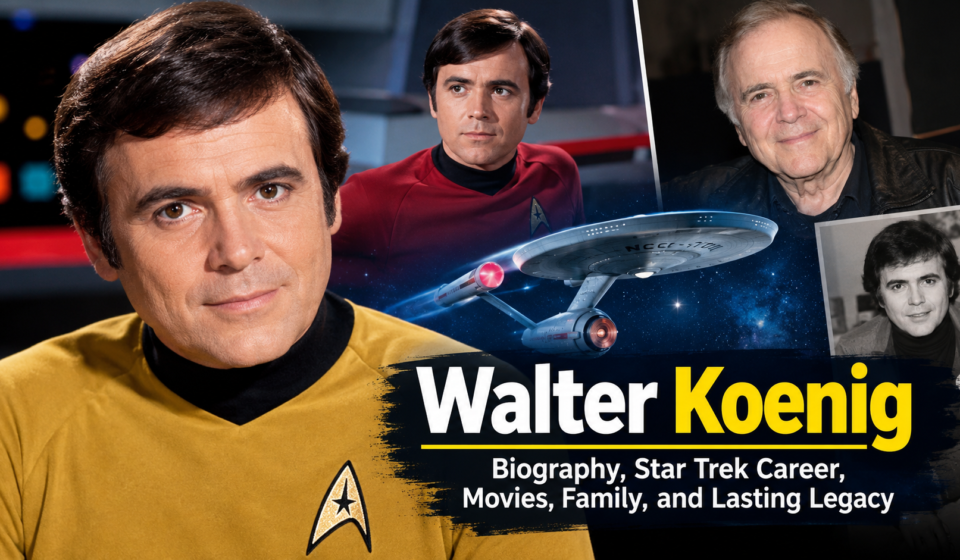

Walter Koenig was an American actor, screenwriter, author, and teacher whose work left a lasting mark on science fiction and television history. Best known for portraying Pavel Chekov in Star Trek: The Original Series, Koenig became part of one of the most recognizable ensembles in entertainment. His performance helped make Chekov a memorable member of the USS Enterprise crew, while his later work demonstrated that his creative abilities extended far beyond a single famous character.
The story of Walter Koenig is about more than an iconic television role. It is also about persistence, artistic curiosity, personal challenges, and the determination to continue creating even when an industry struggles to see an actor beyond one character. From his early life in a family of Russian Jewish immigrants to his work in Babylon Five, television writing, theater, and independent filmmaking, Koenig developed a career that connected several generations of science fiction fans. His life and work remain an important part of the history of American entertainment.
Walter Koenig at a Glance
Walter Koenig, whose full name was Walter Marvin Koenig, was born on September fourteenth, nineteen thirty-six, in Chicago, Illinois. He later grew up in New York City and pursued acting after initially exploring other academic interests. His family background, education, and early experiences helped shape the thoughtful and often self-deprecating personality that audiences came to associate with his public appearances.
Koenig became widely recognized after joining Star Trek during its second season as Ensign Pavel Chekov. Although the original television series had a relatively short run, the franchise continued through films, conventions, books, and other media. Koenig remained associated with the character for decades while also developing a separate identity as a writer, stage performer, director, and educator.
His career eventually included another notable science fiction role in Babylon Five, where he portrayed Alfred Bester, a character whose intimidating personality contrasted sharply with Chekov’s enthusiasm. That contrast demonstrated Koenig’s ability to play different kinds of characters without relying on the same performance style.
In October twenty-six, twenty-twenty-six, news organizations reported that Koenig had died at the age of ninety. Reports placed his death on October twenty-fifth at his home in Los Angeles. His passing brought renewed attention to a career that had influenced science fiction entertainment for generations.
Early Life and Family Background
Walter Koenig was born in Chicago to Russian Jewish immigrant parents. His father, Isadore Koenig, was a businessman, and his mother, Sarah Koenig, helped raise the family. His parents had roots in Eastern Europe, and their experiences as immigrants formed part of the cultural environment in which he grew up. The family later moved to Manhattan, New York, where Koenig spent much of his childhood.
Growing up in New York exposed Koenig to a lively cultural environment. The city offered theaters, museums, films, and a wide variety of artistic influences. Although he did not immediately establish himself as an actor, these surroundings provided opportunities to observe different kinds of people and personalities. Such observations can be especially valuable for performers, who must learn how to communicate character through behavior, speech, and emotion.
Koenig often approached his own life with humor and honesty. His public image was not built around presenting himself as a flawless Hollywood figure. Instead, he frequently acknowledged his insecurities, mistakes, and personal struggles. This openness helped audiences see him as a relatable individual rather than simply a famous face from television.
His family background also became relevant to his most recognizable role. Playing a Russian character on American television during the Cold War placed Koenig in a distinctive cultural position. The role required him to portray someone whose national background differed from that of many of his fellow fictional officers, while still presenting the character as a trusted member of an international crew.
Education and the Decision to Become an Actor
Before fully committing himself to acting, Walter Koenig attended Grinnell College in Iowa and later studied at the University of California, Los Angeles. He graduated from UCLA with a degree in psychology. His education gave him a foundation in understanding human behavior, although becoming a professional performer ultimately became his main career direction.
Psychology and acting have a natural connection. Actors regularly examine motivation, emotional responses, relationships, and the ways people react under pressure. A character may appear confident while privately struggling with uncertainty, or seem aggressive while hiding fear. Understanding these differences helps performers create believable people rather than simply repeating lines from a script.
Koenig continued his training at the Neighborhood Playhouse School of the Theatre in New York. Studying acting gave him opportunities to develop his voice, physical expression, and approach to character work. Professional training also helped him understand the discipline required to work in theater and television, where performers must learn material, respond to direction, and collaborate with an entire production team.
His path was not an overnight success story. Like many actors beginning their careers, Koenig had to compete for opportunities and accept smaller assignments before receiving a role that would transform his professional life. The experience gave him practical knowledge of the entertainment industry and helped prepare him for the pressures that came with international recognition.
Walter Koenig’s Early Acting Career
Walter Koenig began appearing in television productions during the early nineteen sixties. His early work included small roles and guest appearances that allowed him to gain experience in front of the camera. These opportunities were important because television acting required performers to work efficiently, understand technical instructions, and deliver convincing performances within tight production schedules.
He appeared in programs such as Combat!, Mr. Novak, Ben Casey, and The Untouchables. He also worked on other television productions, including Gidget and I Spy. These appearances introduced him to different genres, from drama and crime stories to lighter entertainment. Each assignment offered a chance to observe established actors, directors, and production crews.
Early television roles often provided limited screen time, meaning an actor had to make an impression quickly. Koenig learned to create recognizable personalities even when his character appeared for only a short period. This ability became valuable later, when he joined a large ensemble cast and needed to establish Chekov as a distinct member of the Enterprise crew.
The years before Star Trek also taught Koenig that a career in entertainment requires persistence. Many performers spend long periods moving between auditions, guest roles, and temporary employment. A successful career is rarely determined by a single performance alone. Experience, professional relationships, preparation, and the willingness to continue learning all contribute to long-term development.
How Walter Koenig Joined Star Trek
Walter Koenig’s career changed when he was cast as Pavel Chekov in Star Trek: The Original Series. He joined the program during its second season, which began in nineteen sixty-seven. The series had already introduced audiences to Captain James T. Kirk, Spock, Dr. Leonard McCoy, and the rest of the Enterprise crew. Koenig’s arrival added a youthful Russian officer to the ensemble.
The decision to include Chekov reflected the show’s interest in imagining a future in which people from different countries and backgrounds could cooperate. During the Cold War, American and Soviet political tensions influenced public life, international relations, and popular culture. Introducing a Russian character as a trusted officer aboard an advanced starship offered a hopeful alternative to the conflicts dominating contemporary headlines.
Chekov was portrayed as enthusiastic, intelligent, proud of his Russian heritage, and eager to prove himself. His youthful energy gave the character a different rhythm from the more experienced officers around him. Koenig used humor, earnestness, and occasional overconfidence to make Chekov memorable without turning him into a one-dimensional comic figure.
Joining an established series can be challenging because audiences already understand the existing characters and their relationships. Koenig had to become part of the ensemble while giving Chekov enough individuality to justify his presence. His performance gradually established the navigator as a familiar and valued member of the crew, helping him become an enduring part of the franchise.
Walter Koenig as Pavel Chekov
Pavel Chekov became Walter Koenig’s most famous character. As a young officer aboard the USS Enterprise, Chekov contributed to navigation, tactical operations, and the everyday functioning of the starship. Although he was not always the central figure in an episode, his presence helped create the sense of a working crew made up of people with different skills and personalities.
Koenig’s portrayal balanced confidence with youthful enthusiasm. Chekov often displayed strong pride in Russian culture and sometimes made playful claims about Russian achievements. These moments provided humor, but they also reflected the political atmosphere in which the original series was produced. Koenig helped make those details part of the character’s personality rather than allowing them to overwhelm his broader role.
One reason Chekov remained popular was that audiences could recognize his desire to belong and succeed. He was a capable officer working alongside experienced colleagues, yet he still had room to learn and grow. This combination made him approachable to younger viewers, who could see aspects of their own ambitions in his determination.
Koenig also gave Chekov an expressive quality that worked well within an ensemble cast. His reactions, delivery, and interactions with other characters helped bring energy to scenes that might otherwise have focused entirely on technical discussions or command decisions. Over time, Chekov became more than an additional officer on the bridge. He became a familiar personality whose presence contributed to the emotional identity of Star Trek.
Why Chekov Was Important to Star Trek
Chekov’s significance extended beyond his duties aboard the Enterprise. His character represented an effort to imagine a future in which international differences no longer prevented people from working toward shared goals. The series frequently explored conflict, cooperation, prejudice, and the consequences of fear. Chekov’s position within the crew supported those themes.
During the nineteen sixties, the relationship between the United States and the Soviet Union was marked by suspicion and geopolitical competition. Popular entertainment often reflected those tensions, sometimes presenting foreign characters as threats. Star Trek offered a different possibility by placing a Russian officer among the people responsible for exploring the galaxy and protecting the ship.
Koenig’s performance helped make this concept accessible. Chekov was not presented merely as a political symbol. He was a young officer with humor, ambitions, pride, and a personality of his own. Viewers could appreciate him as an individual before considering the broader message represented by his presence.
The character also strengthened the show’s ensemble structure. Science fiction stories often require audiences to understand unfamiliar technology, alien civilizations, and complicated moral problems. Recurring characters provide a human connection that helps viewers remain emotionally invested. Chekov contributed to that connection, making the Enterprise feel like a community rather than simply a collection of futuristic instruments and uniforms.
Walter Koenig and the Original Star Trek Television Series
The original Star Trek series aired on NBC from nineteen sixty-six to nineteen sixty-nine. It followed the crew of the Enterprise as they traveled through space, encountered unfamiliar civilizations, and faced ethical dilemmas. Although the program initially struggled to establish a large audience, it eventually developed an extraordinary following through reruns and fan enthusiasm.
Koenig appeared in the show’s second and third seasons. His character became part of a cast whose members developed strong professional identities through their performances. The series combined adventure with questions about power, responsibility, equality, and the future of humanity. Its willingness to explore social issues helped distinguish it from many other television programs of the period.
The production environment required the cast to work with elaborate costumes, unfamiliar props, technical dialogue, and stories that moved between serious drama and imaginative adventure. Actors had to make the fictional world believable even when the production’s budget and technology limited what could be shown on screen.
Koenig contributed to that world by treating Chekov as a genuine officer rather than a decorative addition to the bridge. His interactions with fellow crew members reinforced the sense that the Enterprise depended on teamwork. The show’s original run may have been brief, but the relationships established during that period continued through later films and decades of fan interest.
Walter Koenig in Star Trek Films
After the original television series ended, the Star Trek universe continued to expand. Koenig returned as Chekov in the feature films, beginning with Star Trek: The Motion Picture. The transition from television to cinema gave the original cast new opportunities to revisit their characters in stories designed for a larger screen.
Koenig subsequently appeared in films including Star Trek II: The Wrath of Khan, Star Trek III: The Search for Spock, Star Trek IV: The Voyage Home, Star Trek V: The Final Frontier, Star Trek VI: The Undiscovered Country, and Star Trek Generations. These productions allowed audiences to reconnect with Chekov as the fictional world grew more complicated and the characters faced new dangers.
The films also demonstrated the value of continuity in a long-running franchise. Viewers who had followed the television series could watch familiar characters develop over time. The original cast members carried their established relationships into new adventures, creating a connection between the early television era and later cinematic storytelling.
For Koenig, returning to Chekov meant continuing to work with a character who had become deeply associated with his public identity. Although that association sometimes limited the roles available to him, it also created opportunities to revisit a beloved fictional world. The films helped preserve his place in science fiction history and introduced his performance to audiences who had not watched the original series during its first broadcast.
Star Trek II: The Wrath of Khan and Chekov’s Dramatic Role
Star Trek II: The Wrath of Khan is widely regarded as one of the most memorable films in the franchise. Released in nineteen eighty-two, the movie brought Captain Kirk and his crew into a dangerous confrontation with Khan Noonien Singh. The story explored revenge, aging, sacrifice, leadership, and the consequences of decisions made in the past.
Chekov’s role in the film was particularly significant because he became connected to Khan’s earlier history. The encounter created a direct personal dimension within the larger conflict. Rather than functioning only as a bridge officer, Chekov became part of the dramatic mechanism that brought the characters into danger.
Koenig’s performance helped ground the story in the reactions of a recognizable crew member. Science fiction films often rely on extraordinary situations, but the audience needs believable human responses to make those situations meaningful. Fear, uncertainty, professional responsibility, and the instinct to survive give the action emotional weight.
The film also showed how supporting characters can contribute substantially to a major story without replacing its central hero. Koenig worked within an ensemble that included William Shatner, Leonard Nimoy, DeForest Kelley, and other returning cast members. His involvement helped maintain the continuity that fans valued while allowing the movie to explore a darker and more emotionally intense direction.
Walter Koenig’s Work Beyond Star Trek
Although Chekov remained his signature role, Walter Koenig’s professional life was not limited to the franchise. He appeared in other television productions, films, and theatrical performances, while also pursuing opportunities as a writer. These projects revealed a creative personality interested in different forms of storytelling.
Actors associated with a famous character can face a difficult career challenge. Casting directors may assume that audiences will see them only in their best-known role, making it harder to secure unrelated parts. Koenig experienced the effects of this typecasting, particularly during the period following the original series.
Rather than abandoning the profession, he explored other creative directions. Writing allowed him to contribute to entertainment without depending entirely on casting decisions. Theater offered opportunities to work with challenging material and connect with audiences in a different environment. Teaching also enabled him to share practical experience with people learning the craft.
His broader career is important because it shows the difference between public recognition and artistic range. An actor may become famous for a single character while developing interests and abilities that remain less visible to the general public. Koenig continued to work across different forms, demonstrating that his creative identity was considerably broader than his most celebrated television performance.
Walter Koenig’s Role in Babylon Five
Another important chapter in Koenig’s career came through the science fiction series Babylon Five. He portrayed Alfred Bester, a senior officer within the fictional Psi Corps, an organization associated with telepaths and strict control over their activities. The character was intelligent, manipulative, and frequently unsettling.
Bester differed sharply from Chekov. Where Chekov was generally approachable and enthusiastic, Bester could be cold, calculating, and intimidating. His confidence came from institutional power and a belief that the system he represented was justified. The role demanded a different emotional approach from Koenig and showed his ability to move beyond the friendly personality that had made him famous.
Babylon Five was known for its long-form storytelling, political conflict, and complicated relationships between individuals and institutions. Bester fit naturally into those themes because he represented the dangers of concentrated authority and the willingness to sacrifice personal freedom for a claimed social good.
Koenig’s performance gave the character a distinctive presence. Bester was not simply a villain who relied on obvious threats. He could be polite, controlled, and persuasive, which often made him more disturbing. His calm manner suggested that he viewed coercion as ordinary administration rather than an extraordinary abuse of power.
The role introduced Koenig to another generation of science fiction viewers. It also helped demonstrate that his talent could serve very different kinds of stories. His work on Babylon Five remains a major reason fans remember him for more than his association with the Enterprise crew.
Why Alfred Bester Was Different From Chekov
Comparing Chekov and Alfred Bester reveals an interesting contrast in Koenig’s acting career. Chekov generally represented cooperation, youthful ambition, and a belief in shared responsibility. Bester represented institutional control, ideological certainty, and a willingness to manipulate others in pursuit of a larger objective.
These differences required Koenig to adjust his performance. Chekov’s personality allowed for warmth, humor, and spontaneous reactions. Bester demanded restraint, calculated speech, and a sense that the character was constantly evaluating everyone around him. Small changes in expression and delivery could communicate the threat he represented.
The contrast also shows why long-running performers can benefit from roles outside their signature work. Familiarity with a popular character may create professional opportunities, but playing a different personality can challenge an actor to develop new skills. Koenig used Bester to explore a darker side of human behavior and expand the range of characters associated with his career.
For viewers, these performances provide two different ways to appreciate his work. Chekov demonstrates his ability to make a character likable and approachable, while Bester demonstrates how effectively he could create tension. Together, they form an important part of his legacy in television science fiction.
Walter Koenig as a Television Writer
Writing became an important part of Walter Koenig’s professional life. He contributed scripts to several television productions and worked on projects beyond those in which he appeared as an actor. His writing credits included programs such as Land of the Lost, Family, and The Powers of Matthew Star, reflecting his willingness to explore different styles of storytelling.
Television writing requires a different set of skills from acting. A performer interprets a character and brings written material to life, while a writer must develop the structure, dialogue, conflict, and progression of a story. Writing for an established series also requires an understanding of its characters, tone, and production limitations.
Koenig’s experience as an actor gave him practical insight into how scripts function on screen. He understood that dialogue must sound natural when spoken and that scenes need clear dramatic purposes. A compelling story must also allow characters to react in ways that feel consistent with their personalities while still creating room for surprise.
His work behind the scenes demonstrates that his interest in entertainment extended beyond performing. Writing offered him another way to participate in the creative process and express ideas that might not fit within the roles available to him. It also helped establish a professional identity independent of Chekov.
Walter Koenig and Star Trek Writing
Koenig’s relationship with Star Trek included writing as well as acting. He contributed to Star Trek: The Animated Series, which continued the adventures of the original crew in animated form after the live-action program ended. His writing credit on the episode “The Infinite Vulcan” reflected his connection to the franchise as a storyteller.
The animated format allowed the series to explore imaginative concepts that could be difficult to stage in live action. Alien environments, unusual creatures, and futuristic situations could be depicted without relying on the same physical production resources required for a conventional television episode. This gave writers opportunities to imagine stories that expanded the fictional universe.
Writing for a franchise with established characters also brings special responsibilities. Audiences already have expectations about how the crew behaves, how the universe operates, and what kinds of themes belong in the stories. A writer must respect that foundation while adding something new.
Koenig’s involvement in writing demonstrated his understanding of the world he had helped bring to life on screen. He was not simply a performer returning to a familiar role. He was also a creative contributor interested in expanding the possibilities of the fictional universe.
Walter Koenig as an Author
Beyond screenwriting, Walter Koenig published books that offered readers insight into his life and career. His memoir Chekov’s Enterprise: A Personal Journal of the Making of Star Trek: The Motion Picture documented his experience working on the film. It gave fans a perspective on the production process from someone who had participated in the original television series and its transition to cinema.
His later memoir, Warped Factors: A Neurotic’s Guide to the Universe, presented a more personal and humorous account of his experiences. Rather than offering a conventional celebrity narrative focused only on achievements, Koenig explored insecurities, professional disappointments, and the unusual situations that can accompany a career in entertainment.
Memoirs from actors can be valuable because they preserve details that may not appear in official production histories. A performer can describe the atmosphere on set, the challenges of working with particular material, and the personal reactions that accompany professional milestones. Such accounts also reveal how a famous career can look very different from the inside than it does to audiences.
Koenig’s writing reflected his willingness to examine his own experiences with humor and candor. His books offered fans another way to understand the person behind Chekov and showed that his interests extended beyond the performances that made him famous.
Walter Koenig’s Theater Career
Theater remained an important part of Koenig’s artistic life. Stage performance requires a different relationship with the audience from television or film. An actor must sustain a character through an entire performance, project emotion to a live audience, and respond to the energy of the room without the benefit of repeated takes or editorial adjustments.
Koenig appeared in numerous stage productions throughout his career. Theater gave him opportunities to perform material that differed from science fiction and to work with characters whose personalities were shaped by dramatic literature. These roles allowed him to explore complex relationships, moral conflicts, and emotional changes within a more immediate performance environment.
He also directed theatrical productions. Directing requires an understanding of how individual performances contribute to the larger story. A director must consider pacing, staging, movement, tone, and the relationships between performers. Koenig’s experience as an actor provided a useful foundation for helping other performers interpret their roles.
His work in theater illustrates the breadth of his creative interests. Even when the public primarily associated him with television, he continued to participate in a field that values preparation, collaboration, and direct engagement with audiences. The stage offered a different kind of artistic challenge and helped keep his professional life varied.
Walter Koenig as a Teacher and Mentor
Koenig also taught acting and shared his experience with aspiring performers. His teaching work included connections with UCLA and other acting programs. Teaching offered him a way to contribute to the development of performers who were beginning their own careers in a competitive industry.
Acting education involves more than memorizing dialogue or learning how to appear confident. Students must develop listening skills, emotional awareness, physical expression, and the ability to work constructively with directors and fellow performers. They also need to understand the practical realities of auditions, rejection, preparation, and professional discipline.
Koenig had experienced many of these challenges firsthand. His early career involved smaller television appearances before he gained widespread recognition. He also understood the difficulties that can arise when an actor becomes closely identified with a famous role. Those experiences provided valuable perspective for students preparing to enter the profession.
His teaching work added another dimension to his legacy. An actor’s influence does not end with the performances preserved on film or television. Knowledge can also be passed to future performers through instruction, encouragement, and practical advice. By teaching, Koenig contributed to the broader artistic community beyond his own screen appearances.
Walter Koenig’s Personal Life and Marriage
Walter Koenig married Judy Levitt in nineteen sixty-five. Their marriage lasted for decades and remained an important part of his personal story. While Koenig was widely recognized through his professional work, he also maintained a family life away from the entertainment industry.
Judy Levitt supported a household that experienced both the opportunities and pressures associated with a career in acting. The entertainment profession can involve unpredictable schedules, periods without work, travel, and public attention. Maintaining a long-term relationship in that environment requires patience and the ability to navigate changing circumstances.
The couple had two children, Andrew and Danielle. Their family experienced both meaningful moments and profound loss, including the death of their son Andrew in twenty-ten. Judy Levitt died in twenty-twenty-two, leaving Koenig without his longtime partner.
Family relationships are often difficult to understand fully from the outside, particularly when public figures choose to keep much of their private lives away from the media. What is clear is that Koenig’s family formed an important part of his life beyond acting, and his experiences as a husband and father were distinct from the fictional adventures that made him famous.
Walter Koenig’s Children
Walter Koenig and Judy Levitt had two children, Andrew Koenig and Danielle Koenig. Both became associated with creative work, although their professional paths and personal experiences were different. Their lives formed an important part of Koenig’s identity as a father.
Andrew Koenig became known as an actor and editor. He appeared in television productions, including the popular sitcom Growing Pains, in which he played Richard “Boner” Stabone. His work introduced him to audiences beyond those familiar with his father’s science fiction career.
Andrew’s death in twenty-ten was a devastating loss for the family. His struggles and passing brought attention to the serious impact of depression and the importance of compassionate support. Discussing this part of the family’s history requires care because it involved deeply personal circumstances and lasting grief.
Danielle Koenig pursued work as an actress and writer. She later married comedian Jimmy Pardo. Although public interest in the family often arose from Walter’s fame, Danielle developed her own creative identity. The family’s story illustrates that people connected to well-known entertainers have their own ambitions, experiences, and challenges outside the public image of a famous parent.
Walter Koenig and the Loss of His Son
The death of Andrew Koenig in twenty-ten was one of the most painful events in Walter Koenig’s personal life. Andrew was an adult with his own career and experiences, but his passing affected the entire family. The loss also drew public attention to the emotional challenges associated with depression and the need to treat mental health concerns seriously.
Grief does not follow a simple timetable, and the death of a child can have lasting effects on parents and relatives. Public figures may receive sympathy from fans, but public attention cannot remove the private difficulty of such an experience. The Koenig family’s loss was personal, even as it became part of broader public discussion.
Andrew’s story also encouraged conversations about mental health awareness. Depression can affect people in different ways, and it is not always visible to friends, relatives, or colleagues. Compassionate communication, access to appropriate support, and a willingness to take emotional distress seriously are important parts of responding to mental health challenges.
Walter Koenig’s public life included humor, professional resilience, and creative achievement, but those qualities did not make him immune to grief. His family’s experience is a reminder that famous performers face many of the same painful realities as other people. Their work may entertain millions, yet their private lives remain human and vulnerable.
Walter Koenig’s Friendship With the Star Trek Cast
The original Star Trek cast became known not only for their fictional relationships but also for the professional connections that developed over the years. Walter Koenig worked alongside performers including William Shatner, Leonard Nimoy, DeForest Kelley, Nichelle Nichols, George Takei, and James Doohan. The shared experience of creating the original series helped connect members of the ensemble long after filming ended.
Like many long-running professional relationships, the cast’s interactions were not always uncomplicated. People working together may experience disagreements, misunderstandings, and periods of distance. The public image of a beloved television ensemble does not necessarily reflect every detail of the relationships behind the scenes.
Over time, however, several cast members developed lasting friendships and continued to meet through conventions, interviews, and special events. Koenig’s friendship with George Takei became particularly visible. Koenig served as best man at Takei’s wedding to Brad Altman in twenty-eight, demonstrating the closeness of their relationship by that stage of their lives.
These friendships contributed to the wider culture surrounding Star Trek. Fans often value the sense of community created by the original cast, especially when actors continue to celebrate the series together long after its first broadcast. Their appearances helped preserve the history of the production while giving audiences opportunities to reconnect with familiar performers.
Walter Koenig and Star Trek Conventions
Science fiction conventions became an important part of Koenig’s relationship with fans. These gatherings allow viewers to meet performers, ask questions, discuss favorite episodes, and celebrate the stories that influenced them. For actors associated with long-running franchises, conventions can become a way to maintain a direct connection with the audience.
Koenig participated in convention appearances for many years. He spoke about his career, shared memories of working on Star Trek, and discussed the experiences that shaped his professional life. Such events allowed fans to learn more about the production process and the person behind Chekov.
Conventions also helped sustain the franchise during periods when new television episodes or films were not being released. Fan communities kept the series visible through discussion, memorabilia, creative projects, and organized events. The enthusiasm of these communities played a significant role in the continued cultural relevance of the original show.
Koenig’s participation reflected an understanding that the audience was central to the franchise’s long life. A television series may begin with a network and production company, but its cultural future depends partly on the people who continue watching, sharing, and discussing it. His interactions with fans helped strengthen that connection across generations.
Walter Koenig’s Acting Style
Walter Koenig’s acting style combined expressive reactions, careful timing, and an ability to communicate a character’s personality through small details. His performance as Chekov depended partly on enthusiasm and humor, but it also required him to function naturally within scenes involving complicated dialogue and technical situations.
An ensemble actor must understand how to support the main action without disappearing from the story. When another character delivers an important line, a meaningful reaction can reinforce the scene’s emotional tone. Koenig’s work often contributed to the atmosphere of the Enterprise bridge through expressions and interactions that made the fictional crew seem connected.
His performance as Alfred Bester required a different set of techniques. Rather than relying on open enthusiasm, he used controlled speech and a restrained presence to suggest that Bester was constantly thinking ahead. The contrast between the two characters reveals his ability to adjust his performance to the demands of different stories.
Koenig’s approach also reflected the importance of consistency. A character becomes recognizable when speech, behavior, and emotional responses work together. Chekov’s pride, curiosity, and youthful confidence formed a coherent personality, while Bester’s composure and ideological certainty created a very different impression. Both performances benefited from clear character choices.
Walter Koenig’s Influence on Science Fiction
Walter Koenig contributed to science fiction during a period when television was helping establish the genre as a space for ambitious storytelling. Star Trek presented a future in which technology could create opportunities for exploration while also raising questions about ethics, power, and responsibility. Koenig’s character became part of that larger vision.
Science fiction often reflects the concerns of the time in which it is created. Stories about alien societies can explore prejudice, while futuristic governments can reveal anxieties about authority. The genre can also imagine alternatives to existing political and social arrangements. Chekov’s place within the Enterprise crew supported the idea that cooperation across national differences could become possible.
Koenig’s later role in Babylon Five contributed to a different but related exploration of social and political issues. Alfred Bester represented the dangers of institutions that claim to protect society while restricting individual freedom. The character’s actions encouraged viewers to consider the relationship between security, personal rights, and centralized authority.
Together, these roles connected Koenig to different approaches within science fiction. One celebrated the possibilities of cooperation and exploration, while the other examined the darker consequences of power and control. His work helped make both stories more compelling by giving their ideas a recognizable human presence.
Walter Koenig’s Contribution to Representation
Chekov’s Russian identity was especially meaningful in the historical context of the original series. During the Cold War, audiences were accustomed to hearing political rhetoric that emphasized differences between the United States and the Soviet Union. Presenting a Russian officer as a trusted member of an American-led fictional crew challenged some of the assumptions that shaped popular entertainment.
The character did not erase political conflict or pretend that international disagreements were unimportant. Instead, he suggested that individuals from different backgrounds could work together when they shared responsibilities and goals. This was a hopeful idea, particularly during a period marked by geopolitical tension.
Koenig’s performance helped make the idea tangible. Chekov had recognizable habits, opinions, humor, and professional responsibilities. He was not simply a representative of a nation; he was a person who participated in the crew’s everyday life. That characterization allowed the broader message to emerge through relationships rather than speeches alone.
Representation in entertainment is most effective when characters are treated as individuals rather than symbols alone. Chekov’s place in the franchise offered an early example of how popular science fiction could imagine a more cooperative future. Koenig’s work remains part of that history.
Walter Koenig’s Challenges With Typecasting
Despite the recognition that came with Star Trek, Koenig faced professional limitations associated with typecasting. Once an actor becomes strongly identified with a popular character, casting professionals may struggle to imagine that performer in a different role. Audiences can also develop expectations that make it difficult for an actor to establish a new identity.
Koenig’s association with Chekov brought substantial benefits, including continued employment within the franchise and a lasting connection with fans. However, that fame did not automatically translate into a steady stream of unrelated acting opportunities. The industry often treats a familiar character as both an asset and a limitation.
Typecasting can be especially challenging for actors whose best-known roles are closely connected to a specific genre. Viewers may expect the same personality, accent, or behavior even when a performer is capable of doing something entirely different. Breaking away from those expectations can require patience, experimentation, and a willingness to pursue less conventional opportunities.
Koenig responded by expanding his creative activities. Writing, theater, teaching, and his work on Babylon Five helped him demonstrate different aspects of his abilities. His career shows that an actor’s long-term development may depend on creating opportunities outside the role that first brought widespread recognition.
Walter Koenig’s Work in Independent Projects
Independent productions offered Koenig opportunities to explore material outside major studio franchises. These projects can be attractive to experienced performers because they often allow greater flexibility in subject matter, character development, and production style. They may also involve smaller budgets and fewer commercial guarantees than mainstream entertainment.
Koenig appeared in a variety of film and television projects throughout his career. Some received less attention than his best-known science fiction work, but they formed part of a broader professional record. Independent productions also gave him opportunities to collaborate with filmmakers who approached storytelling from different perspectives.
His involvement in InAlienable, a science fiction legal thriller released in the late two-thousands, demonstrated his continuing interest in imaginative storytelling. Koenig wrote the project and appeared in it, combining his experience as a performer with his interest in developing stories. The film explored questions about identity, responsibility, and the treatment of an unusual form of life.
Projects like this reveal the practical side of a creative career. Not every production becomes widely known, and not every artistic experiment reaches a large audience. Nevertheless, such work can be meaningful because it allows performers and writers to continue developing ideas and exploring subjects that interest them.
Walter Koenig’s Books and Creative Philosophy
Koenig’s books offered insight into his outlook on acting, fame, and personal experience. His writing often included humor and self-reflection, avoiding the impression that professional success had eliminated the ordinary uncertainties of life. This approach helped readers understand the gap between a public image and a person’s private thoughts.
Memoirs can be especially revealing when written by performers whose careers span major changes in the entertainment industry. Koenig experienced the transition from traditional television production to a world in which franchises could continue through films, conventions, games, and other forms of media. His observations helped document that transformation from the perspective of someone directly involved.
His interest in writing also suggests that storytelling was not limited to the roles he performed. Actors spend much of their professional lives interpreting the ideas of others, but writing allows them to decide which characters, conflicts, and themes deserve attention. Koenig’s work as an author gave him greater control over the stories he wanted to tell.
His creative philosophy, as reflected in his public work, valued honesty and the ability to laugh at oneself. These qualities made his memoirs appealing to readers who wanted more than a list of career milestones. They offered a view of a performer who understood that a meaningful life includes uncertainty, disappointment, humor, and continued curiosity.
Walter Koenig’s Public Image and Sense of Humor
Koenig’s public personality often included self-deprecating humor. Rather than treating fame as proof of personal perfection, he frequently discussed the awkward and unexpected situations that accompanied his career. This made him approachable to fans who appreciated his willingness to speak candidly about professional life.
Humor can also be a useful tool for discussing difficult experiences. An actor may face rejection, financial uncertainty, public scrutiny, or the pressure of being recognized everywhere. A humorous account does not make those experiences insignificant, but it can help communicate their absurdity and make them easier for others to understand.
Koenig’s humor fit naturally with the affection many fans felt for Chekov. The character’s enthusiasm and occasional overconfidence created opportunities for comedy without making him a fool. Although an actor’s public personality should not be confused with a fictional character, Koenig’s willingness to laugh at himself helped sustain a friendly connection with audiences.
That public warmth became part of his broader legacy. Fans remembered not only the fictional officer on the Enterprise but also the performer who discussed his work, answered questions, and shared memories. His humor helped make the history of Star Trek feel personal and accessible.
Walter Koenig’s Later Years
In his later years, Walter Koenig remained associated with the entertainment world through public appearances, interviews, and continued interest in his previous work. Although his career naturally changed with age, his connection to science fiction audiences remained strong. Fans continued to celebrate his contributions to Star Trek and Babylon Five.
Older performers often find that their professional identities become tied to the cultural history of their best-known work. Koenig’s appearances allowed him to reflect on a career that had moved through several phases, from early television roles to international recognition and later creative projects. His experiences provided a perspective on how the entertainment industry had changed over time.
His later years also brought personal losses, including the deaths of his son Andrew and his wife Judy. These events formed part of his private life and should be understood with the same sensitivity afforded to other families experiencing grief. Professional recognition does not remove the emotional realities of aging, bereavement, or family change.
Koenig’s continued presence in the public imagination reflects the unusual durability of science fiction franchises. A performance recorded decades earlier can remain meaningful to people who were not yet born when it first appeared. Through reruns, films, recordings, and fan communities, his work continued reaching new audiences long after the original series ended.
Walter Koenig’s Death and Tributes
Walter Koenig died on October twenty-fifth, twenty-twenty-six, at the age of ninety, according to reports published following his death. News coverage stated that he died at his home in the Los Angeles area, with family members present. His passing prompted tributes from colleagues, fans, and people who valued his contribution to science fiction entertainment.
For many viewers, the news marked the loss of one of the performers associated with the original Star Trek era. The series had introduced a future in which exploration and cooperation could overcome many of the divisions that shaped contemporary society. Koenig’s portrayal of Chekov helped make that vision feel personal and memorable.
Tributes also recognized that his career extended beyond his most famous character. His work as a writer, teacher, stage performer, and actor in other science fiction productions demonstrated a broader range of interests. Remembering Koenig only as Chekov would overlook much of the effort and creativity that shaped his professional life.
His death also encouraged fans to revisit the episodes and films in which he appeared. Rewatching a performance can be a way to celebrate an actor’s work and preserve the connection between an artist and the people who appreciated that work. In Koenig’s case, the enduring popularity of Star Trek ensures that his contribution will remain accessible to future generations.
Walter Koenig’s Lasting Legacy
Walter Koenig’s legacy rests on several connected achievements. His portrayal of Pavel Chekov helped establish one of science fiction television’s most recognizable ensembles. His later performance as Alfred Bester showed that he could portray a very different kind of character, while his writing and theater work demonstrated a broader creative range.
The longevity of Star Trek also gave Koenig’s work an unusual cultural reach. The original series became the foundation for films, later television productions, books, games, and a worldwide fan community. Chekov remained part of that shared fictional history, connecting audiences who encountered the franchise at different points in their lives.
His career also illustrates the challenges that accompany a famous role. Recognition can create lasting opportunities, but it may also limit the kinds of parts an actor is offered. Koenig’s willingness to explore writing, teaching, theater, and independent projects shows the importance of continuing to develop creatively even when professional circumstances are complicated.
Beyond individual achievements, Koenig contributed to a tradition of science fiction that uses imaginary worlds to examine real human questions. His characters helped explore cooperation, authority, loyalty, and the consequences of ideology. Those themes remain relevant because the best science fiction is not simply about distant planets or advanced technology. It is also about the choices people make when confronted with uncertainty and change.
Why Walter Koenig Remains Important to Star Trek Fans
Fans continue to value Walter Koenig because Chekov was part of the emotional fabric of the original Enterprise crew. The character contributed humor, energy, and a perspective that complemented the personalities around him. His presence helped the ship feel like a diverse working community rather than a group of unrelated characters assembled for individual scenes.
The franchise also became a source of shared memories for many viewers. Families watched episodes together, friends discussed favorite stories, and convention communities formed around a common appreciation for the series. Koenig’s character became part of those experiences, giving fans a familiar figure to remember and revisit.
His career beyond Star Trek adds another reason for continued interest. The contrast between Chekov and Alfred Bester demonstrates how an actor can create very different personalities within the same broad genre. His writing, books, and teaching also provide a fuller picture of a performer who remained curious about storytelling throughout his life.
Ultimately, the affection for Koenig reflects both the strength of his performances and the longevity of the fictional worlds in which he worked. A memorable character can outlive the original production and continue to influence how people imagine the future. Chekov remains one such character, and Koenig’s contribution to that legacy is secure.
Frequently Asked Questions About Walter Koenig
Who was Walter Koenig?
Walter Koenig was an American actor, screenwriter, author, and teacher best known for playing Pavel Chekov in Star Trek: The Original Series and its subsequent films. He also portrayed Alfred Bester in Babylon Five and worked in theater, television writing, and independent filmmaking.
What was Walter Koenig famous for?
Koenig was most famous for portraying Chekov, the young Russian officer serving aboard the USS Enterprise. The character became a lasting part of Star Trek history because of his enthusiasm, humor, and role in the show’s vision of international cooperation.
What other television series did Walter Koenig appear in?
In addition to Star Trek, Koenig appeared in television productions such as Babylon Five, The Untouchables, Ben Casey, Mr. Novak, Gidget, and I Spy. His career included guest roles, recurring characters, and work behind the scenes as a writer.
Did Walter Koenig work as a writer?
Yes. Koenig wrote for television and contributed to Star Trek: The Animated Series. He also published memoirs and developed other creative projects, including InAlienable, which combined his interests in science fiction, writing, and acting.
Who was Walter Koenig married to?
Walter Koenig married Judy Levitt in nineteen sixty-five. They remained married for decades and had two children, Andrew and Danielle. Judy died in twenty-twenty-two.
Did Walter Koenig have children?
Yes. He had two children, Andrew Koenig and Danielle Koenig. Andrew worked as an actor and editor and died in twenty-ten. Danielle pursued acting and writing and is married to comedian Jimmy Pardo.
What character did Walter Koenig play in Babylon Five?
Koenig played Alfred Bester, a powerful and intimidating officer associated with the Psi Corps. The role differed significantly from Chekov and demonstrated his ability to portray a controlled, morally complicated character.
When did Walter Koenig die?
Reports published in October twenty-twenty-six stated that Walter Koenig died on October twenty-fifth at the age of ninety. His death prompted renewed recognition of his work in Star Trek, Babylon Five, and other creative fields.
Final Thoughts on Walter Koenig
Walter Koenig built a remarkable career through persistence, versatility, and a lasting connection with audiences. His portrayal of Pavel Chekov helped define the original Star Trek ensemble, while his work as Alfred Bester demonstrated that he could move beyond the character that first brought him international recognition. His contributions as a writer, author, theater performer, and teacher added further depth to his professional life.
His story also reflects the complicated realities of an acting career. Fame can open doors while creating new limitations, and professional achievements do not prevent personal hardship. Koenig continued exploring different creative opportunities despite those challenges, leaving behind a body of work that reached far beyond one television role.
For science fiction fans, Walter Koenig will always be associated with the Enterprise crew and the optimistic vision of a future shaped by exploration and cooperation. For those who appreciate acting and storytelling more broadly, his career offers a reminder that creativity can take many forms. His performances, writing, and influence on audiences ensure that his work will continue to be remembered.
Stay in touch to get more updates & news on Magazine Dispatch!