



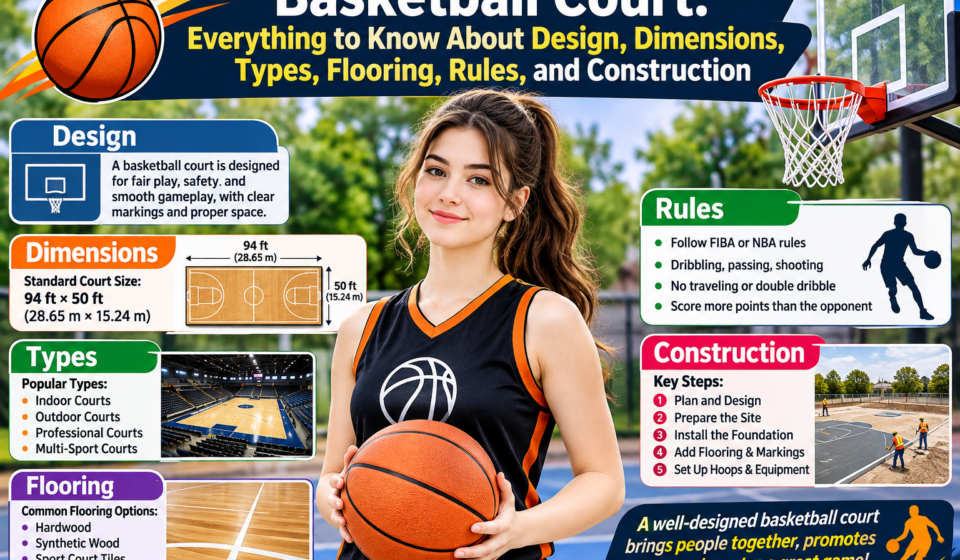
Basketball Court: Everything to Know About Design, Dimensions, Types, Flooring, Rules, and Construction

A basketball court is much more than a flat playing surface with hoops at opposite ends. It is the heart of the game, providing the space where players develop their skills, compete against opponents, build teamwork, and enjoy the excitement of basketball. Whether it is located inside a professional sports arena, at a school, in a public park, or in someone’s backyard, a basketball court creates opportunities for physical activity, recreation, and athletic development. Its design, surface, markings, and equipment all contribute to the quality of the playing experience.
A properly designed basketball court makes the game safer, more enjoyable, and more organized. Every part of the playing area serves a purpose, from the center circle and sidelines to the free-throw line and three-point arc. The flooring also matters because it affects how the ball bounces, how players move, and how comfortably they can run, jump, and change direction. Different environments require different court materials and layouts, making it important to understand the available options before building or choosing a playing space.
Whether someone wants to construct a professional facility, install a basketball court at home, or simply learn more about the sport, understanding its features can be extremely helpful. This guide explores basketball court design, dimensions, flooring materials, equipment, construction, maintenance, safety, and the many benefits of having a dedicated place to play.
What Is a Basketball Court?
A basketball court is a specially designed rectangular playing surface where two teams compete to score points by shooting a ball through the opposing team’s basket. The playing area includes carefully arranged boundaries, painted lines, designated shooting areas, and baskets positioned at opposite ends. These features establish the structure of the game and help players understand where they can move, shoot, defend, and compete.
The basketball court is designed to support continuous movement and quick decision-making. Players sprint across the floor, pass the ball, defend opponents, jump for rebounds, and attempt shots from different positions. Because basketball involves frequent changes in direction and physical contact, the surface needs to provide appropriate traction, stability, and shock absorption.
A basketball court can be found in many different locations. Professional arenas generally feature indoor wooden flooring, while outdoor facilities commonly use concrete, asphalt, or specialized sports surfaces. Schools, colleges, community centers, and recreational parks also provide playing areas for people with different experience levels.
The appearance and construction of a basketball court may vary, but its main purpose remains the same. It provides an organized environment where players can practice basketball, participate in competitions, improve their physical fitness, and enjoy the sport.
History and Development of the Basketball Court
The history of the basketball court is closely connected to the development of basketball itself. The sport was introduced by James Naismith, who created a new indoor activity that could keep students physically active during colder weather. The original game used a relatively simple playing space and baskets attached to elevated structures.
As basketball became more popular, its playing environment gradually developed. Schools, colleges, and athletic organizations began creating dedicated facilities with clearly marked boundaries and improved equipment. The introduction of standardized rules helped make games more consistent, allowing teams from different locations to compete under similar conditions.
Modern basketball courts are considerably more advanced than the early playing areas. Professional facilities now use carefully engineered flooring, specialized lighting, protective equipment, and accurate line markings. These improvements support high-level competition while creating a better experience for players and spectators.
The development of basketball court design also reflects changes in architecture and sports technology. Outdoor courts have become more colorful, indoor facilities have gained better ventilation and lighting, and portable basketball systems have made the sport accessible to more communities.
Standard Basketball Court Dimensions
Basketball court dimensions are important because they determine the amount of available playing space and influence how the game is organized. Different basketball organizations use their own official measurements, which means professional, international, school, and recreational courts may not always have identical layouts.
A full-size professional basketball court generally has a rectangular shape with clearly marked sidelines and baselines. The playing surface includes a center line, center circle, restricted areas, free-throw lines, and three-point arcs. Each marking has a specific purpose and helps maintain consistency during competition.
The National Basketball Association uses a playing court measuring ninety-four feet in length and fifty feet in width. International basketball competitions governed by FIBA generally use a court measuring twenty-eight meters in length and fifteen meters in width. These standards provide a reference for architects, sports facility managers, and organizations planning competitive facilities.
Smaller basketball courts are also common in schools, residential properties, and community recreation areas. Their dimensions can be adjusted according to available space, player age, and intended use. Although smaller courts may not meet professional requirements, they can still provide excellent opportunities for practice and recreational games.
Important Basketball Court Lines and Markings
The lines painted on a basketball court help define different areas of the playing surface. Without these markings, players and officials would have difficulty identifying boundaries, shooting zones, and important positions. Every line contributes to the organization and fairness of the game.
The sidelines run along the longer edges of the court, while the baselines mark its shorter ends. When the ball or a player moves outside these boundaries under the relevant rules, the ball may be considered out of bounds. These markings are essential for maintaining control during competition.
The center line divides the basketball court into two halves. At the center is a circular area used during the opening tip-off. This arrangement helps establish the starting position and creates a clear division between the two sides of the playing area.
Other important markings include the free-throw line, three-point arc, lane lines, and restricted area. Each marking influences player positioning, offensive movement, and defensive strategy. Together, these lines transform an ordinary floor into a properly organized basketball playing surface.
The Center Circle and Midcourt Area
The center circle is located in the middle of a basketball court and plays an important role at the beginning of a game. It provides the designated area for the opening jump ball, where opposing players compete to gain possession. Its position also creates a visual reference point that helps players understand the layout of the playing surface.
The midcourt area is important for offensive and defensive movement. Teams use it to organize their attacks, prepare plays, and transition between different areas of the court. Players must understand their positions in relation to the center line to avoid certain violations and maintain effective team coordination.
A properly painted center circle should be easy to recognize and should match the required dimensions of the competition format. Clear markings help referees make decisions and allow players to follow the rules without unnecessary confusion.
The Three-Point Line
The three-point line is one of the most recognizable features of a modern basketball court. It creates a boundary around the basket that determines whether a successful field goal earns additional points. Shots made from beyond this line are worth more than ordinary field goals.
The distance of the three-point line varies between basketball organizations. Professional leagues and international competitions use different measurements, so players need to understand the rules of the competition in which they participate.
The three-point area has influenced the way basketball is played. Teams increasingly use outside shooting as an important offensive strategy. Players work on shooting accuracy, foot positioning, balance, and release technique to become more effective from long range.
The painted arc also helps coaches design offensive systems. It creates opportunities for spacing, passing, and player movement. Defenders must remain aware of shooters positioned beyond the arc, which can create additional space for teammates closer to the basket.
The Free-Throw Line and Key Area
The free-throw line is an important marking located near each basket. Players use it to attempt uncontested shots after certain fouls or other situations specified by the rules. Successful free throws contribute directly to a team’s score and can become especially important during close games.
The surrounding area is commonly called the key, lane, or painted area. It provides an important space for offensive and defensive activity. Players position themselves around this area to compete for rebounds, create scoring opportunities, and protect the basket.
The key area also contains rules that influence how long offensive players can remain in certain positions. These regulations encourage movement and prevent teams from gaining an unfair advantage by keeping players close to the basket for extended periods.
A clearly marked free-throw area is essential for organized basketball. The lines must be visible, properly positioned, and suitable for the playing format.
Types of Basketball Courts
Basketball courts come in different styles depending on their location, construction materials, and intended purpose. Some are designed for professional competitions, while others are created for casual games, physical education, and neighborhood activities.
Indoor Basketball Court
An indoor basketball court is located inside a sports hall, gymnasium, school facility, or professional arena. These courts provide a controlled environment where players can enjoy basketball without worrying about rain, strong sunlight, wind, or changing outdoor temperatures.
Most professional indoor basketball courts use hardwood flooring. Maple is a popular choice because it provides a smooth playing surface, consistent ball response, and a suitable balance of traction and durability. The flooring is usually finished with protective coatings that help preserve its appearance and performance.
Indoor basketball courts are particularly useful for competitive leagues and organized training programs. Their controlled environment allows facility managers to maintain lighting, temperature, cleanliness, and playing conditions.
Outdoor Basketball Court
An outdoor basketball court is built in an open area, such as a park, schoolyard, residential community, or recreational facility. It provides a convenient place for people to enjoy the sport without needing access to an indoor gymnasium.
Concrete and asphalt are commonly used for outdoor basketball courts because these materials can withstand exposure to different weather conditions. Some modern facilities also use specialized sports coatings that improve grip, appearance, and comfort.
Outdoor basketball courts encourage community participation. Friends, families, students, and local teams can gather to practice, compete, and enjoy physical activity. Their accessibility makes them an important part of public recreation.
Half Basketball Court
A half basketball court provides a smaller playing area that includes one basket and the necessary markings for reduced-court games. It is especially useful for residential properties, small recreational spaces, and locations where a full-size court would require too much room.
Players can use a half basketball court for shooting practice, dribbling exercises, individual training, and games such as half-court basketball. It also provides a practical option for people who want a dedicated playing area without investing in a large facility.
Although a half court offers less space, it can still support valuable skill development. Players can work on ball control, shooting consistency, defensive positioning, and movement near the basket.
Professional Basketball Court
A professional basketball court is designed to meet the requirements of organized high-level competition. It uses accurate dimensions, approved markings, suitable flooring, professional baskets, and carefully planned lighting.
These courts are commonly found in major sports arenas and dedicated training centers. Their construction focuses on performance, durability, player safety, and spectator experience.
Professional basketball courts may also include team logos, custom colors, advertising designs, and electronic equipment. Despite these visual additions, the official playing markings must remain clear and consistent with the applicable competition rules.
School Basketball Court
A school basketball court provides students with a place to learn basketball and participate in physical education. These facilities are usually designed to accommodate different age groups and skill levels.
Some schools have indoor gymnasiums, while others use outdoor concrete or asphalt surfaces. The design depends on available space, funding, local weather, and the school’s athletic programs.
A school basketball court can support physical fitness, teamwork, confidence, and healthy competition. It also gives students opportunities to develop communication skills and learn the importance of discipline.
Backyard Basketball Court
A backyard basketball court is a private playing space constructed at a home. It can range from a simple hoop installed on a driveway to a professionally designed half-court or full-court facility.
Homeowners often choose backyard basketball courts because they provide convenient access to exercise and recreation. Children can practice shooting, adults can enjoy casual games, and families can spend time together through sports activities.
The design should reflect the available property space. A suitable surface, secure hoop installation, proper drainage, and enough clearance around the playing area are important considerations.
Basketball Court Flooring Materials
Flooring is one of the most important elements of basketball court construction. The surface affects player movement, ball bounce, traction, comfort, and long-term maintenance requirements. Selecting the appropriate material depends on whether the court will be used indoors or outdoors.
Hardwood Flooring
Hardwood is widely associated with professional indoor basketball. Maple flooring is especially popular because of its strength, smooth texture, and consistent playing characteristics.
A hardwood basketball court offers a comfortable surface for running, jumping, and changing direction. It also provides a predictable ball response, which is important for professional players and competitive teams.
However, hardwood requires regular maintenance. The surface must be cleaned properly, protected from moisture, and refinished when necessary. This makes it a more demanding option than some synthetic alternatives.
Concrete Flooring
Concrete is a common choice for outdoor basketball courts. It offers strength, stability, and resistance to heavy use. When properly installed, a concrete surface can remain functional for many years.
A concrete basketball court requires a carefully prepared foundation. The surface should be level, properly finished, and designed to manage rainwater. Poor installation can lead to cracks, uneven areas, and drainage problems.
Although concrete is durable, it is relatively hard. Players may experience greater impact when running and jumping compared with certain specialized sports surfaces.
Asphalt Flooring
Asphalt is another popular material for outdoor basketball courts. It is commonly used in parks, schools, and recreational facilities because it can provide a practical and relatively economical playing surface.
The material can be finished with sports coatings to improve its appearance and provide additional grip. Different colors can also be used to distinguish playing areas and make court markings easier to recognize.
Like concrete, asphalt needs regular inspection. Weather exposure and heavy use may eventually cause cracks or surface deterioration. Timely repairs help maintain safety and extend its useful life.
Synthetic Sports Flooring
Synthetic flooring is designed specifically for athletic activities. It can include modular tiles, rubber-based systems, and specialized sports surfaces that provide different levels of cushioning and traction.
These materials are popular for both indoor and outdoor recreational basketball courts. Certain systems are designed to support drainage, reduce surface heat, and provide improved comfort during physical activity.
The performance of synthetic flooring depends on its quality, installation, and intended use. Buyers should select products designed for basketball rather than assuming every outdoor plastic or rubber surface will provide suitable playing conditions.
Basketball Court Colors and Designs
The appearance of a basketball court can make a facility more attractive and recognizable. Traditional courts often use natural wood tones, while outdoor facilities may feature bright colors that distinguish playing areas and create a modern appearance.
Professional teams sometimes customize their basketball courts with logos, team names, and distinctive color combinations. These visual elements help establish team identity and improve the atmosphere of sporting events.
Outdoor basketball courts often use different colors for the main playing surface, painted key, center circle, and surrounding areas. Good color contrast makes important markings easier to see and can improve the overall appearance of the facility.
However, appearance should never take priority over performance. The surface must remain suitable for running, jumping, stopping, and changing direction. Coatings should be selected for their durability and sports-related properties.
Essential Basketball Court Equipment
A basketball court needs appropriate equipment to support safe and organized play. The quality and installation of this equipment influence how enjoyable the game becomes.
Basketball Hoop
The basketball hoop is the most important piece of equipment on the playing surface. It consists of a backboard, rim, net, and supporting structure. Players score by sending the ball through the basket.
A standard regulation rim is positioned ten feet above the playing surface. The backboard provides a surface that players can use for bank shots and other shooting techniques.
Hoops are available in fixed, adjustable, portable, and professional designs. The best option depends on the court’s location and the age and experience of the players.
Backboard
The backboard is positioned behind the rim and provides a consistent surface for shooting. It is commonly made from tempered glass, acrylic, polycarbonate, or other suitable materials.
Professional indoor facilities frequently use tempered glass backboards because they provide excellent visibility and a consistent response. Recreational courts may use acrylic or other materials depending on their budget and intended use.
A properly installed backboard should remain stable during play. Its supporting structure must be strong enough to handle normal basketball activity.
Basketball Net
The net is attached to the rim and helps players and spectators recognize successful shots. When the ball passes through the basket, the net provides a visible indication that a goal has been scored.
Basketball nets are made from different materials, including nylon and metal chains. Nylon nets are commonly used indoors, while chain nets may be selected for certain outdoor environments.
The net should be inspected regularly. A damaged or missing net can affect the appearance and functionality of the basketball hoop.
Basketball
A basketball is essential for playing the sport. It is generally made from rubber, synthetic composite materials, or leather, depending on its quality and intended use.
Indoor basketballs are designed for wooden or specialized gym flooring, while outdoor basketballs are generally made to withstand rougher surfaces. Using the appropriate ball can improve grip, durability, and overall playing comfort.
Players should also maintain suitable inflation. A basketball that is underinflated or overinflated may not bounce or handle as expected.
Court Lighting
Lighting is particularly important for indoor basketball courts and outdoor facilities used after sunset. Proper illumination allows players to see the ball, teammates, opponents, and court markings clearly.
Indoor courts commonly use overhead sports lighting designed to distribute light evenly. Outdoor courts may use dedicated floodlights positioned to illuminate the playing surface without creating excessive glare.
Good lighting improves visibility and helps create a safer playing environment. Electrical installations should be designed and maintained by qualified professionals.
How to Build a Basketball Court
Building a basketball court requires careful planning and attention to construction details. The process begins with choosing an appropriate location and deciding how the facility will be used.
The available space, expected number of players, budget, local weather, and surface requirements should all be considered before construction begins. A well-planned project is more likely to produce a durable and functional playing area.
Choose the Right Location
The first step is selecting a suitable location. The area should provide enough room for the playing surface and additional space around its boundaries.
Outdoor locations should be checked for drainage, sunlight exposure, nearby trees, and possible obstacles. Indoor facilities need suitable ceiling height, ventilation, lighting, and structural support.
The surrounding environment also matters. A basketball court should be positioned where players can participate without creating unnecessary disturbances or safety concerns.
Prepare the Ground
Ground preparation is essential for outdoor basketball court construction. The selected area must be cleared of vegetation, debris, loose soil, and other materials that could interfere with the foundation.
The ground may need excavation, grading, and compaction before the playing surface is installed. Proper preparation helps prevent future movement, uneven areas, and structural problems.
Drainage should be planned carefully. Standing water can damage certain surfaces, create slippery conditions, and make the basketball court difficult to use after rainfall.
Install the Foundation
The foundation supports the playing surface and contributes to its long-term stability. Concrete and asphalt courts require properly prepared base layers to distribute weight and reduce the risk of uneven settling.
The foundation should be installed according to the selected material and local construction requirements. Qualified contractors can help determine suitable thickness, reinforcement, drainage, and finishing methods.
A poorly constructed foundation can create problems that are expensive to repair later. Investing in proper groundwork is therefore one of the most important parts of the project.
Install the Playing Surface
Once the foundation is ready, the selected flooring material can be installed. Concrete may be finished and coated, asphalt may receive a sports surface treatment, and modular flooring systems may be assembled according to manufacturer instructions.
Indoor hardwood flooring requires additional preparation and specialist installation. The subfloor, wood panels, protective coatings, and expansion requirements must all be considered.
The playing surface should be inspected before the court markings and equipment are added. Any uneven sections, sharp edges, or installation defects should be corrected.
Paint the Court Markings
The next stage involves adding the appropriate lines and markings. The exact layout depends on the intended competition format and the dimensions of the basketball court.
Sports-specific paint should be selected to provide visibility and suitable surface characteristics. The markings must be measured carefully to avoid incorrect positioning.
Different colors can be used to make the design more attractive, but the official lines should remain easy to distinguish.
Install the Basketball Hoops
The final major construction stage involves installing the basketball hoops. Their positions, height, stability, and surrounding clearance should be checked carefully.
Fixed outdoor systems generally require secure foundations, while portable systems need stable bases designed to prevent tipping. Indoor facilities may use wall-mounted or ceiling-supported equipment.
Before the basketball court is opened for regular use, all equipment should be inspected to confirm that it is secure and suitable for play.
Basketball Court Maintenance
Regular maintenance helps preserve the appearance, safety, and performance of a basketball court. Even durable surfaces can deteriorate when they are exposed to heavy use, weather conditions, moisture, and poor cleaning practices.
An effective maintenance routine should include cleaning, surface inspections, equipment checks, and timely repairs. The exact requirements depend on the flooring material and whether the facility is indoors or outdoors.
Cleaning the Playing Surface
A clean basketball court provides a better playing experience. Dust, leaves, mud, and other debris can reduce traction and make certain areas slippery.
Indoor courts should be cleaned with suitable products and equipment that will not damage their protective finish. Outdoor courts may require sweeping, washing, and removal of accumulated debris.
Harsh chemicals should be avoided unless they are approved for the particular surface. Following manufacturer recommendations can help protect the flooring.
Inspecting the Flooring
Regular inspections can reveal problems before they become serious. Cracks, loose tiles, uneven sections, damaged coatings, and rough areas should be addressed as soon as possible.
Indoor hardwood surfaces should be checked for moisture damage, worn finishes, and loose boards. Outdoor concrete and asphalt courts should be examined for structural deterioration.
Early repairs can reduce long-term costs and help prevent injuries.
Maintaining Basketball Hoops
Basketball hoops should be inspected regularly to make sure their supporting structures remain secure. Loose bolts, damaged rims, unstable bases, and broken backboards can create serious safety concerns.
The net should also be checked and replaced when necessary. Portable hoops should be positioned on stable ground and secured according to the manufacturer’s instructions.
Regular equipment maintenance ensures that players can enjoy the basketball court without unnecessary risks.
Protecting Outdoor Courts From Weather
Outdoor basketball courts face challenges that indoor facilities generally avoid. Rain, sunlight, heat, dust, and temperature changes can affect flooring and equipment.
Proper drainage helps prevent standing water. Protective coatings may also reduce weather-related deterioration, depending on the surface material.
In areas with intense sunlight, equipment and surface coatings should be selected for outdoor conditions. Periodic inspections can identify weather damage before it affects the playing experience.
Basketball Court Safety
Safety should always be an important consideration when designing and using a basketball court. The playing surface must provide suitable traction, and the surrounding area should be free from unnecessary obstacles.
A slippery or uneven floor can increase the risk of falls. Loose equipment, exposed foundations, damaged rims, and sharp edges may also create hazards.
Players should wear suitable basketball shoes that provide appropriate grip and support. Before playing, they should check the surface and make sure the area is ready for physical activity.
Warm-up exercises are also helpful. Basketball involves sprinting, jumping, turning, and sudden stops, so preparing the body before intense activity can support better movement.
Facilities should maintain enough clearance around the boundaries to reduce the possibility of players colliding with walls, fences, spectators, or other objects.
Benefits of Playing on a Basketball Court
A basketball court provides much more than a place to compete. It supports physical fitness, social interaction, personal development, and healthy recreational habits.
Basketball involves a combination of cardiovascular exercise, coordination, balance, strength, and quick decision-making. Regular participation can contribute to overall physical well-being.
The sport also creates opportunities for people to build friendships and develop communication skills. Team games require cooperation, trust, and an understanding of shared responsibilities.
Improves Physical Fitness
Playing basketball involves continuous movement, including running, jumping, walking, and changing direction. These activities can improve cardiovascular fitness and muscular endurance.
Players also develop coordination and balance as they control the ball while moving across the basketball court. Repeated practice can improve agility and body awareness.
Regular activity can support a healthier lifestyle when combined with suitable nutrition, rest, and recovery.
Develops Teamwork
Basketball is a team sport that depends on cooperation. Players must communicate, pass effectively, understand different positions, and work together to create scoring opportunities.
A basketball court provides an environment where people learn how individual actions contribute to a shared goal. Successful teams generally depend on trust and consistent communication.
These lessons can also be useful outside sports. Cooperation, responsibility, and respect are valuable skills in schools, workplaces, and everyday relationships.
Builds Confidence
Learning basketball skills requires patience and practice. Players gradually become more comfortable with shooting, passing, dribbling, and defending.
A basketball court provides a place where individuals can work on their abilities and recognize personal progress. Improving a difficult skill or contributing to a team’s success can increase confidence.
The sport also teaches players how to respond to mistakes. Missing a shot or losing possession is part of the game, and learning to recover positively is an important part of athletic development.
Encourages Community Interaction
Public basketball courts often become gathering places for local residents. People from different backgrounds can meet, participate in games, and develop friendships through shared interests.
Community facilities also create opportunities for youth programs, recreational tournaments, and organized training sessions.
An accessible basketball court can therefore contribute to stronger social connections and provide a positive environment for young people.
Indoor Basketball Court vs Outdoor Basketball Court
Choosing between an indoor and outdoor basketball court depends on personal needs, available space, climate, budget, and intended use. Both options have advantages, but their construction and maintenance requirements are different.
Indoor basketball courts provide protection from weather and usually offer more consistent playing conditions. Their flooring can be designed for competitive basketball, and their lighting makes it possible to play throughout the day.
Outdoor basketball courts offer greater flexibility for public recreation and home use. They can be installed in parks, schools, residential areas, and community spaces without requiring a complete indoor building.
The best option is the one that matches the needs of the players. Someone interested in professional training may prefer an indoor facility, while a family looking for convenient recreational activity may find an outdoor basketball court more practical.
Professional Basketball Court vs Recreational Court
Professional and recreational basketball courts share the same basic purpose, but they differ in construction quality, equipment, dimensions, and intended use.
Professional facilities are designed to meet the requirements of organized competitions. They usually feature carefully maintained hardwood flooring, regulation equipment, accurate markings, professional lighting, and spectator facilities.
Recreational basketball courts focus more on accessibility and everyday use. They may have simpler flooring, portable hoops, smaller playing areas, and fewer additional facilities.
A recreational court can still provide an excellent playing experience. Its most important requirements are a suitable surface, secure equipment, clear markings, and enough room for safe movement.
Basketball Court Design Ideas for Homes
A home basketball court can be a valuable addition for people who enjoy sports and outdoor activities. It offers convenient access to exercise and creates a dedicated place for family members and friends to play.
The design should begin with the available space. A homeowner with limited room may choose a half-court layout, while a larger property may accommodate a more extensive playing area.
Color selection can help create an attractive design. Some homeowners prefer traditional basketball colors, while others choose custom combinations that match their property or personal style.
Lighting is another useful feature. Proper outdoor lighting can make evening practice more convenient, provided that the installation is safe and does not create excessive glare.
The basketball hoop should be selected according to the available space and expected users. Adjustable systems can be especially useful when children and adults share the same court.
Basketball Court for Schools and Colleges
Schools and colleges use basketball courts for physical education, sports training, recreational activities, and organized competitions. These facilities help students remain active while developing important personal and social skills.
An educational basketball court should be designed to accommodate different age groups and experience levels. Equipment should be appropriate for the students, and the playing surface should be regularly inspected.
Indoor gymnasiums offer year-round opportunities for sports activities, while outdoor courts provide additional space for students during suitable weather.
Basketball programs can also help schools encourage participation in athletics. Students have opportunities to learn teamwork, discipline, leadership, and respect for opponents.
Basketball Court for Community Parks
Community parks are important locations for outdoor basketball courts. They provide accessible recreational spaces where residents can participate in physical activity without needing membership in a private sports facility.
A well-designed park basketball court should include durable flooring, secure hoops, visible markings, and appropriate surrounding space. Seating areas and nearby walking paths can make the facility more convenient for families and spectators.
Community involvement can also improve the success of these projects. Local residents may help identify suitable locations, support maintenance programs, and organize recreational activities.
Public basketball courts can become valuable neighborhood spaces when they are accessible, safe, and properly maintained.
How to Choose the Right Basketball Court Flooring
Selecting flooring requires an understanding of the environment and expected level of use. A material that performs well indoors may not be suitable for outdoor conditions.
Hardwood is a popular choice for professional indoor facilities because of its playing characteristics. Concrete and asphalt are common for outdoor installations because they provide durable foundations.
Synthetic sports flooring may offer additional options for recreational facilities. Some systems are designed to provide cushioning, drainage, and improved surface consistency.
Before choosing a material, consider installation costs, expected maintenance, local weather, player comfort, and long-term durability. The cheapest material is not always the most economical choice over the life of the facility.
Common Basketball Court Construction Mistakes
Building a basketball court without proper planning can lead to expensive problems. One common mistake is selecting a location without considering drainage. Water accumulation can damage surfaces and create unsafe playing conditions.
Another mistake involves using unsuitable flooring materials. Not every concrete coating, outdoor tile, or rubber product is designed for basketball activity. Materials should be selected according to their intended sports use.
Incorrect measurements can also create problems. Even recreational courts benefit from carefully planned layouts and clearly positioned markings.
Poor hoop installation is another important concern. A basketball system must be securely supported and installed according to the manufacturer’s requirements.
Finally, some projects overlook maintenance. A basketball court requires regular care, and ignoring small problems can eventually result in more expensive repairs.
How to Improve Basketball Skills on a Court
A basketball court provides an ideal environment for developing individual skills. Players can use it to improve shooting accuracy, ball control, footwork, passing, and defensive movement.
Consistent practice is generally more valuable than occasional intense training. Players should focus on proper technique and gradually increase the difficulty of their exercises.
Shooting practice can begin with close-range attempts before moving to longer distances. This helps players develop balance, hand positioning, and a consistent release.
Dribbling exercises can improve coordination and confidence. Practicing with both hands allows players to become more comfortable controlling the ball in different situations.
Passing exercises also matter. Accurate passing helps teams maintain possession and create better scoring opportunities.
Defensive practice should include footwork, positioning, awareness, and controlled movement. Players who develop strong defensive habits can contribute significantly to their teams.
The Importance of Basketball Court Accessibility
An accessible basketball court allows more people to enjoy the sport. Facility designers should consider the needs of children, adults, beginners, experienced players, and people with disabilities.
Accessible routes, appropriate entrances, suitable seating, and clear surrounding spaces can improve the overall experience. Facilities should also consider inclusive recreational programs.
Basketball can be adapted for different abilities and playing styles. Wheelchair basketball, for example, demonstrates how the sport can provide meaningful opportunities for athletes with different mobility requirements.
Community facilities benefit when their designs encourage participation rather than creating unnecessary barriers.
Modern Technology in Basketball Court Design
Technology has changed the way modern sports facilities are designed and managed. Basketball courts can now include advanced flooring systems, electronic scoreboards, improved lighting, and specialized training equipment.
Some facilities use digital cameras and performance tracking systems to help coaches analyze player movement and shooting performance. These tools can support training programs and provide useful feedback.
Modern flooring systems may also use specialized materials designed to improve durability and consistency. The best products are selected according to the facility’s requirements rather than appearance alone.
Technology can also improve facility management. Digital booking systems, security equipment, and maintenance monitoring can help organizations manage basketball courts more efficiently.
Basketball Court Etiquette and Rules
Good court etiquette helps create a positive environment for everyone. Players should respect other participants, follow agreed playing rules, and avoid unnecessary arguments.
Sharing the basketball court is especially important in public facilities. Players should take turns when the area is crowded and allow others to participate.
Good sportsmanship is another essential part of basketball. Respecting opponents, listening to officials, and accepting decisions helps maintain a fair playing environment.
Players should also avoid damaging equipment and should leave the playing area clean. These simple habits help keep community facilities enjoyable for everyone.
Why Basketball Courts Are Important for Young People
Basketball courts can have a positive influence on young people by providing opportunities for exercise, skill development, and social interaction.
Young players can learn discipline by attending practice sessions and working toward personal goals. They also learn how to cooperate with teammates and respond to challenges.
A local basketball court can provide a healthy alternative to spending excessive time on inactive entertainment. It encourages movement, participation, and outdoor recreation.
Coaches, teachers, and parents can help create supportive environments where young players feel comfortable learning the sport. The goal should be to develop skills while encouraging enjoyment and respect.
Basketball Court Maintenance Costs and Long-Term Value
The cost of maintaining a basketball court depends on its material, location, construction quality, and frequency of use. Indoor hardwood facilities may require specialized cleaning and refinishing, while outdoor concrete and asphalt surfaces need periodic repairs and protective treatments.
Regular cleaning is usually one of the simplest ways to protect a playing surface. Removing dust, leaves, and debris reduces unnecessary wear and helps maintain suitable traction.
Equipment maintenance should also be included in the facility budget. Hoops, nets, backboards, lighting systems, and surrounding structures all require occasional inspection.
Although maintenance involves ongoing expenses, it can protect the original investment. A properly cared-for basketball court is more likely to remain safe, attractive, and functional over time.
The Future of Basketball Court Design
The future of basketball court design will likely focus on better performance, accessibility, sustainability, and community participation. New materials and construction methods may provide additional options for sports facilities.
Environmental considerations are becoming increasingly important. Facility planners may explore durable materials, efficient lighting, responsible water management, and construction practices that reduce unnecessary waste.
Modern recreational spaces may also combine basketball with other physical activities. Multi-purpose sports areas can make better use of limited land and provide more opportunities for community participation.
The appearance of basketball courts may continue to evolve through creative colors, custom artwork, and modern architectural designs. However, safety, durability, and playing performance will remain essential priorities.
Frequently Asked Questions About Basketball Courts
What Is the Purpose of a Basketball Court?
A basketball court provides a designated playing area where individuals and teams can participate in basketball. It includes boundaries, baskets, and markings that organize the game and help players follow its rules.
It can also serve as a recreational and training space. Schools, parks, sports clubs, and residential communities use basketball courts to encourage physical activity and social interaction.
What Is the Best Material for a Basketball Court?
The best material depends on the location and intended use. Maple hardwood is widely used for professional indoor basketball, while concrete and asphalt are common choices for outdoor facilities.
Synthetic sports flooring can also be suitable for recreational installations. Buyers should consider durability, traction, comfort, weather resistance, and maintenance requirements before making a decision.
How High Is a Basketball Hoop?
A regulation basketball hoop is positioned ten feet above the playing surface. This standard is widely used in professional, international, and organized basketball competitions.
Adjustable hoops are also available for younger players and recreational environments. Lowering the basket can help beginners practice shooting with greater confidence.
Can a Basketball Court Be Built at Home?
Yes, a basketball court can be built at home if enough suitable space is available. Homeowners can choose a driveway hoop, a half-court layout, or a larger custom installation.
The project should include a suitable playing surface, secure equipment, proper clearance, and appropriate drainage for outdoor installations.
Is an Outdoor Basketball Court Better Than an Indoor Court?
Neither option is automatically better. Indoor courts offer protection from weather and generally provide more consistent playing conditions, while outdoor courts are convenient for recreation and community use.
The right choice depends on the climate, budget, available space, and intended level of play.
How Do You Maintain a Basketball Court?
A basketball court should be cleaned regularly and inspected for surface damage. Flooring, markings, hoops, backboards, and surrounding equipment should all receive appropriate attention.
Outdoor facilities also need protection from weather-related deterioration. Prompt repairs can prevent small problems from becoming larger maintenance issues.
What Is the Difference Between a Full Court and a Half Court?
A full basketball court has baskets at both ends and provides the complete playing area used for traditional team basketball.
A half basketball court generally includes one basket and a smaller playing area. It is commonly used for individual practice, recreational games, and residential installations.
Why Are Basketball Court Markings Important?
Court markings define boundaries, shooting areas, and important playing positions. They help players understand the layout and allow officials to apply the rules consistently.
Clear markings also make basketball easier to learn because beginners can identify different areas of the playing surface.
Can Basketball Courts Be Used for Other Sports?
Some basketball courts can accommodate additional recreational activities, depending on their size, surface, and equipment. However, multi-purpose use should be planned carefully.
The playing surface and markings must be appropriate for the activities being offered. Shared facilities should also establish clear rules to protect equipment and maintain safety.
Final Thoughts on Basketball Courts
A basketball court is an essential part of the sport, providing the environment where athletic ability, teamwork, discipline, and competition come together. From professional indoor arenas to simple neighborhood playing areas, every basketball court creates opportunities for people to enjoy the game and develop valuable skills.
Choosing the right design involves understanding dimensions, flooring materials, equipment, construction requirements, and maintenance needs. A well-planned playing surface can improve the overall experience while helping players participate more comfortably and safely.
Whether someone wants to build a backyard basketball court, improve a school facility, or create a public recreational space, careful planning makes a significant difference. With suitable materials, secure equipment, clear markings, and regular maintenance, a basketball court can remain a valuable place for exercise, learning, and community interaction for many years.
Stay in touch to get more updates & news on Magazine Dispatch!