



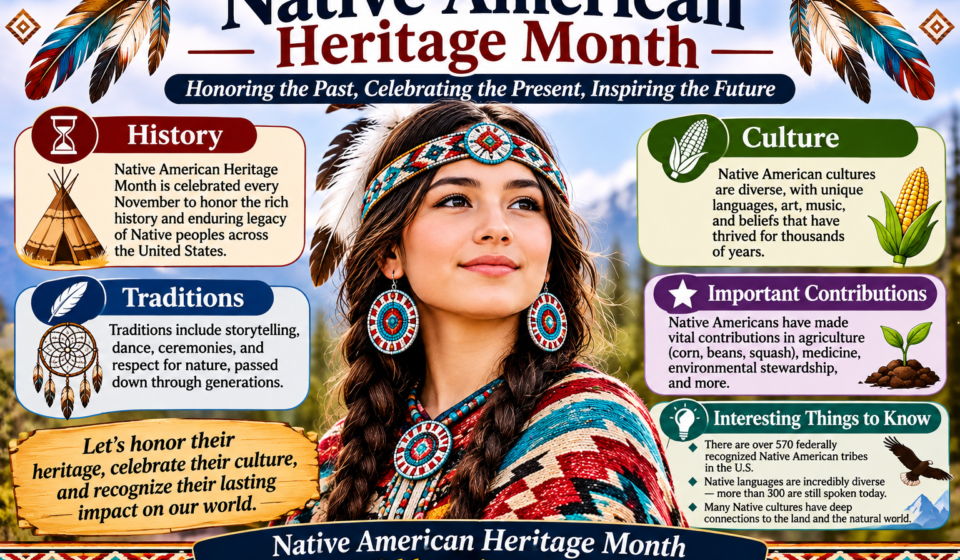
Native American Heritage Month Facts: History, Culture, Traditions, Important Contributions, and Interesting Things to Know

Native American Heritage Month is a meaningful annual observance that celebrates the history, culture, traditions, achievements, and contributions of Indigenous peoples across the United States. Observed throughout November, this special month provides an opportunity to recognize Native American communities, learn about their experiences, appreciate their cultural identities, and understand their important role in shaping the nation’s history. Native American Heritage Month facts help people discover stories that are often overlooked in traditional history lessons, from ancient civilizations and traditional knowledge to modern achievements in education, science, business, art, and public service.
Native American Heritage Month is about much more than remembering the past. It also highlights the strength, creativity, resilience, and continuing influence of Indigenous communities today. Native Americans represent many distinct nations, languages, cultural traditions, and ways of life. Their contributions can be seen throughout American society, including agriculture, medicine, environmental protection, literature, music, government, and technology. Understanding Native American Heritage Month facts encourages people to move beyond stereotypes and recognize Indigenous people as an important part of both American history and its future.
What Is Native American Heritage Month?
Native American Heritage Month is an annual observance dedicated to honoring American Indian, Alaska Native, and Indigenous communities throughout the United States. It takes place during November and celebrates their cultural heritage, historical experiences, achievements, and contributions to society. The month also encourages schools, museums, libraries, government organizations, and communities to provide educational opportunities that help people better understand Indigenous cultures.
One of the most important Native American Heritage Month facts is that the observance recognizes living communities rather than focusing exclusively on historical events. Native American nations have existed for thousands of years, and their descendants continue to maintain their languages, traditions, governments, and cultural identities. Many Indigenous communities are actively involved in education, business, environmental protection, healthcare, politics, and other areas of modern life.
The observance also provides an opportunity to discuss difficult parts of American history. These include forced removals, broken treaties, discrimination, land dispossession, and federal policies that attempted to weaken Indigenous cultures. Recognizing these experiences helps create a more complete understanding of the nation’s development.
Native American Heritage Month encourages everyone to approach Indigenous history with curiosity and respect. It is a time to listen to Native voices, learn directly from Indigenous educators, and appreciate the diversity of communities that have helped shape the country.
When Is Native American Heritage Month Celebrated?
Native American Heritage Month is celebrated every November in the United States. During this month, communities organize educational programs, cultural exhibitions, storytelling events, traditional performances, discussions, and other activities that highlight Indigenous history and achievements.
November was selected for the national observance through federal recognition in the late twentieth century. The timing provides an annual opportunity for Americans to explore Native American history and recognize Indigenous contributions that deserve attention throughout the year.
Schools frequently use November to introduce students to Native American nations, historical figures, cultural traditions, and contemporary Indigenous communities. Museums and cultural institutions may organize special exhibitions, lectures, film screenings, and educational activities.
However, Native American Heritage Month is not limited to November. Indigenous cultures and histories are important throughout the year. Many Native American communities organize their own celebrations, ceremonies, and cultural events according to their individual traditions and calendars.
The History Behind Native American Heritage Month
The history of Native American Heritage Month began long before it became a nationally recognized observance. During the early twentieth century, several Indigenous advocates and supporters worked to establish a special day that would recognize Native American people and their contributions to American society.
Arthur C. Parker, a Seneca historian and advocate, was among the important early figures who promoted recognition of Indigenous heritage. He supported educational initiatives that encouraged Americans to learn about Native history and culture. Other advocates also worked to establish a national observance that would acknowledge Native Americans as important members of the country’s society.
Red Fox James, a member of the Blackfeet Nation, became another significant figure in the movement. He traveled across different states seeking support for an American Indian recognition day. His efforts helped bring greater attention to the idea of officially recognizing Indigenous communities.
Over time, the movement developed from local and regional recognition into broader federal observances. Congress and presidential administrations introduced different resolutions and proclamations that gradually expanded recognition from a single day to a week and eventually an entire month.
These developments demonstrate how Native American Heritage Month emerged from years of advocacy, public education, and efforts to recognize Indigenous history more meaningfully.
Who Established Native American Heritage Month?
Native American Heritage Month became a nationally recognized observance through congressional action and presidential approval. President George H. W. Bush signed a joint congressional resolution in August of nineteen ninety, establishing November of that year as National American Indian Heritage Month.
The legislation was an important step toward giving Indigenous history and culture greater national recognition. It encouraged government institutions, educational organizations, and the general public to participate in activities honoring American Indian communities.
The observance developed from earlier efforts that had promoted American Indian recognition days and heritage weeks. Advocates had spent decades encouraging the government to establish a permanent opportunity for the public to learn about Indigenous contributions.
Presidential proclamations subsequently continued the recognition, and the name evolved over time. Since two thousand nine, presidents have used the designation National Native American Heritage Month in their annual proclamations.
This history is one of the most important Native American Heritage Month facts because it shows that the observance was not created overnight. It resulted from decades of advocacy and a growing recognition of the importance of Indigenous history.
Interesting Native American Heritage Month Facts Everyone Should Know
There are many interesting facts about Native American Heritage Month that help explain why this observance matters. One important fact is that Native American communities are not a single cultural group. They include numerous distinct nations with their own histories, languages, traditions, governments, and identities.
Another interesting fact is that Indigenous people have contributed significantly to American agriculture. Crops such as corn, beans, and squash were cultivated by Indigenous communities long before European colonization. These agricultural traditions helped influence food systems around the world.
Native American languages also represent an extraordinary cultural legacy. Many Indigenous languages contain unique knowledge about local environments, traditional medicine, family relationships, storytelling, and community history. Language preservation programs help younger generations reconnect with these important cultural resources.
Native American communities have also influenced American art, literature, music, architecture, and environmental knowledge. Indigenous artists, writers, scientists, educators, and business owners continue to introduce new ideas while maintaining connections to their cultural traditions.
Another important fact is that Native Americans serve in many different professional fields. Indigenous people work as doctors, teachers, engineers, elected officials, entrepreneurs, researchers, athletes, and artists. Their achievements demonstrate that Native American identity is fully connected to contemporary American society.
Native American Heritage Month Recognizes Hundreds of Tribal Nations
One of the most important Native American Heritage Month facts is the extraordinary diversity of Indigenous communities. The United States recognizes hundreds of federally recognized tribal nations, each with its own political identity, history, and relationship with the federal government.
Tribal nations are not simply cultural organizations. They have their own governments, legal systems, leadership structures, and responsibilities to their citizens. Their sovereignty is an important part of the relationship between Indigenous nations and the United States.
Some well-known tribal nations include the Cherokee Nation, Navajo Nation, Choctaw Nation, Lakota communities, Chickasaw Nation, and many others. Each nation has its own traditions, community experiences, and cultural history.
There are also state-recognized tribes and Indigenous communities that have different legal relationships with state and federal governments. Recognition status does not determine the cultural importance or historical significance of a community.
Understanding tribal diversity helps people avoid treating Native Americans as one uniform group. Different nations have different languages, traditional practices, histories, and contemporary priorities.
Native American Heritage Month provides an opportunity to learn about individual tribal nations and understand their contributions without overlooking their unique identities.
Native American Heritage Month and Indigenous Languages
Language is one of the most valuable parts of cultural identity. Indigenous languages carry stories, traditional knowledge, family histories, community values, and ways of understanding the natural world.
Before European colonization, hundreds of Indigenous languages were spoken across the lands that now form the United States. These languages belonged to different language families and communities. They reflected the diversity of Indigenous societies and their relationships with the environments in which they lived.
Colonization, forced assimilation, and government policies that discouraged Indigenous language use caused many languages to become endangered. Boarding schools often punished Native children for speaking their traditional languages, creating lasting harm to families and communities.
Today, many tribal nations and Indigenous organizations are working to preserve and revitalize their languages. These efforts include language classes, community programs, dictionaries, digital learning materials, cultural camps, and immersion schools.
Language revitalization is especially important for younger generations. Learning an ancestral language can strengthen relationships between children, parents, grandparents, and community elders.
Native American Heritage Month encourages people to recognize that language preservation is not simply about saving old words. It is about protecting cultural knowledge, strengthening community connections, and supporting the future of Indigenous identities.
Native American Contributions to American Agriculture
Agriculture is one of the most significant areas in which Indigenous communities influenced the development of American society. Native American farmers developed sophisticated agricultural systems that supported communities for generations.
Corn, beans, and squash are particularly important examples. These crops are often associated with the agricultural tradition known as the Three Sisters. When cultivated together, they can support one another in several ways. Corn provides a structure for climbing beans, beans contribute nitrogen to the soil, and squash spreads across the ground, helping reduce weeds and retain moisture.
Indigenous agricultural knowledge also included techniques for selecting seeds, managing soil, conserving water, and adapting crops to local climates. These practices reflected generations of observation and experimentation.
Native communities cultivated numerous other foods, including potatoes, tomatoes, peppers, pumpkins, and different varieties of beans. Many foods that are now common throughout the world have deep Indigenous agricultural histories in the Americas.
Native American Heritage Month facts help highlight how Indigenous knowledge influenced global food systems. Modern agriculture continues to benefit from crop varieties and traditional growing methods developed by Indigenous communities.
Recognizing these contributions also reminds people that Native Americans were skilled farmers, innovators, and environmental observers long before European settlers arrived.
Native American Contributions to Medicine and Traditional Healing
Traditional healing practices are another important part of Indigenous heritage. Native American communities developed extensive knowledge of plants, natural materials, wellness practices, and relationships between physical, emotional, and spiritual well-being.
Different communities developed their own approaches to healing based on local environments and cultural traditions. Knowledge of medicinal plants was passed between generations through observation, teaching, and community experience.
Some plants traditionally used by Indigenous communities later became important subjects of scientific research. Willow bark, for example, contains salicin, a compound related to the development of aspirin. Indigenous knowledge about medicinal plants has contributed to broader discussions about the relationship between traditional practices and modern science.
However, it is important to understand that traditional medicine is not identical across all Native American nations. Healing traditions are culturally specific, and some knowledge is considered private or sacred.
Many Indigenous healthcare organizations now combine contemporary medical services with culturally respectful approaches to community wellness. These programs may include language access, traditional foods, community involvement, and recognition of Indigenous cultural values.
Native American Heritage Month provides an opportunity to appreciate traditional healing knowledge while respecting the communities that developed and continue to maintain it.
Native American Heritage Month and Traditional Food
Food is an important part of Indigenous identity because it connects people with their ancestors, land, community, and cultural traditions. Native American cuisine is diverse and varies according to geography, available ingredients, and the histories of individual nations.
Traditional foods may include corn, beans, squash, wild rice, fish, berries, nuts, game meat, and locally gathered plants. Coastal communities developed food traditions connected to fishing and marine resources, while other communities relied on farming, hunting, gathering, and seasonal harvesting.
Wild rice holds special cultural importance for several Indigenous communities in the Great Lakes region. Salmon is deeply connected to the traditions and identities of many Pacific Northwest tribes. In other areas, corn-based dishes have remained central to community celebrations and family gatherings.
Food traditions also tell stories about survival and adaptation. Colonization disrupted Indigenous food systems through land loss, environmental changes, forced relocation, and restrictions on traditional harvesting practices.
Today, Indigenous chefs, farmers, and food educators are helping revive traditional ingredients and cooking methods. Their work supports cultural preservation while introducing wider audiences to Native American culinary traditions.
Learning about Indigenous food during Native American Heritage Month is a meaningful way to understand how culture, history, and the environment are connected.
The Importance of Native American Storytelling
Storytelling has always played an important role in many Indigenous cultures. Stories help preserve history, explain cultural values, teach lessons, and maintain connections between generations.
Traditional stories may describe the creation of the world, relationships between humans and animals, community origins, important historical experiences, and responsibilities toward nature. They can also communicate practical knowledge about survival, agriculture, weather, and local environments.
Storytelling traditions differ significantly between tribal nations. Some communities use oral histories, songs, performances, and ceremonial narratives to preserve knowledge. Other communities maintain written traditions alongside oral storytelling.
Elders often play an important role in passing stories to younger generations. Their experiences and knowledge help maintain cultural continuity and provide guidance for community members.
Modern Indigenous writers, filmmakers, and artists continue this storytelling tradition through books, documentaries, television, poetry, and digital media. Their work introduces audiences to contemporary Native American experiences while challenging outdated stereotypes.
Native American Heritage Month is an excellent time to discover Indigenous literature and listen to Native storytellers. It encourages people to understand that Indigenous stories are not simply historical material but living expressions of cultural identity.
Native American Art and Creative Traditions
Native American art represents a rich collection of creative traditions developed across different Indigenous nations. These traditions include pottery, weaving, beadwork, basketry, carving, painting, jewelry making, sculpture, and contemporary visual arts.
Different regions developed distinct artistic styles based on local materials, cultural practices, and community histories. Southwestern communities are widely recognized for pottery and weaving traditions, while many Great Lakes and Plains communities have developed distinctive beadwork and quillwork practices.
Indigenous artists often use art to communicate cultural stories, family histories, spiritual ideas, and connections to ancestral lands. Traditional patterns and materials can carry meanings that are important within particular communities.
Contemporary Native American artists also work with photography, film, digital illustration, fashion, installation art, and experimental media. Their creativity demonstrates that Indigenous art continues to develop while maintaining meaningful cultural connections.
It is important to recognize Native artists as individual creators rather than assuming that every Indigenous artwork represents the same tradition. Cultural designs may have specific meanings, and some are connected to community practices that should be approached respectfully.
Native American Heritage Month provides an opportunity to support Indigenous artists, visit Native-led galleries, explore museum exhibitions, and appreciate the creativity of Indigenous communities.
Native American Music, Dance, and Cultural Celebrations
Music and dance are important forms of cultural expression in many Native American communities. They may be connected to ceremonies, community celebrations, storytelling, social gatherings, and expressions of cultural identity.
Traditional instruments can include drums, rattles, flutes, and other instruments made from natural materials. Their use and significance vary between communities.
Powwows are among the best-known Native American cultural gatherings. They often bring together dancers, singers, families, artists, vendors, and visitors. Powwow traditions differ by region and community, but many events provide opportunities to celebrate Indigenous identity and maintain cultural connections.
Traditional dance styles may include fancy dance, grass dance, jingle dress dance, traditional dance, and other forms. Each style can have its own history, clothing, movements, and cultural significance.
Native American music also includes contemporary genres such as hip-hop, rock, country, electronic music, and alternative music. Indigenous musicians frequently combine traditional influences with modern creative approaches.
Native American Heritage Month encourages people to explore these artistic traditions with respect. Visitors should follow event guidelines, ask permission before taking photographs when appropriate, and understand that some songs or dances may have specific cultural or ceremonial purposes.
Native American Clothing and Traditional Regalia
Traditional Native American clothing reflects the history, environment, artistic traditions, and cultural identity of different Indigenous communities. Materials and designs vary according to regional resources, historical influences, and individual traditions.
Some traditional clothing may feature leather, woven fabrics, feathers, shells, beads, natural dyes, or decorative stitching. Different communities developed their own methods of making clothing and ceremonial items.
Regalia is an especially meaningful concept in many Indigenous cultural settings. It refers to clothing and accessories that may carry personal, family, cultural, or ceremonial significance. It should not be treated as a costume or generic decoration.
Contemporary Native American designers are also influencing the fashion industry. They create clothing and accessories that combine modern design with Indigenous creativity, cultural knowledge, and traditional craftsmanship.
Supporting Native-owned fashion businesses and purchasing authentic Indigenous artwork can help recognize the skill and creativity of Native artists.
Native American Heritage Month offers an opportunity to learn about traditional clothing without reducing different cultures to a single visual stereotype.
Famous Native American Leaders and Historical Figures
Native American history includes many influential leaders, activists, diplomats, artists, educators, and community organizers. Their achievements have helped shape Indigenous communities and American society.
Sitting Bull, a Hunkpapa Lakota leader, became an important figure in Indigenous resistance during the nineteenth century. His leadership and determination remain significant parts of Lakota history.
Chief Joseph of the Nez Perce became widely recognized for his leadership during the conflict between the Nez Perce people and the United States government. His experiences represent an important chapter in the history of Indigenous resistance and forced displacement.
Wilma Mankiller, a member of the Cherokee Nation, became the first woman elected principal chief of the Cherokee Nation. Her leadership focused on community development, healthcare, education, and improving opportunities for Cherokee citizens.
Deb Haaland, a member of the Laguna Pueblo community, made history as the first Native American to serve as a United States cabinet secretary when she became secretary of the interior.
These individuals represent different periods and experiences in Native American history. Their stories demonstrate leadership, perseverance, public service, and the importance of Indigenous representation.
Native American Heritage Month helps ensure that these contributions receive recognition and that younger generations have opportunities to learn about Indigenous role models.
Native American Heritage Month and Tribal Sovereignty
Tribal sovereignty is an essential concept for understanding Native American history and contemporary Indigenous rights. It refers to the inherent authority of tribal nations to govern themselves and make decisions about their communities.
Federally recognized tribes have a government-to-government relationship with the United States. This relationship is shaped by treaties, federal laws, court decisions, and historical agreements.
Tribal governments may operate their own courts, educational programs, police departments, healthcare services, and economic development initiatives. Their authority and responsibilities can vary according to federal law, treaties, and individual circumstances.
Sovereignty is closely connected to Indigenous identity and self-determination. It recognizes that tribal nations existed as political communities before the establishment of the United States.
Understanding tribal sovereignty also helps explain why Native American communities have distinct relationships with federal and state governments. They are not simply cultural groups seeking recognition but political nations with continuing rights and responsibilities.
Native American Heritage Month is an appropriate time to learn about tribal governments and understand the importance of respecting Indigenous self-determination.
The History of Native American Boarding Schools
One of the most difficult subjects connected to Native American Heritage Month is the history of federal Indian boarding schools. These institutions were established as part of policies intended to assimilate Indigenous children into mainstream American society.
Many Native children were taken away from their families and communities and placed in boarding schools. Some attended voluntarily, while others were forcibly removed under government policies and pressure.
Children at these schools frequently experienced strict rules designed to separate them from their cultural identities. Traditional languages were often prohibited, and children were pressured to adopt unfamiliar clothing, names, religious practices, and social customs.
The consequences extended far beyond the students themselves. Families lost important connections with their children, languages were weakened, and cultural knowledge was interrupted. Many survivors experienced abuse, neglect, and lasting emotional harm.
The effects of these policies continue to influence Indigenous families and communities. Understanding this history is necessary for recognizing the experiences of survivors and supporting efforts toward truth, education, and healing.
Native American Heritage Month should create space for these difficult conversations. Celebrating Indigenous achievements does not mean ignoring historical injustices. Both recognition and honest education are necessary.
Native American Contributions to Science and Technology
Native Americans have contributed to scientific knowledge and technological innovation throughout history. Indigenous communities developed sophisticated methods for agriculture, architecture, environmental management, transportation, and resource conservation.
Traditional ecological knowledge is an especially important contribution. It includes generations of observations about plants, animals, water systems, weather patterns, and natural environments.
Indigenous communities developed practices for managing forests, protecting water resources, cultivating crops, and maintaining ecological balance. These methods were adapted to local environments and passed between generations.
Native American scientists and researchers continue to contribute to modern scientific fields. Indigenous professionals work in medicine, environmental science, engineering, astronomy, education, and technology.
Many researchers also explore ways to combine scientific methods with traditional ecological knowledge. This collaboration can help improve environmental research and create more culturally informed approaches to conservation.
Native American Heritage Month facts remind people that Indigenous innovation is not limited to ancient history. Native American scientists, inventors, and researchers continue to influence the modern world.
Native Americans and Environmental Protection
The relationship between Indigenous communities and the environment is an important part of Native American heritage. Many tribal nations maintain cultural, spiritual, and practical connections with ancestral lands, rivers, forests, mountains, and wildlife.
Traditional ecological knowledge often emphasizes long-term relationships between communities and their natural surroundings. It includes careful observation, sustainable harvesting, seasonal awareness, and responsibilities toward future generations.
Many Indigenous communities are actively involved in environmental protection. Their work includes defending water resources, restoring forests, protecting wildlife, monitoring pollution, and preserving culturally important landscapes.
Native American leaders have also participated in national and international discussions about climate change. Indigenous knowledge can provide valuable perspectives on environmental changes because many communities have maintained close relationships with particular ecosystems for generations.
However, environmental challenges affect tribal nations in different ways. Some communities face threats from drought, flooding, pollution, changing wildlife patterns, and damage to traditional food sources.
Native American Heritage Month provides an opportunity to recognize Indigenous environmental leadership and understand why protecting land and water is important to many Native nations.
Native American Heritage Month in Schools and Education
Education is one of the most effective ways to make Native American Heritage Month meaningful. Schools can use November to introduce students to Indigenous history, cultural diversity, historical experiences, and contemporary achievements.
Teachers can organize classroom discussions about tribal nations, Indigenous languages, Native American literature, traditional agriculture, and influential historical figures. These activities help students understand that Indigenous communities have diverse experiences and identities.
Students can also explore books written by Native authors, watch documentaries created by Indigenous filmmakers, and examine historical materials from reliable museums and educational institutions.
It is important for schools to avoid outdated stereotypes and inaccurate classroom activities. For example, asking students to create generic Native American costumes or imitate sacred ceremonies can be disrespectful.
Instead, educational activities should emphasize accurate history, individual tribal identities, and the importance of listening to Indigenous perspectives.
Teachers can also invite Native educators, artists, historians, and community representatives to share their knowledge when appropriate.
Native American Heritage Month is most effective in education when it encourages year-round learning rather than treating Indigenous history as a subject that only matters during November.
How Families Can Celebrate Native American Heritage Month
Families can celebrate Native American Heritage Month through simple educational and cultural activities. Parents can introduce children to Indigenous history by reading books written by Native authors and discussing the stories, characters, and experiences they present.
Visiting museums and cultural centers can also provide valuable learning opportunities. Many institutions offer exhibitions that explore Native American history, artwork, traditional knowledge, and contemporary community life.
Families can explore Indigenous food traditions by learning about ingredients such as corn, beans, squash, wild rice, and regional foods. Cooking can become an opportunity to discuss agricultural history and cultural diversity.
Another meaningful activity is learning about the Indigenous nation whose ancestral lands include the area where a family lives. This can encourage discussions about local history, tribal sovereignty, and the continuing presence of Native communities.
Parents should also teach children to respect cultural differences and avoid stereotypes. Native American people should be recognized as individuals and members of distinct communities rather than as characters from historical stories.
These activities make Native American Heritage Month a valuable opportunity for family learning and meaningful conversations.
Native American Heritage Day and Its Connection to Heritage Month
Native American Heritage Day is a separate observance connected to the broader recognition of Indigenous history and contributions. It takes place on the Friday following Thanksgiving in the United States.
The Native American Heritage Day Act became law in two thousand nine. It established a national day of recognition intended to encourage Americans to honor Native American heritage and achievements.
Although Native American Heritage Day and Native American Heritage Month are closely connected, they are not exactly the same observance. The month provides a broader period for education, celebrations, and cultural recognition, while the day offers an additional opportunity to highlight Indigenous communities.
Schools, museums, public organizations, and cultural institutions may organize special programs around both observances.
The relationship between these occasions also reminds people that recognition should not be limited to a single day or month. Indigenous history, rights, and contributions deserve attention throughout the year.
Native American Literature and Modern Writers
Native American literature is an important expression of Indigenous identity and creativity. Native writers have produced novels, poetry, memoirs, essays, children’s books, historical works, and contemporary fiction.
Their writing explores many subjects, including family relationships, community traditions, cultural survival, identity, historical injustice, spirituality, and modern Indigenous experiences.
Louise Erdrich, a member of the Turtle Mountain Band of Chippewa Indians, is an influential Native American author known for her novels and storytelling. Her writing often explores Indigenous communities, family histories, and the complicated relationships between tradition and modern life.
Joy Harjo, a member of the Muscogee Nation, is another significant literary figure. Her poetry and writing explore identity, history, memory, and cultural experience. She also served as the United States poet laureate.
Contemporary Native authors continue to expand the literary landscape. Their work gives readers opportunities to understand Indigenous experiences through personal perspectives rather than relying exclusively on outside interpretations.
Native American Heritage Month is an excellent time to explore Indigenous literature and support Native writers.
Native American Contributions to Sports and Athletics
Native American athletes have made important contributions to sports throughout American history. Indigenous competitors have participated in football, basketball, baseball, boxing, running, wrestling, and many other athletic activities.
Jim Thorpe, a member of the Sac and Fox Nation, is one of the most famous Native American athletes. He achieved international recognition for his performances in the Olympic Games and became an influential figure in American sports history.
Billy Mills, an Oglala Lakota athlete, made history by winning the Olympic gold medal in the men’s ten-thousand-meter race. His achievement remains an important moment in Olympic history.
Native American athletes also participate in professional sports, college athletics, traditional games, and community competitions.
Sports can provide opportunities for Indigenous representation, leadership, and cultural pride. Many athletes use their platforms to discuss Native American identity, community issues, and the importance of representation.
Native American Heritage Month encourages sports organizations and fans to recognize Indigenous athletes and learn about their achievements.
Native American Contributions to Music and Entertainment
Indigenous artists have influenced entertainment through music, acting, filmmaking, comedy, television, and digital media. Their work has helped introduce new perspectives and challenge inaccurate portrayals of Native American people.
Native American performers have appeared in a wide variety of entertainment genres. Some combine traditional musical influences with contemporary sounds, while others create films and television projects centered on Indigenous experiences.
Indigenous filmmakers have also become increasingly important in the entertainment industry. Their projects explore family histories, community experiences, historical events, and contemporary challenges.
Representation matters because Native American characters have historically been portrayed through stereotypes in some films and television programs. Indigenous creators are helping change this situation by developing authentic stories and presenting Native communities with greater depth.
Native American Heritage Month is an opportunity to discover Indigenous musicians, actors, comedians, directors, and writers. Supporting their work helps expand the visibility of Native American creativity.
Common Misconceptions About Native American Heritage
There are many misconceptions about Native American communities that continue to influence popular culture. One common misunderstanding is the idea that all Native Americans share the same traditions, clothing, language, and cultural practices.
In reality, Indigenous communities are extremely diverse. Their traditions vary according to geography, history, language, family relationships, and tribal identity.
Another misconception is that Native Americans belong only to the past. Indigenous people are active members of contemporary society and work in every area of modern life.
Some people also assume that all Native Americans live on reservations. Although reservations are important for many tribal nations, Native people live in cities, towns, rural communities, and other locations throughout the country.
Another inaccurate belief is that Indigenous cultures have disappeared. In fact, Native communities continue to maintain languages, ceremonies, traditions, governments, and cultural institutions.
Native American Heritage Month provides an opportunity to correct these misunderstandings through accurate education and respectful conversations.
The Role of Museums in Preserving Native American Heritage
Museums play an important role in preserving and sharing Indigenous history, artwork, historical records, and cultural knowledge. They can provide opportunities for visitors to learn about Native American communities through exhibitions, educational programs, and historical collections.
The Smithsonian National Museum of the American Indian is one of the most recognized institutions dedicated to Indigenous cultures and histories. It presents exhibitions and educational resources that explore Native American experiences from historical and contemporary perspectives.
Other museums and cultural centers also work with Indigenous communities to preserve historical materials and share cultural knowledge.
However, responsible museum practices require more than displaying objects. Institutions must consider the cultural importance of collections, consult tribal communities, and respect the wishes of Indigenous nations concerning their heritage.
Many museums are also working to improve the representation of Native voices in exhibitions and educational programs.
During Native American Heritage Month, visiting an Indigenous cultural institution can be a valuable way to learn about Native American history while supporting organizations that preserve cultural heritage.
Native American Heritage Month and Contemporary Indigenous Communities
One of the most important reasons to celebrate Native American Heritage Month is to recognize the continuing presence and achievements of Indigenous communities.
Native Americans are active in government, education, healthcare, science, business, entertainment, environmental protection, and public service. Their contributions influence communities throughout the United States.
Tribal governments continue to develop programs that support education, economic opportunities, healthcare, cultural preservation, and community development.
Indigenous entrepreneurs operate businesses in many industries, including technology, fashion, food, tourism, construction, and professional services.
Native educators and researchers are also working to make education more inclusive and ensure that Indigenous history receives appropriate attention in schools and universities.
Contemporary Indigenous communities face challenges, including access to healthcare, environmental protection, infrastructure, and educational opportunities. However, these challenges do not define the entirety of Native American life.
Native American Heritage Month encourages a balanced understanding that recognizes both historical experiences and present-day accomplishments.
Why Native American Heritage Month Matters Today
Native American Heritage Month matters because Indigenous history is an essential part of understanding the United States. Native communities existed long before the country’s formation, and their contributions continue to influence its culture, economy, environment, and society.
The observance also encourages people to recognize historical injustices. Learning about forced relocation, broken treaties, discrimination, and boarding schools helps create a more complete understanding of American history.
It also provides an opportunity to celebrate cultural survival. Despite generations of challenges, Indigenous nations have maintained their identities, traditions, languages, and community connections.
Another important reason the month matters is representation. Native American children and young adults deserve opportunities to see their cultures, histories, and achievements recognized in educational materials and public institutions.
For the wider public, the observance encourages respect, understanding, and meaningful engagement with Indigenous communities.
Native American Heritage Month is not simply about looking backward. It is also about recognizing the importance of Indigenous voices in shaping a more informed and inclusive future.
How Businesses and Organizations Can Recognize Native American Heritage Month
Businesses and organizations can participate in Native American Heritage Month by supporting Indigenous communities and recognizing their contributions in meaningful ways.
One approach is to feature Indigenous-owned businesses and artists. Organizations can purchase authentic Native-made products, collaborate with Indigenous entrepreneurs, and provide opportunities for Native professionals to share their expertise.
Companies can also organize educational programs that introduce employees to tribal sovereignty, Indigenous history, and contemporary Native American achievements.
Supporting Native-led organizations is another useful approach. Donations, community partnerships, educational sponsorships, and cultural initiatives can help strengthen programs that preserve Indigenous heritage.
Businesses should avoid using Indigenous symbols, artwork, or cultural designs without permission. Respectful recognition requires understanding that some cultural expressions have specific meanings and may be protected by community traditions or intellectual property rights.
Organizations can make their recognition more meaningful by consulting Indigenous representatives and supporting initiatives that continue beyond November.
Ways to Support Native American Communities Throughout the Year
Supporting Native American communities should not be limited to Native American Heritage Month. Meaningful support involves learning, listening, and taking actions that respect Indigenous priorities throughout the year.
People can begin by purchasing products from Indigenous-owned businesses and supporting Native artists, authors, musicians, and entrepreneurs.
Another important step is to learn about tribal sovereignty and the history of Indigenous nations. Understanding treaties, federal policies, and historical experiences can help people become more informed members of their communities.
Supporting Native-led educational and cultural organizations is also valuable. These institutions often work to preserve Indigenous languages, protect historical knowledge, and provide opportunities for younger generations.
People can also attend public cultural events, visit museums, and participate in educational programs organized by Indigenous communities.
Most importantly, support should involve listening to Native voices rather than assuming that outsiders know what Indigenous communities need.
Respectful engagement recognizes that Native American nations have their own leadership, priorities, and visions for the future.
Frequently Asked Questions About Native American Heritage Month
Why Is Native American Heritage Month Celebrated?
Native American Heritage Month is celebrated to recognize Indigenous history, cultures, traditions, achievements, and contributions to American society. It also provides opportunities to learn about historical experiences and contemporary Indigenous communities.
What Month Is Native American Heritage Month?
Native American Heritage Month takes place every November in the United States. Educational programs, cultural events, and public celebrations are organized throughout the month.
Who Started Native American Heritage Month?
The national observance was established through congressional legislation signed by President George H. W. Bush in nineteen ninety. Its development followed decades of advocacy for greater recognition of Indigenous history and contributions.
Why Was November Chosen?
November became the month for the national observance through the federal designation made in nineteen ninety. Historical accounts connect the choice with the traditional harvest season and a period associated with thanksgiving and celebration among some Native American communities. However, Indigenous traditions and seasonal calendars differ across nations.
Is Native American Heritage Month the Same as Indigenous Peoples’ Day?
No. Native American Heritage Month is a month-long November observance in the United States. Indigenous Peoples’ Day is observed on a different date and recognizes Indigenous peoples, their histories, cultures, and contributions. The two observances have related goals but are separate occasions.
How Can Children Celebrate Native American Heritage Month?
Children can celebrate by reading books by Native authors, learning about different tribal nations, exploring Indigenous artwork, visiting museums, and discovering traditional foods and languages. These activities should be educational and respectful.
Are Native Americans Still Living in the United States Today?
Yes. Native American communities are active throughout the United States. Indigenous people live in cities, rural areas, reservations, and other communities while maintaining their cultural identities and participating in modern society.
How Many Native American Tribes Are There?
The United States recognizes hundreds of federally recognized tribal nations. There are also state-recognized tribes and other Indigenous communities with distinct historical and legal circumstances.
What Is the Difference Between Native American and American Indian?
Both terms are used in the United States, although individual people and communities may prefer particular terminology. American Indian is widely used in federal legal and institutional settings, while Native American is also common. It is respectful to use the name or terminology preferred by the individual or tribal nation being discussed.
What Is Native American Heritage Day?
Native American Heritage Day is a national observance held on the Friday after Thanksgiving. It provides an additional opportunity to recognize Indigenous history, culture, and contributions.
Final Thoughts on Native American Heritage Month Facts
Native American Heritage Month is an important opportunity to celebrate the cultures, histories, achievements, and continuing contributions of Indigenous communities across the United States. Learning Native American Heritage Month facts helps people understand that Indigenous history is not limited to ancient traditions or historical events. Native Americans are part of contemporary society and continue to influence education, science, agriculture, medicine, literature, entertainment, government, and environmental protection.
The observance also reminds people that Indigenous communities have faced serious historical injustices, including forced removal, discrimination, broken treaties, and policies designed to weaken their cultural identities. Recognizing these experiences is an important part of understanding the complete history of the country.
Perhaps the most meaningful lesson is that Native American heritage should be respected throughout the year. People can contribute by supporting Indigenous-owned businesses, reading Native authors, learning about tribal nations, attending cultural events, and listening to Indigenous voices.
Native American Heritage Month is ultimately about recognition, education, respect, and cultural preservation. By understanding the past and appreciating the achievements of present-day Indigenous communities, everyone can help create a future in which Native American history and contributions receive the recognition they deserve.
Stay in touch to get more updates & news on Magazine Dispatch!